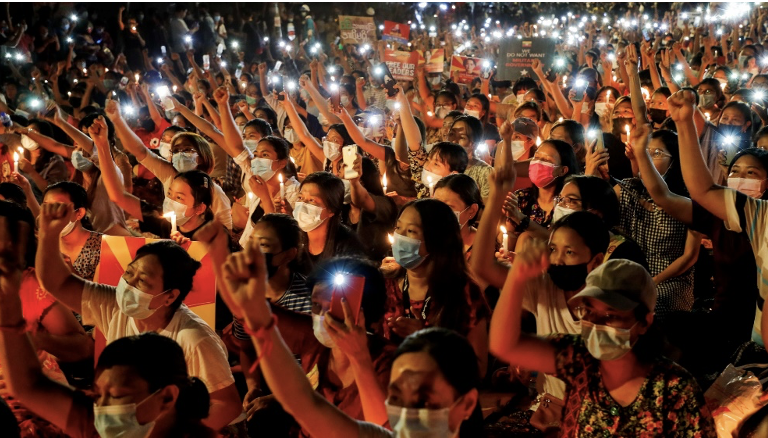
Female political activists fleeing from the military council following the coup, faced physical, mental and sexual threats, said the Myanmar Women Parliamentarians Network (MWPN).
This is stated in a research paper by the MWPN about the challenges faced by women political activists in their resistance against the dictator and the roles they are currently playing.
Ellen, a researcher who took the lead in compiling a research paper on the experiences of Myanmar women politicians during the revolution said: “They are mainly concerned about their physical security. Because they faced such threats. Another significant concern is sexual security. They were very concerned about that.”
Lead researcher Ellen emphasized that sexual violence against women has been a longstanding tactic used by the military to suppress dissidents in the past, and it continues to be employed to this day.
“In the past, the military’s oppression was focused on ethnic areas. They targeted women sexually as part of their suppression and operations. There are numerous instances of sexual assaults and violence aimed at undermining the political activism of a woman, said Ellen.
The MWPN highlighted that female political prisoners faced additional challenges such as family pressures, financial dependence, health problems, as well as various psychological stress and challenges.
Since the coup, Myanmar women politicians have faced more challenges than men. So, special attention should be paid to addressing the difficulties they are facing, said the MWPN.
According to the paper, female politicians have also advocated for the establishment of female-led armed forces. They are actively involved in key roles such as humanitarian aid measures, fundraising, community mobilization, educational initiatives, media engagement, and the use of digital technologies.
The paper noted that women politicians successfully fostered solidarity among all women, without gender discrimination, to achieve the goal of building a federal union and implementing a shared vision.
According to a report by the National Unity Consultative Council (NUCC) on 1 February 2024, women political activists were involved in the development and adoption of several key initiatives, including the Federal Democracy Charter (FDC), interim constitutional measures, the CDM policy for civil servants, federal democratic education policy, gender equality position paper, and transitional justice policies.
Since the military coup until today, out of the 26,210 prisoners arrested for political activism, 5,416 (20.7 percent) are women, and 810 women (17.6 percent) have been killed, according to a report by the Association for the Assistance of Political Prisoners (AAPP).
Sent by NMG.