Stubborn Adherence to the NCA : The Still Elusive Path to Peace
The military junta and seven Ethnic Armed Organizations (EAOs) that signed the Nationwide Ceasefire Agreement (NCA) and are not participating in the Spring Revolution are still clinging to the NCA. They remain hopeful for a peace process. However, three other EAOs have taken divergent positions on the NCA, splitting into groups that either align with the Spring Revolution or maintain ties with the military junta. On the other hand, the three other EAOs, including the Karen National Union (KNU), turned their back on the NCA and fully joined the Spring Revolution.
Despite the fact that some have abandoned the elected government, the elected parliament, and the NCA after the military coup, those who are waiting for the stalled NCA process to become active are said to be stubbornly clinging to the NCA. The path to peace, which could resolve the deeply entrenched and increasingly intense and widespread military and political crisis in Myanmar, remains vague.
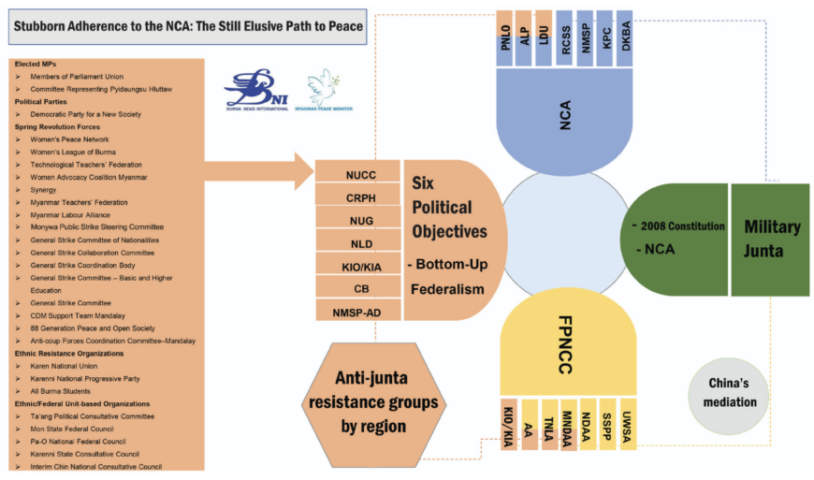
Although the military junta extensively employs rhetoric about a ‘ceasefire’ and ‘peace’ to reduce military pressure from resistance forces and to gain acceptance from the international community, not a single day has passed without artillery shelling and aerial bombing across the country. Furthermore, the ceasefire and dialogue offered by the junta are primarily aimed at ethnic armed resistance organizations, and they do not even consider the resistance forces that have emerged in response to the 2021 military coup as dialogue partners. More concerning is their attempt to organize new elections, which is the military’s ultimate exit strategy, under the guise of peace.
Colonel Saw Kyaw Nyunt, the spokesperson for the 7 EAO Alliance, who attended the peace forum organized by the National Solidarity and Peace-making Negotiation Committee (NSPNC) on 25-27 June 2025, stated that he had witnessed two ‘peace dialogues’ but no political discussions. Among the main attendees were representatives from political parties approved by the regime, while the ethnic armed resistance organizations were reportedly met separately.
“In the three-day meeting with over 200 representatives, they presented the current situation of the country from various angles. There were discussions presenting different views. They also invited EAOs individually. It’s hard to say exactly what they discussed with each group. Roughly speaking, the main focus of the discussions was to find solutions to the difficulties and challenges we all face,” said Colonel Saw Kyaw Nyunt. 1
According to a speech given by junta leader Senior General Min Aung Hlaing during the forum, nothing was considered beyond the 2008 Constitution, the NCA, and the military’s six peace principles. He also stated that their planned election could be held with a decision from the National Defense and Security Council. 2 The military leader views the resistance forces fighting against the military junta as those rebelling against the state and has urged them to abandon the armed path and resolve issues through political and electoral means.
On the other hand, the resistance forces have publicly declared six common political objectives, opening the door for dialogue: ending the military’s involvement in Myanmar politics, placing all armed forces nationwide fully under an elected civilian government, completely abolishing the 2008 Constitution and combating any attempts to revive it, as well as ensuring justice for victims of illegal acts during the conflict and implementing transitional justice processes. They also state that a new constitution based on a federal and democratic system, acceptable to all stakeholders, is necessary to restore national equality, democracy, peace, and stability. 3
In essence, the possibility of finding a solution through dialogue between the military junta, which seeks to maintain state power through various means and considers itself on par with the state, and the resistance forces remain far out of reach and vague.
For the ethnic armed organizations, political parties, and civil society groups that have not fully sided with the Spring Revolution, which are still entangled with the military regime to varying degrees, are observing the momentum of the Spring Revolution. With the military coup surpassing four years, they have remained silent about the military junta’s aerial attacks targeting civilians.
Notably, even the Chinese-mediated dialogues have not extended beyond reducing military tensions in border areas. The Chinese government’s mediation, primarily aimed at protecting China’s and Chinese citizens’ interests in Myanmar, is unlikely to lead to an end to conflicts and lasting peace in Myanmar. Similarly, the temporary ceasefires that occurred due to ASEAN’s calls were unable to halt the junta airstrikes. Declarations of temporary ceasefires, even those prompted by the powerful Sagaing earthquake on 28 March 2025, were merely for show.
Consequently, clinging to the Nationwide Ceasefire Agreement (NCA) that predates the military coup, adhering to the 2008 Constitution that predates the NCA, and addressing the demands and aspirations of the Spring Revolution forces that emerged following the coup through dialogue remain vague. The path to peace, capable of effectively resolving these issues, continues to be shrouded in uncertainty to this day.
1 “Is the peace forum heading towards an election?”, Than Lwin Times, 15 Jul 2025
2 Junta chief Senior General Min Aung Hlaing’s speech, NSPNC, 30 Jun 2025
3 Joint statement, CRPH, 3 Feb 2025