Introduction
The upcoming election set to be held by Myanmar’s military junta is widely expected to be nothing more than a change from military uniforms to civilian attire. The nominal number of constituencies, the electoral system designed to ensure the military regime’s victory, the dominance of former military personnel within the political party, the addition of recently retired military officers, and arrests and imprisonments under the election protection law, which allows sentences up to the death penalty — are among the visible developments leading up to the upcoming ‘change from military uniforms’. Even more concerning is the junta’s indiscriminate use of aerial attacks across all regions and at all times throughout Myanmar.
This week’s BNI-Myanmar Peace Monitor’s Bi-Weekly News Reviews examines observations and developments leading up to the new election organized by the military junta, presenting an analysis of a post-election scenario based on recent events and data.
Observations Prior to the New Election
As stated by the junta chief, elections will be held nationwide without leaving any states or regions behind. The junta-appointed Union Election Commission (UEC) has officially announced on paper the designation of constituencies: 330 constituencies for the Pyithu Hluttaw (Lower House), 110 constituencies for the Amyotha Hluttaw (Upper House), and 322 constituencies for the State/Regional Hluttaws.
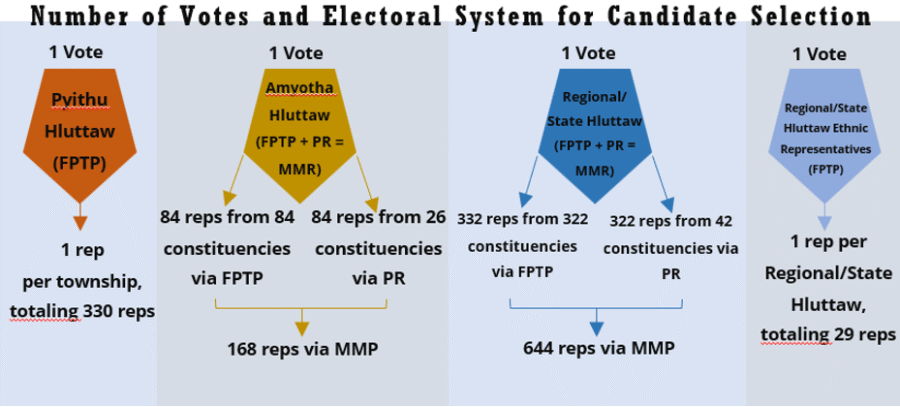
Of these constituencies, the Proportional Representation (PR) system will be used in 26 Amyotha Hluttaw constituencies and 42 State/Regional Hluttaw constituencies, while the First-Past-The-Post (FPTP) system will be used in 330 Pyithu Hluttaw constituencies, 84 Amyotha Hluttaw constituencies, and 322 State/Regional Hluttaw constituencies. Despite the use of two mixed electoral systems, voters are reportedly limited to casting only one vote for each respective parliament.
As the junta has announced that elections cannot be held in 56 out of the 330 townships, it is understood that they will hold the elections in a fragmented manner across the remaining 274 townships nationwide. The first phase of the election, scheduled for 28 December 2025, is reportedly planned for 102 townships.
On 9 September 2025, the UEC dissolved the National Democratic Force (NDF), citing a failure to meet the minimum number of party members. Similarly, the Democratic Party of National Politics (DNP), the Women Party (Mon), and the Union Farmer-Labour Force Party were also dissolved by the military-appointed UEC for not meeting the required number of party offices.
In a statement released on 23 September, a total of 4,963 candidates have been registered for the first phase of the election. This includes candidates from six parties contesting nationwide, 51 parties contesting within individual states or regions, and independent candidates. Among them, the Union Solidarity and Development Party (USDP), which evolved from successive military circles, and the National Unity Party (NUP) have submitted the largest number of candidates.
A notable development is that, under the orders of junta chief Senior General Min Aung Hlaing, a total of 489 individuals from the military regime have reportedly shed their uniforms and transferred to the Union Solidarity and Development Party (USDP). This includes ranks, from General and Lieutenant General down to Superintendent and Sergeant Clerk, as well as other ranks. According to Captain Zin Yaw, who joined the Civil Disobedience Movement (CDM), the military leader directed the transfer of 1 General, 6 Lieutenant Generals, 12 Major Generals, 300 individuals holding the ranks of Brigadier General, Colonel, and Lieutenant Colonel, 110 individuals holding the ranks of Captain and Major, and 60 individuals of other ranks, including Superintendent and Sergeant Clerk. 1
In addition, around ten officers at the ranks of Colonel and Lieutenant Colonel currently serving in the military are reportedly set to retire and contest the election under the National Unity Party (NUP). The NUP, which has the second-highest number of registered candidates after the USDP, is a party that was renamed from the Burma Socialist Programme Party, originally founded by former military dictator General Ne Win. 2
A Post-Election Scenario
If the military regime systematically conducts the first phase of the election scheduled for December 28 and convenes the Hluttaw (Parliament), Pyithu Hluttaw (Lower House) will consist of 102 representatives elected through the First-Past-The-Post (FPTP) system from 102 constituencies, along with 110 military-appointed representatives under the 2008 Constitution, which forms 25% of the total.
Similarly, examining the 102 townships included in the first phase of the election, a total of 13 elected representatives are likely to emerge: 11 representatives elected through the FPTP system from 11 Amyotha Hluttaw constituencies, and 2 representatives from the single constituency using the PR system. If the parliament is convened, the Amyotha Hluttaw will include 13 representatives under the Mixed Member Proportional (MMP) system, along with 56 military-appointed representa-tives under the 2008 Constitution.
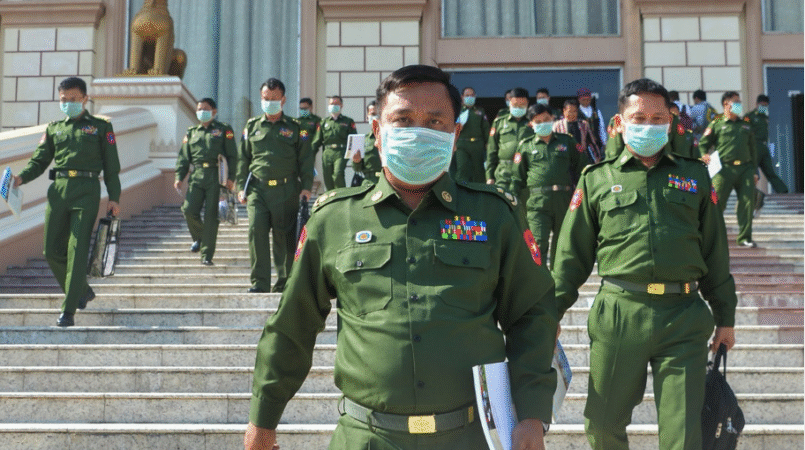
Therefore, if the junta convenes the Pyidaungsu Hluttaw (Union Parliament) following the first phase of election, it can be estimated that the Union Parliament will be constituted by 115 elected parliamentary representatives and 166 military-appointed representatives under the 2008 Constitution.
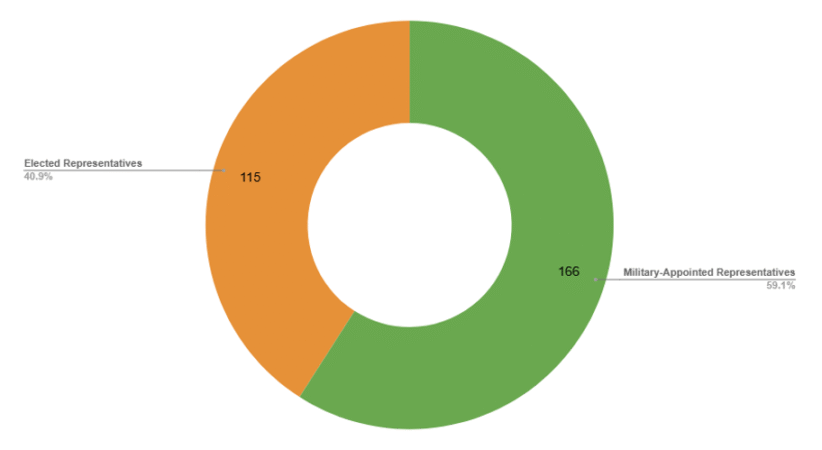
The composition of the parliament resulting from this new election orchest-rated by a military junta that forcibly nullified the results of the 2020 General Election and seized power, is unlikely to produce any significant change. A point to watch out for is the UEC’s past practice of manipulating results with pre-filled ballot boxes, as seen in the 2010 election. In the upcoming election, the Electronic Voting Machines (EVMs), which remain under the total control of the military junta, will be a major concern for the competing parties and candidates.
Given the coup leader’s action of transferring nearly 500 former military personnel to the USDP led by former Police Chief U Khin Yee, it is highly conceivable that the USDP is the party guaranteed to win the junta- orchestrated election.
Analysis
So far, the military junta has arrested and prosecuted 12 civilians, imposing long-term prison sentences, under the pretext that they were inciting protests against the election process. Additionally, the junta has filed cases under the election protection law against the Chairman and senior leaders of the Karen National Union (KNU), as well as members of the Chinland Government.
On the other hand, the junta is aggressively escalating aerial attacks nationwide in an attempt to broaden the territory where its planned election can be held. Specifically, it is targeting and bombing towns, villages, and military positions that have been lost to resistance forces.
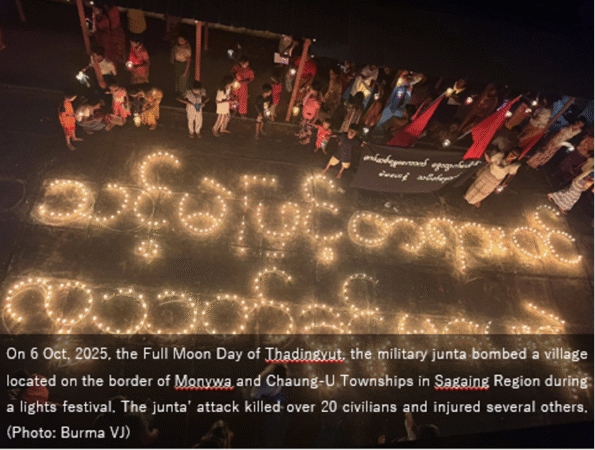
The actions of the military junta, carried out with the intent of holding the new election, are only leading to increased regional insecurity, instability, and military conflicts. Despite their parroting of calls for a “free and fair election,” the findings ahead of the first phase of election reveal no consideration whatsoever for the will of the public.
Looking ahead to the post-election scenario systematically and meticulously prepared by the junta to conclude its failed coup the outcome will merely be a transition from military uniforms to civilian attire.
1. 489 military personnel, ranging from Generals to lower ranks, including officers, Superintendent and Sergeant Clerk, transferred by Min Aung Hlaing’s order, Yangon Khit Thit, 17 Sept 2025
2. Majors, Lieutenant Colonels to retire and contest election representing NUP, DVB, 26 Sep 2025