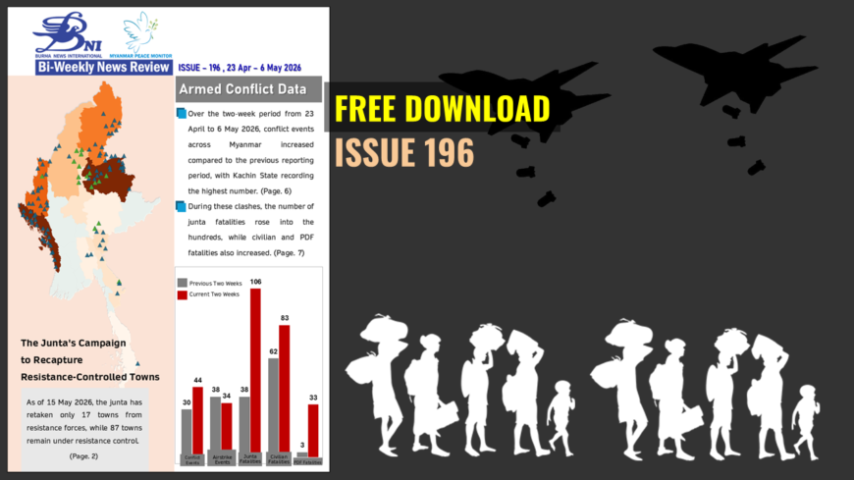
Since mid-2025, BNI-Myanmar Peace Monitor has documented a sustained junta campaign to reclaim towns lost to resistance forces, one that has combined disinformation to fracture resistance unity, Chinese-mediated pressure on armed groups, and intensified aerial bombardment including indiscriminate strikes.
On 5 May 2026, Maw Luu in Indaw Township, Sagaing Region, became the 17th town the junta has retaken from the resistance forces.
In this issue, BNI-Myanmar Peace Monitor examines the methods, patterns, and incidents behind the junta’s ongoing campaign to retake resistance-controlled towns.
Data
On 24 July 2021, M’kuiimnu in Mindat Township, Chin State, became the first town the junta lost to resistance forces. The most recent loss was Taw Kywe Inn Town in Kyauktaga Township, eastern Bago Region, on 9 January 2026.
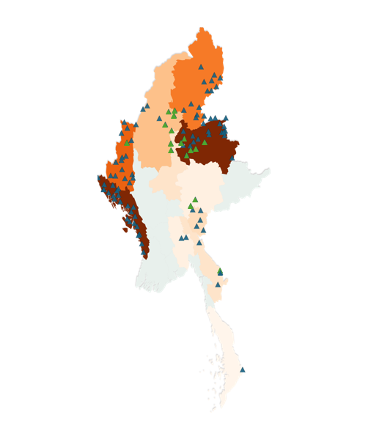
Across the country, resistance forces have seized control of a total of 104 towns across 10 states and regions: 24 in northern Shan State, 24 in Arakan State, 16 in Chin State, 14 in Kachin State, 8 in Sagaing Region, 5 in Karenni (Kayah) State, 4 in Mandalay Region, 4 in Karen State, 2 in southern Shan State, 2 in eastern Bago Region, and 1 in Tanintharyi Region.
According BNI-Myanmar Peace Monitor data as of 15 May 2026, the junta has retaken only 17 towns in total from the resistance forces: 3 in 2024, 9 in 2025, and 5 in 2026, leaving up to 87 towns still under resistance control. [1]
How the Junta Recaptures Towns
After the collapse of regional military commands, ground bases, and battalions, and their fall to the resistance forces, the junta resorted to launching aerial attacks to reclaim lost territories across the country. As of 6 May 2026, BNI-Myanmar Peace Monitor recorded a total of 3,163 airstrike events across 177 townships. Of these, 639 incidents took place across 15 townships subsequently retaken by the junta, including Maw Luu and Moebye.
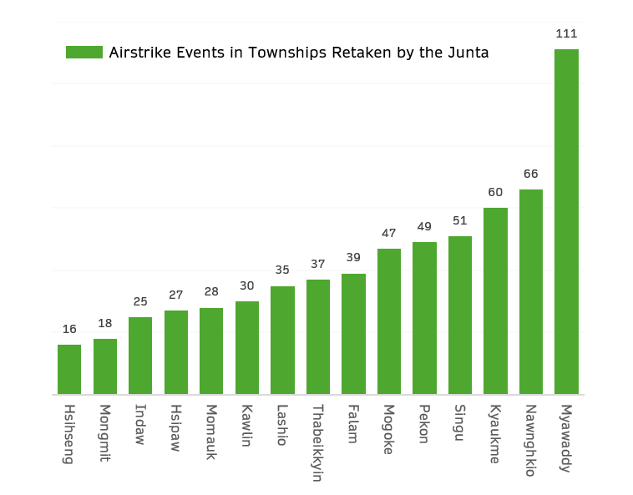
Analysis of airstrike activity in townships later retaken by the junta shows that Myawaddy Township, briefly held by the Karen National Union (KNU) and allied forces, faced the heaviest bombardment.
Nawnghkio and Kyau-kme, towns controlled by the Ta’ang National Libera-tion Army (TNLA), were also subjected to repeated air-strikes until a negotiated arrangement was reached with the junta. Similarly, Singu Township in Mandalay Region, held by the National Unity Government (NUG)-affiliated People’s Defence Force-Mandalay and local allied groups, faced the most intense aerial bombardment.
A second method employed by the junta to retake towns has been leveraging mediation of the Chinese government to pressure armed groups to hand territories back. The most prominent case was the return of Lashio, seat of the Northeastern Regional Military Command (known locally as YaMaKha), which had been captured by the Myanmar National Democratic Alliance Army (MNDAA). The Chinese government’s mediation was similarly instrumental in the return of Mogoke and Momeik Townships, previously held by the TNLA and allied resistance groups.
In a recent interview with The Diplomat, Arakan Army (AA) Commander-in-Chief General Twan Mrat Naing spoke about the circumstances that led to their meeting with the junta under Chinese pressure:
“As long as the military junta is bombing civilians, it will remain extremely difficult for us to engage in any political process. The junta wants to negotiate from a position of advantage, but we will not yield to that kind of pressure.” [2]
Regardless, the ceasefires reached with both MNDAA and TNLA allowed the junta to rebuild ground offensive capacity to a meaningful degree, and created favorable conditions for recapturing towns previously lost.
Examining the cases of the 6 towns retaken by the junta in 2026, the operations involved the combined use of ground and air offensives, deploying pro-military Pyu Saw Htee militia forces, other armed groups, and conscripts fighting alongside junta troops. The retaking of Banmauk in Sagaing Region was carried out through a joint offensive operation between the junta troops and the local Shan Nationalities Army (SNA). [3]
Why Towns Fell Back to the Junta
While Lashio, Mogoke, and Momeik were relinquished under Chinese-mediated pressure, the remaining 14 towns, including Kawlin, Indaw, Maw Luu, and Falam, were largely lost because resistance forces could not withstand the junta’s combined airstrikes and ground offensives. Insufficient manpower and ammunition have been the key factors behind the steady erosion of their defensive capacity.
On the other hand, some view the loss of towns to the junta as a strategic withdrawal, with resistance forces aiming to surround and contain junta-held towns. However, unity among resistance forces remains in question. The formation of the Spring Revolution Alliance (SRA), the establishment of the Steering Council for the Emergence of a Federal Democratic Union (SCEF), and the creation of regional federal units and governing structures are viewed as political progress for resistance forces, yet a stronger, more cohesive unified front remains distant.
The absence of a solid, unified front among resistance forces continues to represent a significant opportunity for the junta.
Analysis
The military junta is likely to continue pursuing combined land, air, and naval operations, including artillery fire from the sea, in its efforts to retake all towns currently under resistance control. At the same time, it will likely continue leveraging Chinese government assistance to exert pressure on Ethnic Resistance Organizations (EROs).
Beyond manpower and weapons shortages, resistance forces should make building a strong, operationally coordinated unity their most urgent strategic priority.
[1] Towns Controlled by Resistance Groups, BNI-MPM, 15 May 2026
[2] “We’re ready to face any situation,” DMG, 6 May 2026
[3] Junta retakes Banmauk previously held by NUG forces, Mizzima, 9 Feb 2026