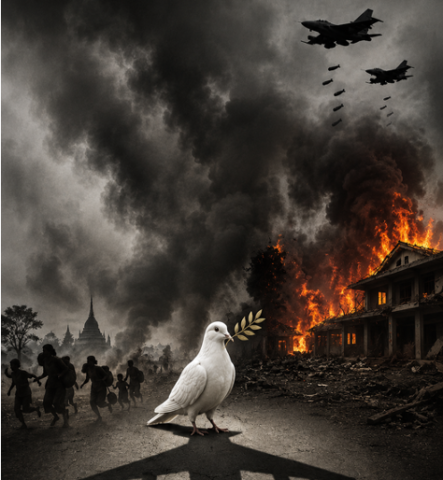
What is being passed off as ‘peace talks’ – so-called peace invitations issued by a junta leader, one who retired from the position of Commander-in-Chief only to appoint himself President and seize state power, alongside meetings held among select ethnic armed organizations in the absence of any actual cessation of hostilities – differs in no meaningful way from the patterns frequently observed throughout more than five years since the military coup.
Yet, as if peace could be achieved overnight, the military council and its aligned groups continue to peddle such narratives. In practice, however, peace overtures and dialogue processes pursued by successive military regimes have served as nothing more than instruments of rhetoric, deployed to prolong military authoritarian rule.
This issue of BNI-Myanmar Peace Monitor’s Biweekly News Review examines the peace-branded meetings being staged, the nature and standing of the parties involved in those meetings, and the prospects for genuine peace.
Peace-Branded Meetings
One thing must be clearly understood: attaching the label of ‘peace’ to these engagements is nothing more than a propaganda exercise by the military junta. Since 1 February 2021 – the day of the military coup – the entire NCA-based peace process has ground to a halt. The institutional foundations of government, military, and parliament collapsed, and the cohesion of NCA-signatory EROs eroded.
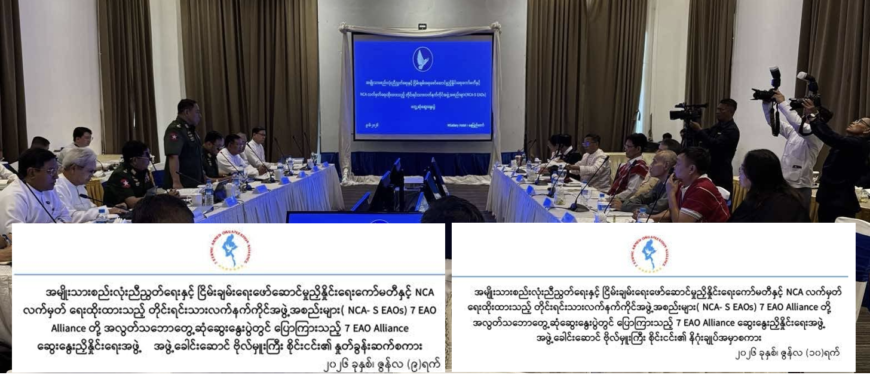
The junta framed the meeting under the title “Dialogue between the National Solidarity and Peace Negotiation Committee (NSPNC) and NCA-signatory Ethnic Armed Organizations (NCA-S EAOs),” while deliberately obscuring which organizations had actually signed the NCA and how many were in attendance.
On the ERO side, however, the negotiating team leader Colonel Sai Ngern made clear in both his opening and closing remarks that the delegation represented only the 7 EAO Alliance (7 EA) – not the broader body of NCA signatories.
Col. Sai Ngern, who also serves as a representative of the Restoration Council of Shan State (RCSS), set out three positions held by the 7 EA with respect to the peace process: reviving the peace process in a manner responsive to current conditions; ensuring the participation of all organizations that ought to be included; and pursuing the peace process with the aim of building lasting peace.
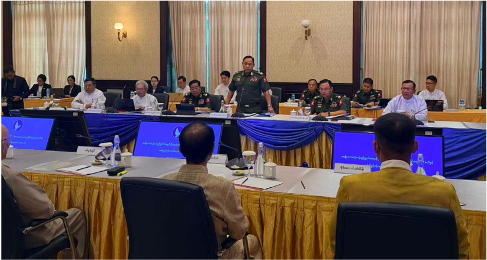
On 12 June 2026, the Shan State Progressive Party/Shan State Army (SSPP/SSA) and the military council’s NSPNC held a separate bilateral meeting, during which both sides presented their respective positions.
In particular, the military council’s demand that SSPP/SSA refrain from collaborating with other armed groups that could undermine territorial stability laid bare the domineering posture the military council brought to the table.
It must therefore be concluded that the informal engagements currently taking place between the military council and select ethnic armed organizations – whether ceasefire parties or not – have yet to produce any meaningful impact on reducing the widespread and escalating armed conflict across the country, and cannot yet be appropriately characterized as peace talks in any substantive sense.
The Nature of the Parties Involved in the Meetings
Beginning with the Party 1, the military junta’s NSPNC: the military’s peace negotiation committee, established on 9 November 2020 – one day after the general elections – was reconstituted and renamed the National Solidarity and Peace Negotiation Committee (NSPNC) on 1 February 2021, the day of the military coup. Lieutenant General Yar Pyae, who had previously served as the military’s representative within the National Reconciliation and Peace Centre (NRPC) under the National League for Democracy-led government, was appointed Chair of the NSPNC and has retained that position since the coup.
Turning next to Party 2, the NCA-signatory EROs: Among the EROs that signed the Nationwide Ceasefire Agreement (NCA) under the Thein Sein government and the subsequent NLD-led government, ten organizations are signatories in total, whose leaders collectively formed the Peace Process Steering Team (PPST). However, three EROs – All Burma Students’ Democratic Front (ABSDF), Chin National Front (CNF), and Karen National Union (KNU) – that actively opposed the military coup withdrew from the PPST, weakening the cohesion of the grouping. Among the remaining seven, four organizations – Arakan Liberation Party (ALP), Lahu Democratic Union (LDU), Pa-O National Liberation Organization (PNLO), and New Mon State Party (NMSP) – have themselves experienced internal fractures, splitting between factions that oppose the coup and factions that engage with the junta. 1
Accordingly, of the 7 EAO Alliance that recently met informally with the junta, only Restoration Council of Shan State (RCSS), Democratic Karen Buddhist Army (DKBA), and KNU/KNLA Peace Council (KPC) retain any meaningful organizational cohesion.
Turning finally to the Party 3, non-NCA signatory EROs that met the military junta individually: the Shan State Progress Party/Shan State Army (SSPP/SSA), United Wa State Party/United Wa State Army (UWSP/UWSA), and National Democratic Alliance Army (NDAA-Mongla) each carry distinct characteristics, but all are members of the Federal Political Negotiation and Consultative Committee (FPNCC) – a seven-organization bloc pursuing a track outside the NCA framework.
It can be argued that the FPNCC has been unable to engage collectively largely because of restrictions imposed by the junta. Other FPNCC members – Myanmar National Democratic Alliance Army (MNDAA), the Ta’ang National Liberation Army (TNLA), and the Arakan Army (AA) – have little choice but to engage with the junta as a result of China’s mediation.
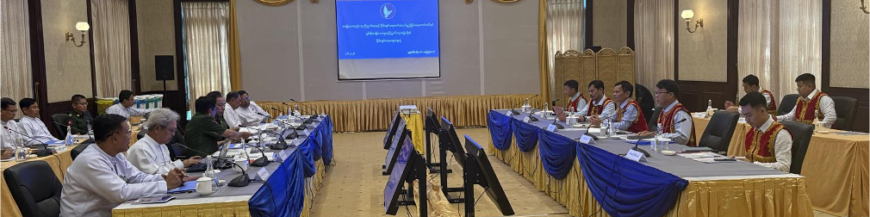
Notably, the military junta has increasingly promoted the Shan Nationalities Unity Council/Shanni Nationalities Army (SNUC/SNA) as a dialogue partner – an organization that frequently engages in intense armed clashes with the Kachin Independence Army (KIA) and local People’s Defence Forces (PDFs), both of which are actively fighting against the junta forces. The SNA is also an organization that was previously denied eligibility to sign the NCA and was excluded from NCA-based peace dialogue processes.
Analysis
Against this backdrop, it is difficult to regard the junta’s dialogue partners as actors genuinely committed to reducing armed conflict in Myanmar. The grouping includes organizations that are effectively compelled to engage with the junta, as well as organizations whose relevance appears to depend on continued engagement with the junta – not on any cessation of hostilities.
Regardless, the junta will almost certainly exploit these dialogue partners to create the illusion of vibrant peace talks before ASEAN and the broader international community. The “peace” rhetoric advanced by the junta to entrench and perpetuate military authoritarian rule should be understood as nothing more than an instrument of manipulation and deliberate deception.
Arakan Army Commander-in-Chief Major General Twan Mrat Naing has responded to the junta’s peace overtures in the following terms:
“As long as the military continues to bomb civilians, it will remain extremely difficult for us to engage in any political process. The junta seeks to negotiate from a position of advantage. We, however, will not yield to that kind of pressure.”