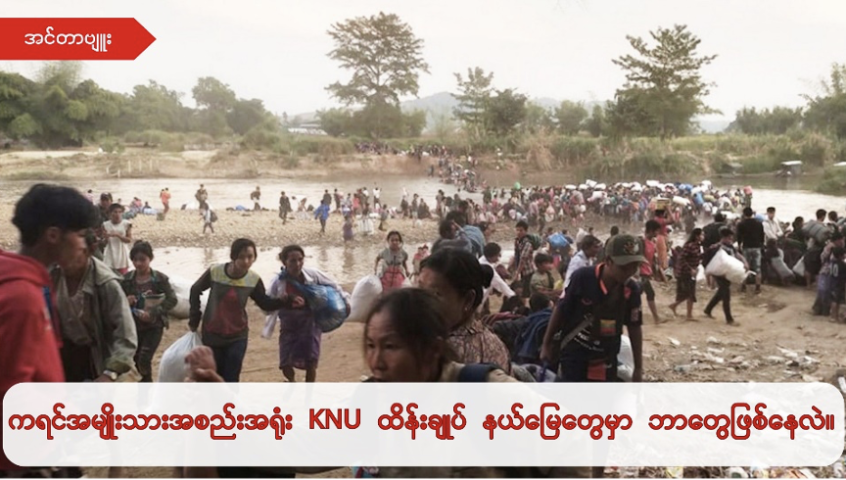
An interview with Saw Nanda Hsu, Spokesperson of the Karen Human Rights Group, about the human right violations and targeted attacks on civilians in KNU-controlled territory during the coup.
Since the coup, the military council has perpetrated severe human rights violations against civilians in territories controlled by the Karen National Union (KNU).
For nearly four years since the coup, human rights violations in KNU-controlled areas have been rampant, with daily aerial bombings and artillery shelling targeting civilians.
The Than Lwin Times interviewed Saw Nanda Hsu, spokesperson for the KHRG, to explore the severity of the situation in KNU-controlled areas, the challenges faced by local communities, and the repercussions of the recent flood disaster and the implementation of the military service law.
Q: How do the military council’s human rights violations against civilians in various districts of the Karen National Union (KNU) continue? How are you receive information about the displacement of people and the use of civilians as human shields?
A: Artillery shelling and drone attacks are ongoing. These attacks have increased. Especially, these attacks continue in the conflict areas like Brigade-3, 5 and 6. Similar incidents are also reported in other brigades.
Basically, the military council continues to execute attacks that result in human rights violations. During these armed conflicts, civilians face numerous issues, including displacement, loss of livelihoods, and reduced access to education and healthcare, similar to previous conditions. However, the use of civilians as human shields has not been as prevalent as it once was.
Q: Recently, the military council has conducted aerial bombardments targeting civilians. What is your view on this ongoing bombing?
A: Targeted attacks on civilians have been an ongoing issue since the coup until today. This is a blatant war crime against humanity. They enjoy impunity because they have not been prosecuted at either the domestic or international levels. It is clearly seen that they continue to violate and commit the offenses without any accountability and responsibility. Another thing is the violation of international humanitarian law. This is something that all armed forces must abide by, but the military council appears to be blatantly violating it. Such airstrikes, indiscriminate shelling, and targeted attacks on civilians constitute violations of international humanitarian law. For instance, arbitrary arrests, extrajudicial killings, torture, and enforced disappearances are attacks on innocent civilians that constitute violations of international humanitarian law.
Q: Due to the ongoing military situation, the number of people fleeing the conflict in the Karen National Union (KNU) territory is rising. What is the current status of humanitarian aid, healthcare, and other conditions for internally displaced persons (IDPs)?
A: Displacement will persist as long as the armed conflict continues. Areas inhabited by ethnic minorities have experienced armed conflicts for many decades, not just since the 2021 coup. Humanitarian aid is crucial whenever such conflicts arise.
So far, the growing number of IDPs has not received adequate assistance. We continue to urge international aid organizations to find more effective ways to deliver direct aid to the groups and organizations that can help those in need on the ground.
Another point is there is a gap between the capacity to provide assistance and the growing number of refugees in need. The rapid increase in displaced persons creates a persistent gap in aid availability. The displacement situations are different. Some people reside permanently in IDP camps, while others return home temporarily, only to flee again, and some seek refuge in the forests. Organizations assisting non-permanent IDPs often struggle to deliver aid in a timely manner. Moreover, the challenges faced by those fleeing the conflict are not only influenced by the war but are also exacerbated by natural disasters.
Especially during heavy rains and strong winds, IDPs are at greater risk of diseases due to the weather, in addition to facing natural disasters. Malaria, influenza, and diarrhea are easily transmitted in these conditions, further complicating the struggles of those already affected by armed conflict.
Q: Flooding has impacted the Sittaung, Thaungyin, and Thanlwin Rivers in areas controlled by the KNU. What challenges are the local people facing as a result of this natural disaster?
A: The people are enduring significant hardships from natural disasters while also grappling with severe armed conflicts. Armed conflict, floods, and flooding hinder the survival of the population. Both IDPs and non-IDPs are negatively affected, particularly those reliant on agriculture, livestock breeding, and paddy farming. The flooding has devastated transportation, destroyed homes, and resulted in the loss of livestock.
Q: What actions should organizations supporting those affected by natural disasters take to provide effective assistance? As KHRG, what specific topics would you like to prioritize?
A: There are many organizations that are helping people affected by natural disasters. We appreciate their support either domestically or abroad. In this situation, the domestic and international organizations need to actively work with the groups on the ground. Especially the members of international organizations which are providing financial support. Establishing direct connections with local organizations focused on public interest is essential. At the same time, international organizations need to fully and adequately support organizations working on the ground. Only then will aid reach the civilians in need.
As we’ve mentioned, the military council is responsible for human right violation and the ongoing crisis. If international organizations give aid through the military council, the aid will not reach the civilians, and the military council may weaponize that assistance.
Q: What is the situation of young people in the country following the enactment of the military service law? What reports have you heard regarding human rights violations? The elderly are also being recruited for public security. What are the likely consequences of these actions?
A: This military service law is a serious threat to especially, the safety of young people across the country. The military council will use the elderly in addition to the youths whose age bracket are stipulated in the military service law. Especially, this is an initial situation which causes a serious threat to the lives of for civilians who are arrested are under military service law. So, the violation of human rights resulting from the military service law seriously threatens the survival of civilians and the serious violation of freedom of movement and rights to livelihoods.
Sent by Than Lwin Times