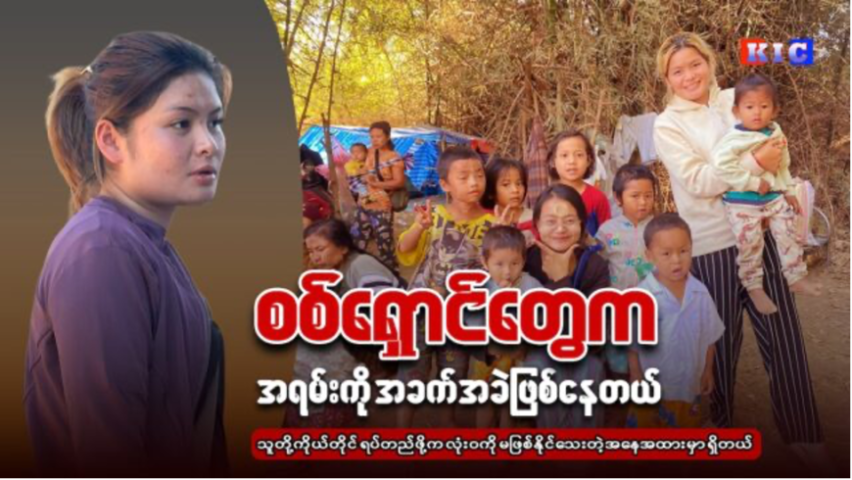
Interview with Naw Jet, a member of Lay Kay Kaw Youth Network
In this interview, Karen Information Center (KIC) spoke with Nar Jat of the Lay Kay Kaw Youth Network about the living conditions, basic needs, and humanitarian support situation of internally displaced persons (IDPs) in the Lay Kay Kaw area in southern Myawaddy Township, who have now been displaced for over four years.
Q: Can you tell us about the current situation of the displaced people in the Lay Kay Kaw area who have been displaced for so long?
A: In Lay Kay Kaw area, people have been displaced for over four years now, going into five years, really. Throughout those four-plus years, people have been surviving under tremendous hardship. Food, clothing, shelter, healthcare, children’s education, every single aspect of life has been a struggle. And right now, with fewer donors, things have gotten a lot harder. There are no jobs for people to support themselves with.
In the early days of displacement, individual donors and organizations came and helped. But now, even the organizations that do come, they only show up once in a long while. That’s just the way it is these days.
Q: Can you also tell us about the situation of IDP shelters?
A: Some IDPs are living in camps, but some are afraid to stay in the camps. And then there are others who’ve put up makeshift shelters along the riverbank and are living there. The reason some people are scared to stay in the camp is that there are a lot of people concentrated there, and what they’re worried about is drone strikes.
On top of that, they can hear artillery going off constantly. So, people are even scared to take shelter inside the IDP camps when fighting breaks out. For the elderly especially, the sounds of drones and artillery have caused some of them to develop mental health conditions. In the Lay Kay Kaw area, there are around seven villages including Lay Kay Kaw, Ya Thayt Gu, and Mae Wah Khee, none of them are safe to return to yet.
Q: With aid dwindling and no job opportunities, how are people managing their day-to-day needs?
A: With support drying up, people just have to make do with whatever rations they get. They find all kinds of ways to scrape by. Back before all this, our area was close to the border so there was quite a bit of work available. But now, trading isn’t possible anymore. Cornfields, farmland — most of that is basically gone. Everyone is displaced, so nobody dares go back to work the land. And even if they wanted to, there are landmines and artillery threats. You’d be risking your life, so people just won’t go back.
Before, people could afford to build a lot of houses, so some people made a living as carpenters or masons. But now that construction has stopped, those carpenters and masons are out of work. And crossing to the other side of the border isn’t easy like it used to be either. Between the political situation and the heavy security crackdowns related to border scam compound operations, going in and out to work on farms over there has become really difficult.
Q: Please tell us about displaced youth and their employment prospects in the IDP camps.
A: When it comes to young people in the Lay Kay Kaw area, some have gone to work in the neighboring country. Some have joined various organizations. Some come back to help out in the camps. Those are the ones within our reach, so to speak.
Some have gone to work as cleaners at scam compound sites. After those sites were raided, some of them came back to the camps to be with their families. Another thing we’re seeing is that because young people in the camps don’t have much access to education, some are getting married very early. So, that’s how things are looking for the youth right now.
Q: With fighting intensifying again recently, has the number of IDPs been increasing? And what kinds of assistance do they most need?
A: Since the junta pushed through the Asia Road, the numbers started climbing again. And now with fighting breaking out in Hpa Lu as well, even more displaced people are coming in. There are around a thousand families currently displaced.
The longer people have been in the camps, the more problems pile up — toilets, water, shelter safety. In summer, the shelters in the camp are mostly tarpaulin, so the heat is really hard to bear. There isn’t enough water, so water has to be piped in. And because water isn’t sufficient, personal hygiene and health are also being affected. With thousands of families, there simply aren’t enough shelters.
Right now, shelters need to be repaired. But without assistance, people are really struggling. During the rainy season, flooding becomes a problem. For those living along the Thaungyin River, the rainy season is especially difficult. In the dry season you can do some work, but in the rainy season there’s nothing to do, no way to earn. So they actually need more food rations in the rainy season than in summer. Since help has been decreasing, we really want organizations to come and assist. It’s just so sad to see the situation of the displaced communities. They are in an extremely difficult situation. Right now, they are in no position whatsoever to support themselves.
Q: Is there anything else you’d like to add about the IDPs?
A: I’m also living as a displaced person myself. I don’t want to experience the consequences of this conflict anymore. Because young people are constantly living in the middle of conflict, thy’re left with no future. They can’t become what they want to be. It’s not easy to keep up with others. People do whatever they can just to feed their families. As for education, schools aren’t running normally, education is patchy and irregular. Young people have no work, so they just stay in the camp, stuck with their families. I want to see my home area, which was once developing, come back to life. And I don’t want the next generation, one after another, to keep suffering the devastation of war.
Sent by KIC