Introduction
For the Myanmar’s military regime, whether it is permanent peace or temporary peace, the term “peace” has historically been nothing more than a façade. Be it temporary ceasefires or nationwide ceasefire agreements, the military regime has consistently violated them. Even at the peace forum held in Nay Pyi Taw during the third week of June, the discussions led by the military junta focused solely on paving the way for elections. Therefore, the “peace” promoted by the junta and their associates is merely a superficial label for public appeal.
This issue of BNI-Myanmar Peace Monitor’s Bi-Weekly News Review takes a closer look at the peace forum held in Nay Pyi Taw and the junta’s efforts to hold elections.
The Normal Peace or Nay Pyi Taw Peace Forum
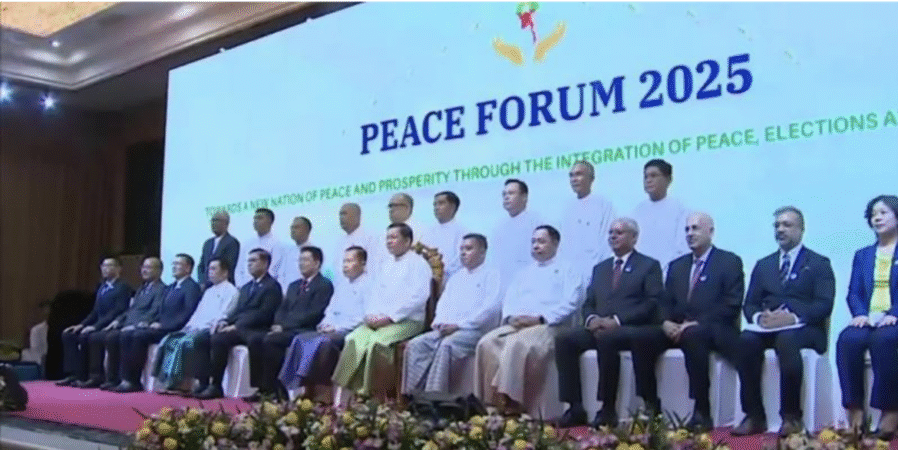
The peace forum, organized by the military junta’s National Solidarity and Peacemaking Negotiation Committee (NSPNC), was held in Nay Pyi Taw for three days, from 25 to 27 June.
The forum was attended by representatives from China, India, Thailand, and Russia. Also present were: some ethnic resistance groups who have friendly terms with the junta, others under Chinese influence, representatives from political parties planning to participate in the junta’s upcoming elections, and experts from various fields who present views favorable to the junta.
Under the slogan “Towards a New Nation of Peace and Prosperity through the Integration of Peace, Elections and Development,” the so-called “Peace Forum 2025” focused on discussing preparations for elections, identifying solutions to address the country’s current political and socio-economic challenges, exploring the role of the international community in building a democratic and federal union post-election, and analyzing geopolitical conditions. The National Solidarity and Peace Negotiation Committee (NSPNC), established by the military regime, promoted the forum as “a new step towards peace amid the Myanmar’s political crisis” in its propaganda.
However, this “new step towards peace” by the junta excluded ethnic resistance organizations genuinely engaged in conflict with the junta’s forces, representatives from political parties not aligned with the junta, experts, or prominent international representatives. Far from including the Spring Revolution forces fighting to end the military dictatorship, even representatives from the Restoration Council of Shan State/Shan State Army (RCSS/SSA), which still adheres to the Nationwide Ceasefire Agreement (NCA) associated with the junta, were notably absent from the peace forum.
The military junta’s use of the universally appealing term “peace” is merely a façade to rally support for their planned elections, exploiting those who support them. Having annulled the 2020 general election results and illegally seized power to this day, the question remains whether a fair new election or a sincere peace process can truly be expected from this military regime.
Military Junta’s Election Efforts
Despite condemnations from the United Nations, ASEAN, and various individuals and groups, the junta appears determined to expedite an election. Major powers like China and Russia, which have turned a blind eye to the junta’s airstrikes and atrocities against civilians for their own self-interest, seem prepared to recognize and support the election planned by the junta.
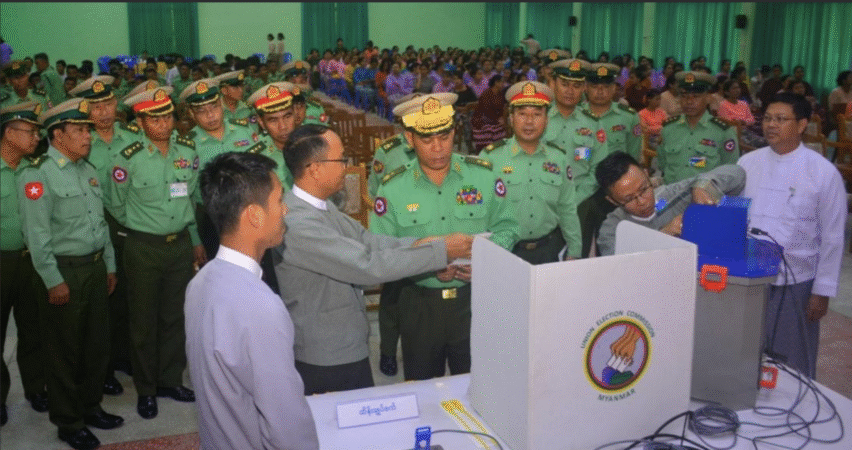
Similarly, political actors sympathetic to the junta, who have remained silent on the violent suppression of peaceful civilian protests with live ammunition and have labeled the resistance groups taking up arms against the junta as resorting to “armed resistance”, are actively preparing to participate in the junta’s planned election.
The leader of the People’s Pioneer Party (PPP), who secured a ministerial position within the junta and is sympathetic to the military junta, has claimed all conflicts she is aware of were initiated not by the junta, but by the resistance groups. Daw Thet Thet Khaing views the junta’s election as a potential solution for the entire nation, including the public, suggesting that an elected government could reduce international pressure and foster reconciliation among domestic forces.
As stated by the coup leader Senior General Min Aung Hlaing himself, elections are planned for December 2025 or early 2026, and election-related activities are becoming increasingly visible. However, the number of townships where the election will be held remains uncertain, and neither the election system nor the election rules to be followed have been officially announced. The junta is still campaigning for recognition of an illegitimate election.
Review
The Myanmar crisis, a consequence of the illegitimate military coup, has put the military junta in a difficult position, as even those urging a resolution to the crisis are now of the view that the junta’s election plans should not yet be implemented. On the other hand, the junta sees holding an election as the only way to successfully conclude their coup, driving their determination to proceed.
However, People’s Defense Forces/Local Defense Forces (PDFs/LDFs), Ethnic Resistance Organizations (EROs), and the National Unity Government (NUG), among other resistance groups, fighting to end the military dictatorship and build a federal democratic union have expanded their armed resistance, with defensive and offensive operations intensifying across 245 townships across Myanmar. This poses a significant security concern for the junta regarding the safety of their planned election, prompting them to reportedly plan a special law to safeguard the electoral process.
The junta faces mounting challenges in military, political, and economic spheres to secure their coup’s success, making the election their last resort. They continue to move forward step-by-step, believing in the fact that there is no provision stating an election is invalid if only a small number of polling stations are open, which may give them confidence in their post-coup exit strategy.
According to the coup leader’s speech at the Nay Pyi Taw Peace Forum, the junta remains committed to the 2008 Constitution, the Nationwide Ceasefire Agreement (NCA), and the military’s six-point peace principles, with no consideration beyond these frameworks. They even suggested that they could hold their election even with a decision by the National Defense and Security Council, which is currently not fully constituted.
For resistance forces opposing the coup and striving for a future federal democratic union, merely condemning the junta’s election or issuing statements of non-recognition will not suffice to halt it. It is crucial to adopt a practical approach to prevent the junta’s election from succeeding, and to develop a strategic plan to address the junta’s post-election scenario.
1. Peace Forum 2025: A new step towards peace amid the Myanmar’s political crisis, NSPNC
2. PPP leader Dr. Thet Thet Khaing says elections must take place, VOM, 26 Jun 2025
3. Myanmar Armed Conflict Dashboard, BNI-MPM, 1 Feb 2021 – 1 Jul 2025