Counting from 3 April 2026 – the day the military junta’s sham Union Parliament elected junta leader Senior General Min Aung Hlaing as President – 30 June marks the 89th day of his presidency. Counting from 10 April 2026, when the sham government headed by the junta chief was formed, it has now been in office for 82 days.
This issue of BNI-Myanmar Peace Monitor’s Biweekly News Review takes a closer look at the nationwide armed conflict events and their consequences observed during the sham government’s 82 days in office –findings that should not be ignored or dismissed by anyone who genuinely seeks and advocates peace in Myanmar.
Conflict Events and Airstrikes: Impact on the Civilian Population
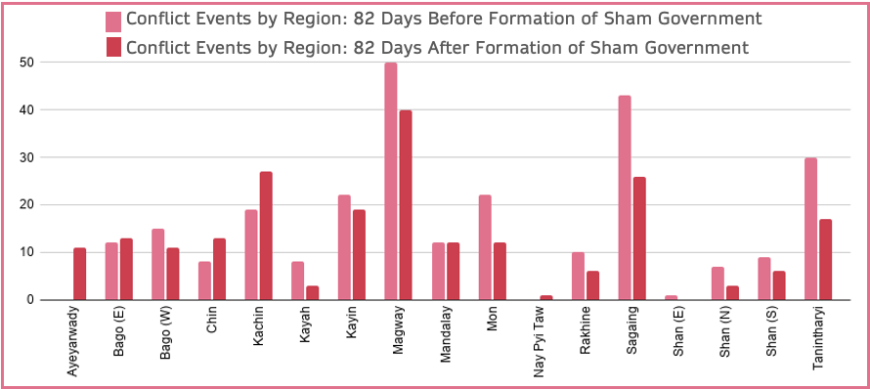
During the 82-day tenure of the sham government headed by junta chief Senior General (Retired) Min Aung Hlaing, from 10 April to 30 June 2026, BNI-Myanmar Peace Monitor recorded a total of 220 conflict events across the country – a slight decrease compared to the number of conflict events recorded in the 82 days prior to the sham government’s formation.
Notably, more conflict incidents took place in Chin, Ayeyarwady, and Bago (East) before the sham government was formed. This suggests that the direction of the junta’s ground and air offensives has appears to have shifted toward Arakan State, where it has suffered the greatest territorial losses.
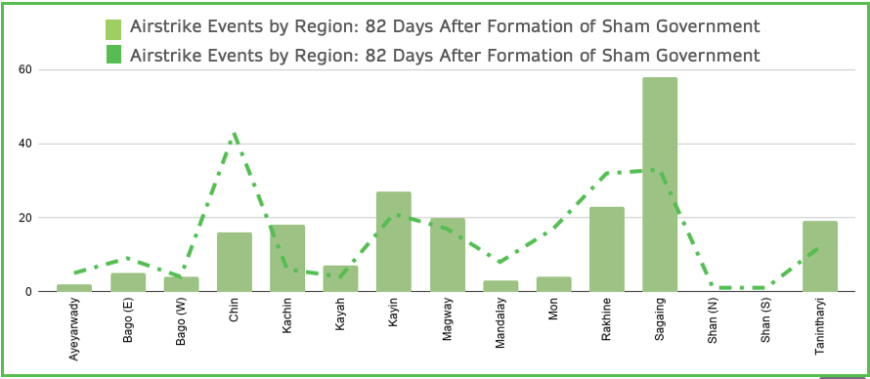
During this period, a total of 213 airstrike events by the military were recorded – more than in the 82 days before the sham government was formed.
The geographic distribution of these airstrikes shows a clear pattern, with Chin State, Bago Region (East), Ayeyarwady Region, and Arakan State being the primary targets. This indicates that since the sham government’s formation, the military’s ground and air offensives have been focused on recapturing territory lost across Arakan State to Arakan Army (AA).
As of 30 June 2026, following the formation of the sham government, a total of 483 civilians had been killed and nearly 140,000 displaced due to armed conflict and junta airstrikes.
Key Actors for Conflict Reduction
From 1 February 2021 to 30 June 2026, BNI-Myanmar Peace Monitor recorded a total of 7,453 conflict events between the junta and resistance forces. 54 percent (4,074 events) of these conflict events took place between the junta troops and resistance forces that formed nationwide following the coup, NUG-affiliated People’s Defense Forces (PDF) and other local defense forces.
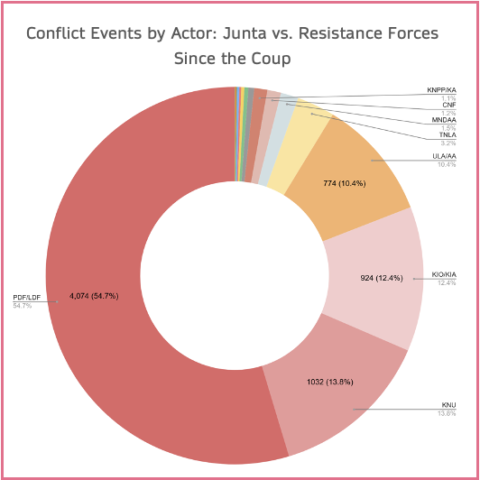
When conflict incidents are broken down by individual Ethnic Resistance Organizations (EROs), the Karen National Union (KNU), Kachin Independence Army (KIA), and Arakan Army (AA) have had the highest number of conflict events with the junta. In addition, the Ta’ang National Liberation Army (TNLA), Myanmar National Democratic Alliance Army (MNDAA), Chin National Front (CNF), and Karenni National Progressive Party (KNPP/KA) also rank among the EROs with the highest number of conflict events with the junta.
Therefore, the invitation extended by the junta chief Senior General (Retired) Min Aung Hlaing – made at a Union Government meeting held 10 days after the sham government’s formation – for PDFs to “enter the legal fold” and his invitation for EROs to hold talks before 31 July, is disconnected from realities on the ground.
“We will hold talks before 31 July. Similarly, as for the PDFs, we invite them to enter the legal fold during this period. Politically, there is no solid justification either,” the coup leader said, referring to the armed resistance.
Analysis
By securing a ceasefire through the mediation of China, the junta has managed to reduce the intensity of the military conflict with the MNDAA and TNLA. However, it has intensified and expanded offensive operations in Kachin, Karen, Bago, Ayeyarwady, Arakan, Sagaing, and Magway.
At the same time, the junta has been attempting to divide the resistance forces into different categories and inviting them to talks under the banner of dialogue. Following the junta’s invitation issued on 21 April 2026, Ethnic Resistance Organizations (EROs) were grouped into three categories: Nationwide Ceasefire Agreement (NCA) signatories, non-signatories, and those that signed the NCA but have since departed from its framework. However, the National Unity Government (NUG) and the People’s Defense Forces (PDFs) and Local Defense Forces (LDFs) that emerged in the wake of the military coup were deliberately excluded from the invitation.
In order for the junta’s sham government to demonstrate genuine will toward ending nationwide armed conflict and resolving political problems through political means, it must first halt its daily airstrikes being conducted across the country. A complete halt to the junta’s airstrikes would be the single most meaningful step toward easing public fears over safety and survival.
If the junta declares a complete halt to nationwide airstrikes and demonstrates this in practice, it is conceivable that pathways for dialogue toward reducing armed conflict and building peace will emerge.