
Introduction
The military junta has regained control over seven out of 101 towns previously captured and controlled by resistance forces, including Thabeikkyin and Nawnghkio. From the junta’s recapture of Kawlin to the relinquishment of Lashio due to China’s mediation, an analysis of the junta’s efforts to restore control over these towns reveals multiple factors: disseminating disinformation to sow discord among resistance forces, leveraging the Chinese government’s support, and launching all-out offensives using combined land, sea, and air forces.
This issue of BNI-Myanmar Peace Monitor’s Bi-Weekly News Reviews presents key observations and lessons learned from the junta’s efforts, based on data and events.
The 7 Towns Retaken by the Junta
The military junta announced on 23 July 2025 that it had regained control of Thabeikkyin in Mandalay Region, which had been under resistance forces’ control since 25 August 2024. Similarly, on 16 July 2025, the junta declared it had recaptured Nawnghkio in northern Shan State, which had been held by the Ta’ang National Liberation Army (TNLA) and allied resistance groups since 26 June 2024.
Furthermore, on 2 July 2025, the junta announced it had regained control of Moebye in southern Shan State, which had been under resistance forces in the Karenni State since 13 November 2023. Notably, within the single month of July 2025, the junta took back three towns previously lost to resistance forces, allowing it to capitalize on its recent victories to further its propaganda efforts.
The junta’s second-in-command, Lieutenant General Soe Win, attributed that their temporary withdrawal from Nawnghkio was to various reasons and stated that elections would be held in December 2025.
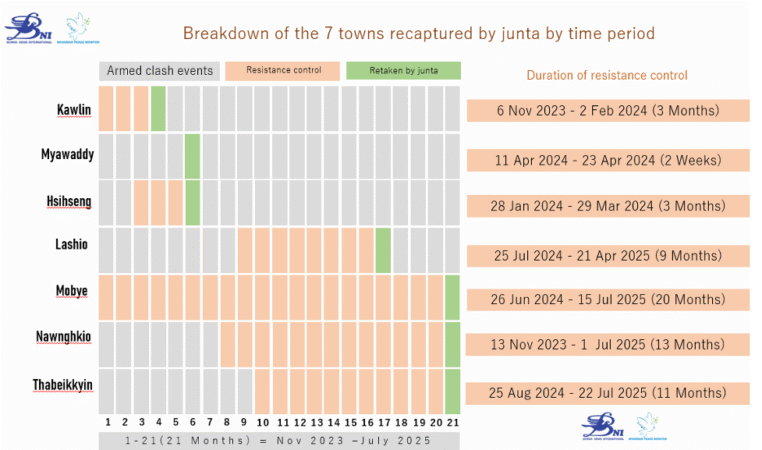
On 25 July 2024, the junta, through China’s mediation, regained control of Lashio in northern Shan State, which it had lost to the Myanmar National Democratic Alliance Army (MNDAA) and allied forces. By 22 April 2025, the junta was granted access to re-establish its presence in Lashio.
Looking at the seven towns recaptured by the junta, it is notable that the junta lost Myawaddy, which was captured by the Karen National Liberation Army (KNLA) and its allies, for only two weeks. However, Mobye, a town on the border between Karenni and southern Shan States, remained under resistance control for over 20 months.
Junta’s Efforts to Retake the Lost Towns
An analysis of the military junta’s recapture of Myawaddy within two weeks reveals that the junta received significant support from its affiliated Border Guard Forces (BGF) in Karen State. Additionally, to prevent the fall of Myawaddy, the junta’s ground operations were facilitated by guidance from troops led by General Bo Bi of the Democratic Karen Benevolent Army (DKBA), another Karen armed group. On the other hand, there was spread of disinformation claiming that an understanding or agreement had been reached between the junta and the Karen National Union (KNU) leaders.
In efforts to regain control of Hsihseng in southern Shan State and Moebye, the junta relied on assistance from its affiliated Pa-O militia, led by U Aung Kham Hti. This support enabled the junta to counter military pressure from local resistance groups. Furthermore, the junta and its allies deliberately disseminated propaganda aimed at inciting ethnic conflicts among Shan, Pa-O, Karenni, and Kayans in these regions. At the same time, the junta intensified aerial attacks and exerted significant efforts to regain the lost towns.
According to Deputy Commander Marwi of the Karenni Nationalities Defense Force (KNDF), credible evidence indicates that since May 2021, the Pa-O National Organization/Pa-O National Army (PNO/PNA) has collaborated with the junta’s Division 55 to launch offensives against resistance forces in Karenni State.
In the case of Nawnghkio, which was out of junta control for 13 months, initial observations noted disinformation campaigns aimed at creating divisions between the Ta’ang National Liberation Army (TNLA) and its local allied forces. Reports, widely circulated across various media outlets, claimed that the TNLA ordered the withdrawal of People’s Defense Forces/Local Defense Forces (PDFs/LDFs), which were operating in alliance with the TNLA in Nawnghkio Township amid intense airstrikes and ground battles.
In essence, an analysis of the junta’s town capture efforts reveals several key factors: the dissemination of propaganda to sow discord among resistance forces, leveraging affiliated local groups such as militias, Pyu Saw Htee groups, and Border Guard Forces, and the intensification of aerial attacks.
Notably, the enactment and implementation of the conscription law in 2023 and 2024, when many towns, villages, and military camps were lost, significantly bolstered the junta’s ground offensive capabilities.
BNI-Myanmar Peace Monitor has found that the junta significantly intensified airstrikes to reclaim towns it had lost. Prior to losing control of the seven towns to resistance forces, only 79 airstrike events were recorded in these areas. However, after the towns were captured, the number of airstrike incidents surged to 209. The junta, disregarding the potential destruction of towns and villages, employed excessive aerial attacks, akin to the mentality “If I can’t have it, no one can”, in its relentless efforts to regain control.
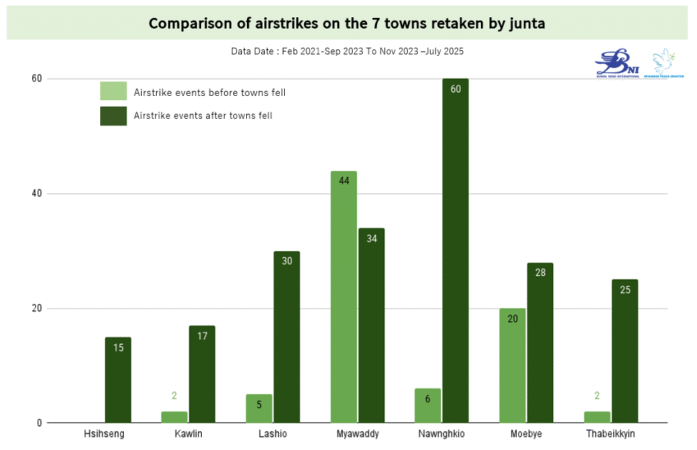
Comparing the junta’s aerial attacks between two periods—February 2021 to September 2023 (before losing the towns) and November 2023 to July 2025 (after losing them)— Nawnghkio experienced the highest number of airstrikes while under resistance control, followed by Lashio as the second most targeted, and Thabeikkyin as the third.
Analysis
The junta’s recapture of Thabeikkyin, which resistance forces held for 11 months, has drawn criticism from observers, particularly directed at the NUG-affiliated local defense forces and PDF battalions. Questions have also been raised regarding Ethnic Resistance Organizations (EROs) and local resistance groups unaffiliated with the NUG in Thabeikkyin and surrounding areas. Similar criticisms and scrutiny arose when Kawlin was lost to the junta.
It is critical to note that as many as 94 towns remain out of junta control as of today. To address this, the junta continues to employ tactics such as sowing discord among resistance forces, spreading disinformation to incite ethnic conflicts, using forcibly conscripted soldiers as human shields in military operations, advancing with large number of troops, and intensifying aerial attacks.
Regaining control of lost towns is likely a significant objective for the junta as they prepare to hold general elections in 2025. To this end, the junta has enacted the election protection law (Law on the Protection of Multiparty Democratic Elections from Obstruction, Disruption and Destruction), which imposes severe penalties, including the death penalty, targeting resistance forces that disrupt or obstruct the election process. This underscores the junta’s determination to regain control of lost territories.
Therefore, halting the junta’s efforts to recapture the lost towns presents an urgent challenge for the resistance forces holding various towns, villages, and junta bases, demanding an immediate solution.
1. The Myawaddy Conundrum, Bi-Weekly News Review, Issue – 143, BNI-MPM
2. Marwi speaks out on why they had to fight Pa-O militia (Video), Irrawaddy, 23 Jul 2025
3. TNLA denies ordering PDF to withdraw from Nawnghkio, says intense fighting continues, Mizzima, 11 Jun 2025
4. Military Junta’s Airstrikes in Myanmar, BNI-MPM’s Ongoing Dashboard, 1 Feb 2021 – 15 Jul 2025