Introduction
Despite widespread opposition and condemnation of the military junta’s proposed new election – labeled a sham election, an illegal election, a political trap, and a staged event, the junta has announced the date for the first phase of the election. With the first phase set to take place in 102 townships, it appears the junta believes that the election will be successful as long as there are candidates and a declared or nominal constituency, regardless of whether the people vote or not.
Therefore, actions such as condemning the election, declaring it illegitimate, refusing to recognize it, launching “No Vote” campaigns, or pressuring those involved in the election process are unlikely to stop or hinder the junta’s new election plan.
This issue of BNI-Myanmar Peace Montor’s Bi-Weekly News Reviews examines the military junta’s new election plan, anti-election campaigns, and the choices facing the resistance forces.
The Junta’s Election Plan
The military junta, which nullified the results of the 2020 general election after the coup, announced on 18 August 2025, that the first phase of its new election would be held on 28 December 2025. On 20 August the junta further announced that this face would cover 102 townships. These townships include 6 in Kachin State, 2 in Kayah (Karenni) State, 3 in Karen State, 2 in Chin State, 12 in Sagaing Region, 4 in Tanintharyi Region, 8 in Bago Region, 9 in Magway Region, 8 in Mandalay Region, 5 in Mon State, 3 in Arakan State, 12 in Yangon Region, 12 in Shan State, 8 in Ayeyarwady Region, and 8 in Nay Pyi Taw Council Territory.
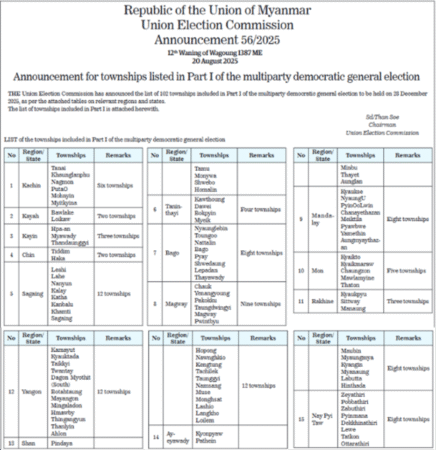
According to the statements of the junta’s reconstituted Election Commission, the election will cover 330 constituencies for the Pyithu Hluttaw(House of Representatives), 84 for the Amyotha Hluttaw (House of Nationalities), and 315 for the Regional/State Hluttaw, using a first-past-the-post system. In addit-ion, 26 constituencies for the Amyo-tha Hluttaw and 42 for the Regional/State Hluttaws will use a proportional representation system. Under proportional representation, 84 representatives will be elected for the Amyotha Hluttaw from 26 constituencies, and 322 representatives for the Regional/State Hluttaws from 42 constituencies. Under the first-past-the-post system, one representative per constituency will be elected for each respective parliament.
For the first phase of the election in December, only the 102 townships have been announced, but there is no clear specification of the electoral system to be used for each constituency. Furthermore, there is no clear plan regarding the convening of parliament or the transfer of government post-election. The junta has enacted an election protection law with penalties up to the death penalty, indicating that their push for this new election is a reckless gamble, intimidating the public.
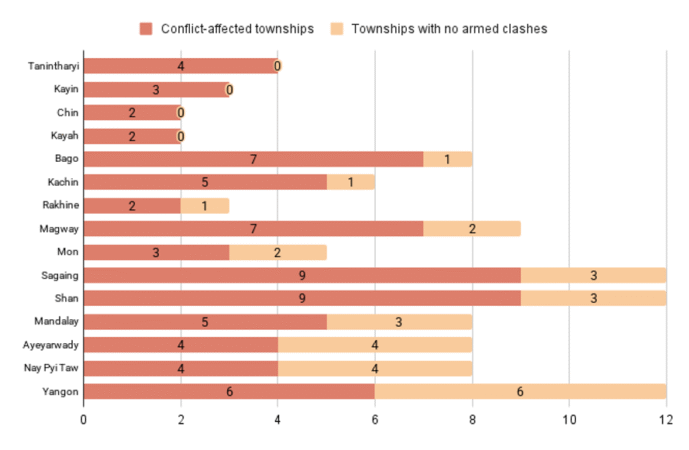
According to BNI-Myanmar Peace Monitor data, over 70% of the 102 townships included in the first phase of the junta’s election are experiencing ongoing armed conflicts. Only 30 townships can be considered free of such conflicts. Holding the election in these areas poses significant security risks for both the public and those involved in the election process.
When analyzing the 102 townships by region and state, only about 50% of the townships in Yangon, Nay Pyi Taw, and Ayeyarwady are free of armed conflict. In contrast, all townships designated for the election in Tanintharyi, Karen, Chin, and Karenni (Kayah) are affected by ongoing conflicts.
Examining specific townships, Myawaddy, Kale, Nawnghkio, Muse, Loikaw, Monywa, Dawei, Homalin, Kyaikto, Tamu, Hakha, Tedim, and Kyaukphyu, among others, have recorded between 50 to over 170 conflict incidents. Elections in these areas are likely feasible only in urban wards.
Therefore, it is evident that the junta’s election plan prioritizes holding a nominal election over ensuring the public’s ability to vote freely and safely.
The People’s Dilemma Amid Anti-Election Campaigns
Resistance forces aiming to end the military dictatorship and build a Federal Democratic Union have firmly opposed and condemned the junta’s new election, refusing to recognize it and urging the public not to participate. People’s Defense Forces/Local Defense Forces (PDFs/LDFs) and Ethnic Revolutionary Organizations (EROs) have also issued warnings of decisive action against those involved in the junta’s election process.
However, the resistance forces do not yet have a clear strategy to halt the junta’s election. Declarations of opposition, condemnation, illegitimacy, or non-recognition have proven ineffective, as evidenced by the junta’s conscription law.
Thousands of young people are already serving in the junta’s military, and countless households in urban and rural areas are paying monthly fees to avoid conscription.
As a result, people in the 102 townships designated for the first phase of the junta’s election may face unavoidable pressure to vote. Just as with the conscription law, avoiding participation could be extremely difficult. Even though the public does not support the junta’s election, resisting participation through non-voting presents significant challenges. Resistance activities opposing the election must be cautious to avoid creating an additional dilemma for the public by pressuring them to participate in anti-election activities.
The Spring Revolution’s Crossroads
If the junta’s new election is seen as the “head” of a coin, the resistance forces face a crossroads that represents the “tail.” The junta’s push to hold this election is an attempt to conclude their failed coup, while the military and political dynamics among the resistance forces signal a critical juncture where all resistance groups must unite and make strategic choices.
To build a future Federal Democratic Union, resistance forces must select shared political objectives and frameworks. This includes reforming ineffective organizations, including the National Unity Government (NUG), and accelerating efforts to include EROs and other resistance groups that have not yet joined the “Bottom-up Federalism” approach, which emphasizes strengthening states to build a stronger union.
Over four years into the Spring Revolution, military victories, extensive territorial control, and the seeds of federalism are becoming more crystallized. The vision of a Federal Democratic Union, encompassing ethnic groups like Kachin, Karen, Kayah (Karenni), Chin, Arakan, Mon, Bamar, and Shan, requires the unified participation of all resistance forces.
Analysis
The military junta is determined to hold a new election to conclude its failed coup, disregarding territorial stability, security, or public participation. With support from governments like China and Russia, and the participation of some political parties, it appears that the junta believes the election will be a success. Stopping their election plan is extremely challenging.
The resistance forces’ intensified anti-election campaigns are raising political awareness among the public. However, coercive pressures to abstain from voting or participation must be approached carefully to avoid creating further dilemma for the public.
With military victories and clearer political objectives, the Spring Revolution is at a crossroads. The unity of all resistance forces and agreement on shared political goals are critical. Without such unity, the resistance forces risk division, manipulation, and military pressure. Their collective strength could be the key to halting the junta’s new election.