Systematic forced recruitment drives are expanding across Myanmar. Incidents have been documented in Yangon and Myaungmya, in Putao in the far north, and under distinct coercive mechanisms in Myawaddy and Hpa-an. In Myingyan in Central Myanmar, abductions have escalated into door-to-door raids directly inside private homes.
As the post-coup conflict drags on, the military regime faces escalating combat across multiple front lines nationwide. To replenish severe troop depletion, the junta activated the ‘People’s Military Service Law’ targeting youth aged 18 to 35. Myanmar’s youth have actively resisted these measures by fleeing abroad, escaping to liberated areas under resistance control, paying bribes, or hiring proxy substitutes to avoid forced enlistment.
In response, the military authorities have increasingly bypassed statutory procedures, resorting to extra-legal abductions and deceptive financial incentives to fulfill recruitment quotas. Through these aggressive drives, the junta has reportedly conducted up to its 28th conscription intake, replenishing its ranks with an estimated total reaching hundreds of thousands of recruits. (Although official policy prescribes an intake quota of 5,000 recruits per batch, the military junta has not disclosed actual recruitment figures to the public).
In this issue of the Bi-Weekly News Review, BNI-Myanmar Peace Monitor examines the worsening sweeps across Myanmar to force youth into military servitude, as well as potential measures to counter and prevent them.
Forced Abductions in Yangon
According to the Rangoon Scout Network (RSN), which monitors military movements and security incidents across Yangon Region, junta forces and affiliated actors forcibly abducted 85 youth across 17 townships between 1 and 20 September 2026. Most of those detained were seized arbitrarily while on or near the roads. 1
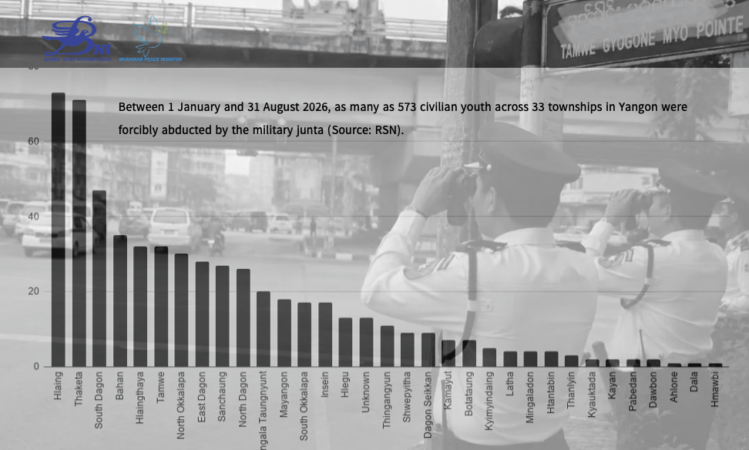
RSN monthly data reveals that between 1 January and 31 August 2026, as many as 573 civilian youth were forcibly detained across 33 townships in Yangon. Hlaing and Thaketa townships registered the highest number of abductions. An analysis of detention methods shows that random street-level sweeps accounted for nearly half of all documented cases.
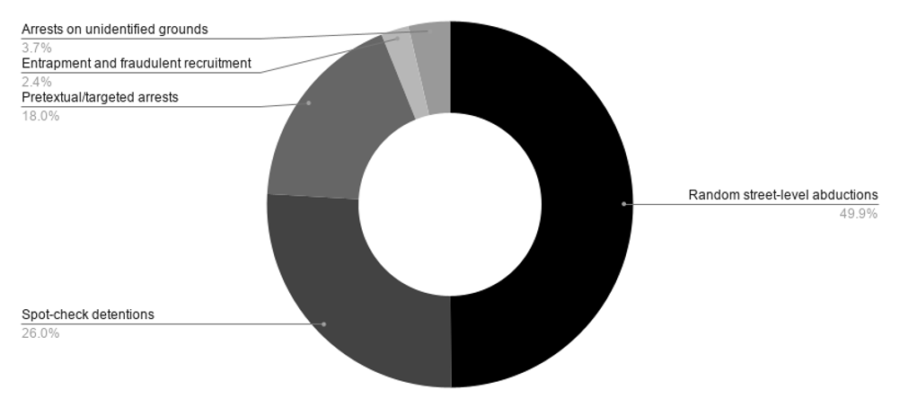
- Random street-level abductions – Abductions occurring while commuting, sitting at teashops or roadside stalls, or traveling inside vehicles.
- Spot-check detentions – Detentions during overnight guest registration inspections, pedestrian stops, vehicular checkpoints, mobile phone inspections, or public fund drives for earthquake relief.
- Pretextual/targeted arrests – Operations based on targeted tip-offs, targeted surveillance, or participation in public protests.
- Entrapment and fraudulent recruitment – Enticement through fraudulent employment offers, solicitation by sex workers, or drugging.
Because recruitment sweeps across Yangon Region increasingly take place during daylight hours, RSN advises youth to exercise caution in deserted public areas. The group also recommends monitoring neighborhood intelligence on conscription rosters, designating temporary evacuation points in advance, avoiding traveling alone or in pairs after dark, and memorizing the contact details of at least two trusted emergency contacts. 2
Nationwide Sweeps and the Substitution Market
In Myaungmya, Ayeyarwady Region, local ward administrators forcibly abducted a 20-year-old resident of 4th Street, Mya Yadanar Ward, to serve as a paid substitute recruit for Hnget Pyaw Taw village. The ward officials reportedly secured roughly 18 million kyat for the substitute transfer, remitting more than 5 million kyat to the township administrator. 3
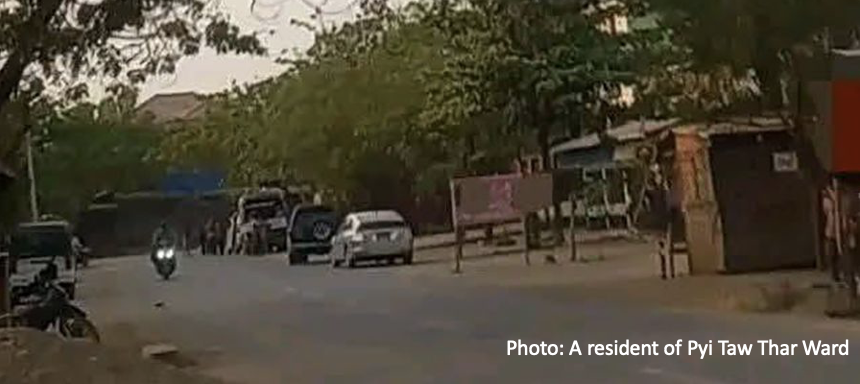
In Monywa, Sagaing Region, military personnel detained nearly 100 civilians from Pyi Taw Tha Ward on 6 August 2026, using cash subsidies as bait. The incident took place in the afternoon as residents were heading to the ward administration office to collect financial support provided by the United Nations Children’s Fund (UNICEF). Troops stationed near the Aung Thu Kha rice mill intercepted the group, detaining mostly youth. 4
In far-northern Kachin State, junta forces and allied Pyu Saw Htee militia elements have systematically rounded up youth across urban wards, rural villages, and local gold mining sites in Puta-O and Kawnglanghpu. In September 2026 alone, approximately 200 youth were detained in operations carried out using military and civilian vehicles by Puta-O-based Light Infantry Battalion-46, Machanbaw-based LIB 137, the Tangutan militia, and local police field units. 5
In Myawaddy, Karen State, military junta forces have detained over 100 individuals – including local youth and migrant workers from other parts of the country – holding them in urban detention centers. Patrol teams conduct mobile sweeps after 9:00pm, transferring detainees to military training centers in regular batches. 6 Meanwhile, ward administrators, members of the Association for the Protection of Race and Religion (Ma Ba Tha), and certain local armed groups have engaged in abducting youth to sell as proxy conscripts. Within this commercialized substitution market in Myawaddy, rates per individual reportedly range between 4 million and 10 million Myanmar kyat. 7
…ward administrators, members of the Association for the Protection of Race and Religion (Ma Ba Tha), and certain local armed groups have engaged in abducting youth to sell as proxy conscripts. Within this commercialized substitution market in Myawaddy, rates per individual reportedly range between 4 million and 10 million kyat.
In Myingyan, Mandalay Region, local administrative personnel under junta control initiated home raids based on compiled conscription registries beginning 11 September 2026. Local households across various wards are also being coerced into paying mandatory ‘military service fees’ ranging from 30,000 to 40,000 kyat per household. 8
These systematic sweeps across both the central lowlands and ethnic borderlands have left civilians living under persistent insecurity and fear of arbitrary detention.
Conscripts as Human-Wave Forces
Chit Ko Zin, a conscript captured by the Arakan Army (AA) during clashes near Pazi village along the Ann–Padan road, was originally a daily-wage bricklayer in Yangon. Junta soldiers detained him on the night of 1 July 2025, at around 9:00pm while he was returning home from work. He was sent to a basic military training depot on 16 July, completed training on 5 October, and was posted to Pakokku-based LIB 259. He was subsequently deployed alongside 118 fellow conscripts to the active front near the Padan artillery base in Magway Region.

“They make us conscripts do all the hard labor. When we have to fight the enemy or move forward, they push us to the front while they stay behind. Most of the casualties and deaths are among us conscripts. Once a battle starts, we can’t run forward and we can’t fall back either. If we go forward, the enemy shoots us; if we retreat, our battalion commander threatens to shoot us,” said Private Chit Ko Zin (Service No. Pa-Sa/168273).” 9
According to an 18 September 2026 statement by the Ministry of Defence (MOD) of the National Unity Government (NUG), the military junta trained approximately 135,080 civilians across 27 intakes between July 2024 and late August 2026, deploying these recruits to active combat zones in human-wave tactics. The NUG-MOD assessed that recruits from these conscription courses now constitute roughly 80 percent of the personnel in the junta’s frontline ground columns. 10
During this two-year period, the junta sustained an estimated 54,049 total personnel casualties and losses: 20,383 killed, 9,792 wounded, 3,874 defectors, and approximately 20,000 desertions. In addition, hundreds of captured junta personnel remain in detention as prisoners of war (POWs) held by the NUG-MOD and various Ethnic Resistance Organizations (EROs).
While the junta relies on forced sweeps to meet numerical recruitment targets, the deployment of involuntary conscripts has failed to reverse its broader operational losses across nationwide combat fronts.
Evading Forced Conscription
The NUG-MOD has issued a three-point advisory to youth facing recruitment sweeps: (1) evacuate immediately to resistance-controlled territories or abroad if forced recruitment is imminent; (2) avoid traveling alone and refrain from going out at night to reduce the risk of being targeted in street abductions; and (3) desert at the earliest opportunity if forcibly conscripted, defecting with service weapons whenever operational conditions permit.
The NUG-MOD also urged local communities not to remain passive bystanders during public abductions, calling instead for collective civilian intervention to resist recruitment sweeps.
88 Generation student leader Min Ko Naing stressed the critical need for collective opposition: “Don’t try to escape on your own – it won’t work. Bribing your way out for a while also doesn’t work. Once they know you can pay, the extortion only gets worse. We have to resist together, all at once.”11
Min Ko Naing noted that by enforcing the conscription law and forcibly detaining youth, the junta is attempting to reinforce its operational apparatus, effectively empowering ‘a legalized kidnapping cartel to terrorize urban centers at will’.
Review
The military junta requires a continuous supply of frontline personnel to sustain its war effort. Official rhetoric framing forced recruitment as a ‘national defense duty’ serves primarily as propaganda to prolong military rule. Rather than seeking an end to the widespread armed conflict triggered by the coup, the junta’s continued act of abducting civilians and dispatching them to active battlefronts under the pretext of statutory service can be considered an extremely deceptive form of manipulation.
Faced with tens of thousands of casualties and the loss of hundreds of bases and towns to resistance forces, the junta under Senior General Min Aung Hlaing has turned to systematic abductions of civilians from urban wards to rural villages. These nationwide sweeps are nothing more than a forced conscription campaign. For Myanmar’s youth, escaping them by any available means remains the only way to avoid needlessly giving their lives for the military regime.
This predicament is reflected in the testimony of Private Chit Ko Zin (Pa-Sa/168273), who was abducted on his way home from bricklaying work in Yangon and deployed directly to the frontline:
“Once a battle starts, we can’t run forward and we can’t fall back either. If we go forward, the enemy shoots us; if we retreat, our battalion commander threatens to shoot us.”
“The nationwide forced arrest and recruitment of civilian youth from urban wards to rural villages and across mountainous and lowland areas amounts to a mass conscription campaign aimed at forcing young people into military service. Avoiding such forced recruitment by whatever means available may be their only way to escape compulsory service and the risk of sacrificing their lives for the military regime.”
1. Rangoon Scout Network statements, 1–20 Sep 2026.
2. Daytime abductions in Yangon make conscription situation most severe, Mizzima, 9 Sep 2026.
3. Youth abducted and sold as conscript substitutes in Myaungmya, DVB, 19 Sep 2026
4. Junta detains nearly 100 civilians in Monywa after promising cash subsidies, DVB, 7 Aug 2026
5. Around 200 youth abducted in Puta-O, KNG, 21 Sep 2026
6. Over 100 youth detained in Myawaddy for forced conscription, Than Lwin Times, 16 Sep 2026
7. People’s militias in Myawaddy make a business out of selling conscripts, 23 Sep 2026
8. Home raids in Myingyan after claiming conscription lottery wins without draws, Mizzima, 17 Sep 2026
9. Junta uses new conscripts in human-wave tactics, DMG, 24 Jan 2026
10. ‘Oppose and dismantle the terrorist military junta’s forced conscription campaign, NUG-MOD, 18 Sep 2026
11. Conscription law has turned the junta into a licensed kidnapping cartel, says Min Ko Naing, NMG, 29 Sep 2026