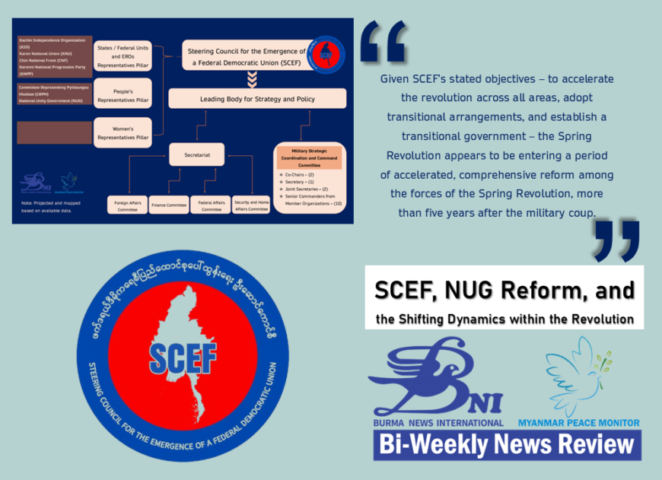
Established on 30 March 2026, the Steering Council for the Emergence of a Federal Democratic Union (SCEF) can be described as a new coalition that has renewed the hopes and aspirations of people supporting the Spring Revolution, more than five years after the military coup.
Structured around three pillars, SCEF’s six core political objectives show no significant divergence from earlier common positions, including the K2C+NUG 1 joint position statement issued on 31 January 2024, the nine-organization 2 position statement based on the Bottom-up Federalism approach released on 19 September 2024, and the 2C3N 3 joint statement published on 3 February 2025. However, SCEF has moved swiftly and proactively since its formation. The council has rapidly engaged with key resistance forces, introduced itself to resistance forces inside Myanmar and to people supporting the revolution within the international community, and sought to establish diplomatic inroads with foreign governments and diplomatic circles.
This issue of BNI-Myanmar Peace Monitor’s Biweekly News Review examines the emergence of SCEF, its structure and strategic direction, and the military and political prospects it may bring for greater alignment and joint action among resistance forces.
The Emergence of SCEF
The SCEF was established on 30 March 2026 with the stated aims of accelerating the revolution, approving transitional arrangements, establishing a transitional government, and taking practical steps toward building a federal democratic union across military, political, federal, and institutional fronts.
SCEF is organized around three pillars: the States/Federal Units and Ethnic Resistance Organizations Representatives Pillar; the People’s Representatives Pillar; and the Women’s Representatives Pillar. Ending all forms of dictatorship, including military rule, serves as SCEF’s strategic objective. The steering council declared that its establishment marks the beginning of a new political landscape capable of pragmatically and effectively advancing these political goals and positions.

According to the official announcement, the Kachin Independence Organization (KIO), Karen National Union (KNU), Chin National Front (CNF), Karenni National Progressive Party (KNPP), Committee Representing Pyidaungsu Hluttaw (CRPH), and National Unity Government (NUG) are recognized as founding member organizations, although the Women’s Representatives Pillar remains unfilled. On 13–14 August 2026, agreements were reached for the Sagaing Federal Unit and Mandalay Region to join SCEF as members.
In terms of representation across the three pillars, Pillar 1 (State/Federal Unit/ERO Representation) comprises four EROs and two federal units, while Pillar 2 (People’s Representation) consists of the CRPH and NUG. However, the Women’s Representatives Pillar, which is intended to serve as an institutional pillar, remains unfilled.
SCEF’s Engagements and Outreach
SCEF convened its first meeting online on 10 April 2026, attended by leaders of the Leading Body for Strategy and Policy, Secretariat members, and SCEF council members. Khu Oo Reh, Chairman of the Karenni National Progressive Party (KNPP) and the Interim Executive Council of Karenni State (IEC), was elected to preside over the meeting.
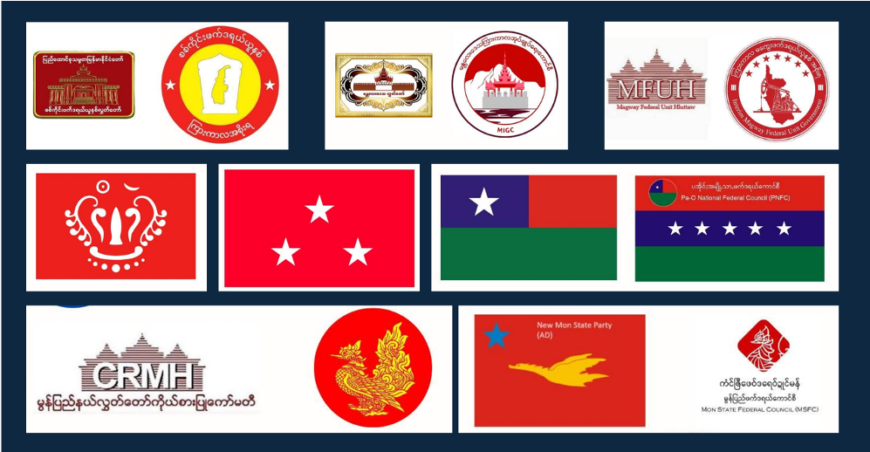
A series of consultations, coordination meetings, and engagements followed. These included meetings with the Sagaing Federal Unit Hluttaw and Interim Government on 13 May 2026; the Mandalay Regional Hluttaw and Interim Executive Council on 14 May; and the Magway Federal Unit Hluttaw and Interim Magway Federal Unit Government on 16 May. SCEF subsequently consulted with officials from the Spring Revolution Alliance (SRA) on 20 July; met with officials from the New Mon State Party (Anti- Military Dictatorship) (NMSP-AD), Mon State Federal Council (MSFC), Mon State Consultative Council (MSCC), and Committee Representing Mon State Hluttaw (CRMH) on 21 July; met with officials from the Pa-O National Liberation Organization/Pa-O National Liberation Army (PNLO/PNLA) and the Pa-O National Federal Council (PNFC) on 22 July; and consulted with officials from the United League of Arakan/Arakan Army (ULA/AA) on 23 July.
On 7 August 2026, SCEF’s Leading Body for Strategy and Policy and Military Strategic Coordination and Command Committee held a joint meeting, at which two co-chairs, one secretary, and two joint secretaries were appointed to the military committee.
On the diplomatic front, SCEF held a briefing on 6 June 2026 attended by diplomats and delegates from 24 countries, as well as representatives of international organizations. SCEF stated that the briefing was part of its ongoing efforts to foster constructive engagement with regional and international partners and explore avenues toward an inclusive, stable, and peaceful future for Myanmar. Subsequently, SCEF foreign affairs delegations visited Canada and Japan to introduce SCEF and conduct outreach among relevant government officials and Burmese diaspora communities.
Against this backdrop, SCEF’s stated commitment to coordinating the military and political activities of resistance forces under legitimate, unified, and accountable leadership has become an important development to watch.
SCEF’s Structure and Strategic Direction
According to Dr. Zaw Wai Soe, Minister of Health and Education of the National Unity Government (NUG), efforts to establish SCEF began as early as October 2022. The process took years due to differences in political cultures, military structures, and historical grievances among the organizations involved. Dr. Zaw Wai Soe, who also serves as an SCEF coordinator, noted that the K2C+NUG “Joint Position Statement on Eradicating Military Dictatorship and Building a Federal Democratic Union,” released on 31 January 2024, served as an initial step toward the establishment of SCEF. 4
Structurally, the Leading Body for Strategy and Policy – composed of seven senior delegates representing the member organizations – serves as SCEF’s highest decision-making body. Below it is the Secretariat, comprising 12 senior officials from the member organizations and entrusted with authority over SCEF’s activities. The Secretariat is supported by four committees –Foreign Affairs, Finance, Federal Affairs, and Security and Home Affairs – which are intended to facilitate coordination, equitable allocation of funds, and a unified voice on the international stage.
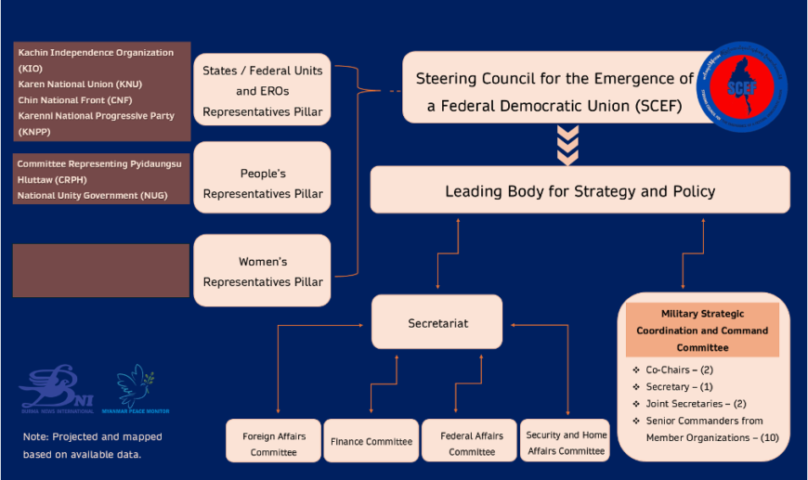
Operating alongside the Secretariat is the Military Strategic Coordination and Command Committee, composed of 10 senior commanders from member organizations. According to Secretariat member Dr. Zaw Wai Soe, the committee oversees military operations, weapons and equipment, and logistics and reports directly to the Leading Body for Strategy and Policy.
SCEF and Shifting Revolutionary Dynamics
The emergence of SCEF underscores the prominent leadership role of the Kachin Independence Organization (KIO), while the National Unity Government’s (NUG) role now appears to constitute one component within the broader SCEF framework. In this sense, SCEF’s emergence may also be viewed as partially reinforcing the NUG’s ongoing reform agenda.
Although the initial grouping comprised six organizations, including EROs, there are clear indications of broader participation by regional resistance forces. SCEF’s capacity for leadership, coordination, and trust-building will be tested as it seeks to unify and strengthen resistance forces exerting pressure on the military junta across both military and political affairs.
From a military perspective, the leadership of SCEF’s Military Strategic Coordination and Command Committee includes two co-chairs – the KIA Commander-in-Chief and the KNLA Commander-in-Chief – and a secretary, the NUG Union Minister of Defense. These individuals also serve as leaders of the Central Command and Coordination Committee (C3C), established jointly by the NUG Ministry of Defense (MOD) and four EROs.
Within the military dynamics of the Spring Revolution, the People’s Defence Force (PDF) operates under the direct command of its headquarters under the NUG Ministry of Defense (MOD); the C3C provides unified coordination; the 19-member Spring Revolution Alliance (SRA) operates collectively; and various local alliances coordinate their activities. Whether SCEF’s Military Strategic Coordination and Command Committee can harmonize and synchronize these key military formations across the Spring Revolution remains to be seen.
“Within the military dynamics of the Spring Revolution, the People’s Defence Force (PDF) operates under the direct command of its headquarters under the NUG Ministry of Defense (MOD); the C3C provides unified coordination; the 19-member Spring Revolution Alliance (SRA) operates collectively; and various local alliances coordinate their activities. Whether SCEF’s Military Strategic Coordination and Command Committee can harmonize and synchronize these key military formations across the Spring Revolution remains to be seen.”
Analysis
In fulfilling its role, SCEF maintains that sovereignty belongs to the people residing within the states and federal units, adhering to the principle of “Shared Sovereignty” between the federal level and constituent states and federal units. Under the principle of “collective leadership,” political decisions are intended to reflect the views of EROs, pro-democracy resistance forces, women’s organizat-ions, and people’s representatives.
Grounded in mutual respect and recognition of diversity, SCEF also adopts the principle of “One Policy, One Strategy,” seeking to balance military, political, and governance priorities while broadening political representation through sustained alliance coordination.
Therefore, SCEF’s emergence can be viewed not only as an impetus for NUG reform but also as a step toward greater military consolidation and coordination among resistance forces.
Given SCEF’s stated objectives – to accelerate the revolution across all areas, adopt transitional arrangements, and establish a transitional government – the Spring Revolution appears to be entering a period of accelerated, comprehensive reform among the forces of the Spring Revolution, more than five years after the military coup.
“Given SCEF’s stated objectives – to accelerate the revolution across all areas, adopt transitional arrangements, and establish a transitional government – the Spring Revolution appears to be entering a period of accelerated, comprehensive reform among the forces of the Spring Revolution, more than five years after the military coup.”
1. K2C+NUG : Chin National Front (CNF), Karenni National Progressive Party (KNPP), Karen National Union (KNU), and National Unity Government (NUG)
2. The nine-organization : CNF, KNPP, KNU, Karenni State Consultative Council (KSCC), Pa-O National Federal Council (PNFC), New Mon State Party–Anti-Dictatorship (NMSP-AD), Mon State Federal Council (MSFC), Ta’ang Political Consultative Committee (TPCC), and Women’s League of Burma (WLB)
3. 2C3N : Chin Brotherhood (CB), Committee Representing Pyidaungsu Hluttaw (CRPH), National League for Democracy (NLD), National Unity Consultative Council (NUCC), and NUG
4. Myanmar’s Resistance Finally Has a Unified Front,” The Diplomat, 13 Aug 2026