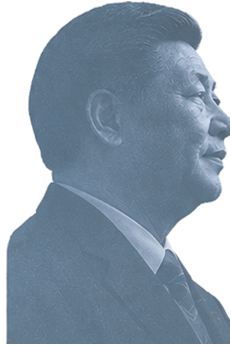
Some sarcastically call the country “the Chinese People’s Republic of Myanmar.” Others say Myanmar is in the palm of China’s hand. Both jibes point, obliquely, to China’s influence over and interference in Myanmar. Beijing, for its part, routinely insists that it does not interfere in Myanmar’s internal affairs.
Yet Foreign Minister Wang Yi has publicly laid down China’s three red lines on Myanmar and warned that they must be firmly upheld. On 15 October 2026, Deng Xijun, Special Envoy for Asian Affairs at China’s Ministry of Foreign Affairs, went further and again urged the exploration of models of “a high degree of autonomy” for ethnic minorities in Myanmar.
This week’s BNI-Myanmar Peace Monitor news review examines China’s increasingly frequent moves in Myanmar’s shifting military and political landscape, now more than five years into the coup, along with the direction Beijing has set and the reasoning behind them.
Beijing’s Call to the Junta
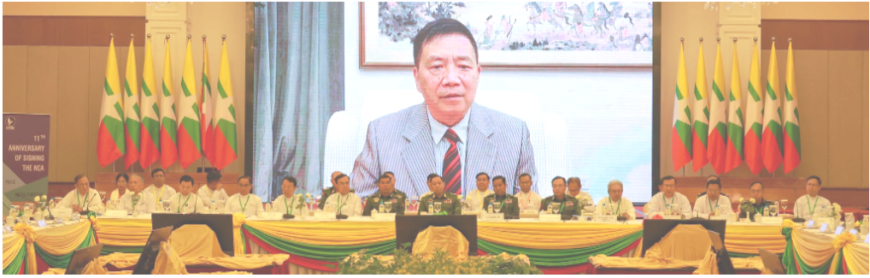
At a ceremony in Nay Pyi Taw on 15 October 2026 marking the 11th anniversary of the Nationwide Ceasefire Agreement (NCA), China’s Special Envoy for Asian Affairs used his speech to deliver a series of calls to all participating organizations, including the military.
Deng said China commended the recent talks between the regime and Ethnic Armed Organizations (EAOs), and hoped both sides would implement the relevant ceasefire agreements, explore models of a high degree of autonomy for ethnic minorities, and find appropriate solutions through dialogue. 1
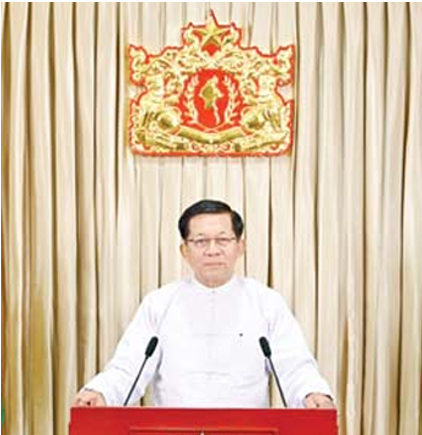
Whether by striking coincidence or by design, Deng’s remarks echoed several points in the opening speech of coup leader Senior General (Retd.) Min Aung Hlaing.
“There is a need to emphasize the principle that a state is not the property of a single ethnic group, but of all the ethnic groups living in that region. On the naming of states in a way that can represent all residents of a region, I would also urge everyone to work together to find a solution, with national unity in mind,” Min Aung Hlaing said. 2 He went on to cite an example:
“For example, it has been stated that Shan State, as designated by name, is only 35 percent Shan, and that Kachin State is likewise only 39 percent Kachin.”
The prospect of renamed states therefore appears to dovetail with the special envoy’s call (in effect, Beijing’s Call to the Junta) for models of a high degree of autonomy.
Behind the Call
In a coup that has yet to succeed, the junta has so far lost 85 towns across 10 states and regions to resistance forces, and most towns are encircled and under military pressure. This may well be what prompted Beijing’s push for “a high degree of autonomy” in the first place.
Apart from Hopang and Panlong, the two towns it was forced to hand over to the United Wa State Party (UWSP), Nay Pyi Taw has yet to accept the loss of any other town. Yet the loss of 14 of Arakan State’s 17 townships to the Arakan Army (AA) is too great to conceal, and shows that the generals are no longer in a position to reject Beijing’s terms.
Beijing’s call can therefore be read as paving the way for EROs, such as the Arakan Army (AA), the Kachin Independence Organization (KIO), the Myanmar National Democratic Alliance Army (MNDAA) and the Ta’ang National Liberation Army (TNLA), to formally retain the towns they have seized. It can equally be read as an exit strategy that would keep the regime in power.
The autonomy proposal can also be linked to the rise of the Steering Council for the Emergence of a Federal Democratic Union (SCEF), the newest coalition on the resistance side, which brings together Spring Revolution forces, including the National Unity Government (NUG), and EROs. The Chinese government and the military appear to have calculated that, if put into practice, the autonomy model could halt the SCEF’s momentum.
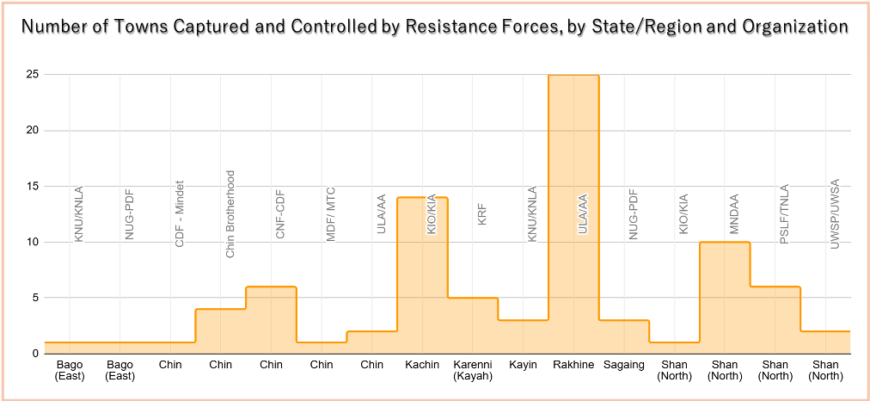
An examination of the towns seized and held by these resistance forces, by region and by organization, suggests that Beijing’s approach is likely to make relations among the conflict’s actors, the regime included, increasingly complex.
Separating the NUG and other Spring Revolution forces from the EROs does not lead toward a resolution of the conflict. Rather, it may simply serve to ease part of the pressure on the junta, which faces mounting military, political and international pressure on multiple fronts.
What Beijing Expects
Deng Xijun said that China stands ready to work with Myanmar to: implement the important agreements reached by the leaders of the two countries; advance key projects under the economic corridor while ensuring security and safety; promote high-quality Belt and Road cooperation; and deepen efforts to build a China–Myanmar community with a shared future.
Notably, he added that China would continue to maintain an impartial position and provide the necessary assistance to Myanmar’s peace process in line with the wishes and expectations of the relevant parties.
Beijing’s military-centered approach thus appears designed to protect its economic and strategic projects in Myanmar while brokering an accommodation between the regime and EROs whose territorial control keeps expanding. What remains unclear is whether Beijing has left the NUG and other Spring Revolution forces resisting the junta entirely for the junta to deal with.
Efforts to keep the EROs and Spring Revolution forces apart, and to drive a wedge between them, are unlikely to resolve Myanmar’s conflicts. They risk deeper fragmentation and a wider, more intense conflict. In particular, they do little to uphold the first of Wang Yi’s three red lines 3: that “Myanmar must not descend into internal instability or civil war.”
Analysis
Beijing has been propping up the junta to enforce its other two red lines: that Myanmar must not drift away from the ASEAN family, and that outside forces must not be allowed to infiltrate and interfere at will. Its efforts to shore up the regime include: backing a sham election to help the junta recast itself as an elected government; the Chinese president’s public engagement with Senior General (Retd.) Min Aung Hlaing, who has gone from coup leader to transitional president; and brokering talks that rescued the army from heavy losses and collapse during the first and second phases of Operation 1027. Beijing should recognize that none of these efforts can de-escalate or end Myanmar’s armed conflict.
It is equally doubtful whether the Min Aung Hlaing’s regime genuinely intends to follow Beijing’s lead. Its overtures to governments at odds with China, such as Japan and the United States, indicate otherwise. Nor should it be forgotten that the military, having monopolized state power for decades in its own interests, has consistently acted with a single aim: preserving its grip on power.
If Beijing wants a Myanmar on the path to lasting peace, stability and an end to conflict, it should rethink an approach built around the generals. Recognizing and engaging with the alliances formed by the NUG, the EROs and other resistance forces would be a surer way to secure the safety and viability of China’s economic and strategic projects in Myanmar.
Beijing must also recognize that the shared political goals of the resistance forces, EROs included (ending military dictatorship and building a Federal Democratic Union), have become factors it can no longer ignore. The junta’s mindset, which casts even airstrikes on civilians as attacks “for the sake of peace,” is deeply alarming. Airstrikes near Chinese businesses and economic zones show that this is a risk Beijing cannot afford to overlook.
1. Junta will have to accept China’s call to explore models of a high degree of autonomy for ethnic groups, says CDM Captain Zin Yaw, Narinjara, 17 Oct 2026
2. Junta chief calls for state names to be redesignated, BNI-MPM, 17 Oct 2026
3. No party should interfere in Myanmar’s internal affairs, warns China, Anadolu Agency, 18 Aug 2026