
Japanese carmaker ISUZU is shutting down its operations and leaving Myanmar. UK consumer goods giant Unilever has announced it will sell its entire stake in its Myanmar joint venture and exit, and Italian telecoms and technology firm SIAE Microelettronica is dissolving its local subsidiary, SIAE Microelettronica Myanmar Company Limited.
Throughout November 2026, foreign investors have pulled out of Myanmar and domestic companies have closed at an increasing pace. Meanwhile, reports that the junta plans to print large amounts of new banknotes have sent the kyat sharply lower, deepening hardship for the public.
This issue of BNI-Myanmar Peace Monitor’s Bi-Weekly News Review examines the warning signs that Myanmar is heading toward state failure, as reflected in the junta’s current crisis and the hardships facing the people of Myanmar.
Foreign Companies Leaving Myanmar
ISUZU Truck Service Factory, operating under Japan’s Itochu Corporation, announced on 14 November that it will hold its final general meeting on 13 December as part of the liquidation process to wind down all of its operations in Myanmar. In Myanmar, the company manufactured machinery and equipment; produced motor vehicles, trailers and semi-trailers; and sold and repaired motor vehicles and motorcycles. As ISUZU is a group that manufactures and distributes vehicles and machinery in more than 100 countries, its departure means Myanmar and its people have lost the benefits it brought. 1
Unilever, a UK-based manufacturer and distributor of consumer and household goods, is reportedly selling all of its shares in its Myanmar joint venture to its local partner and leaving the country. Unilever had previously suspended its operations and left Myanmar after 1965, under the government of former military dictator General Ne Win, citing the domestic political situation. Forty-five years later, in 2010, during Myanmar’s political transition, it returned to the Myanmar market by importing goods through Thailand. In 2013, it formally registered in Myanmar, set up a head office and manufacturing plants, and fully resumed operations. In 2017, it partnered with the local conglomerate Europe & Asia Commercial (EAC) to establish Unilever EAC Myanmar Company Limited (UEMCL), becoming one of the country’s largest consumer goods businesses. 2
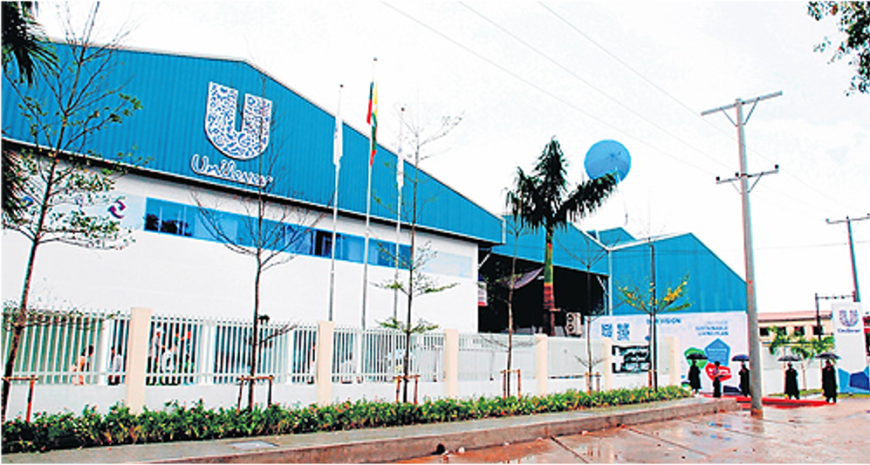
With Unilever’s exit, brands long familiar to Myanmar consumers – Sunsilk and Miss shampoos, Family Care and Lifebuoy body soaps, Elan and Win detergent powders, Signal toothpaste, Fair & Lovely face cream and Knorr chicken powder – can no longer be produced locally. Shortages are likely, and prices are expected to rise as these products will have to be imported from countries such as Thailand.
According to available data collected by BNI-MPM, nearly 40 companies have left or are trying to leave Myanmar since the coup, citing the political instability that followed it, the spread of armed conflict, and the collapse of a business environment in which companies can operate normally. These are companies from 16 countries, including Western countries such as the United Kingdom, Spain, Germany, Austria, the United States, Italy and Norway, as well as neighboring countries in the region such as Thailand, Malaysia and India.
By sector, the departing businesses include offshore oil and gas, energy and gas-fired power generation, mining, banking, automobiles, cement, high-end housing, and telecommunications and technology, as well as beverages, microfinance, garments, cosmetics, household goods and food. In particular, the withdrawal of cut-make-pack (CMP) orders by 12 global fashion brands – including Uniqlo, Mango, H&M, Inditex (Zara) and Primark – from Myanmar’s garment industry has hit garment factory workers hard.

The withdrawal of these foreign companies directly affects the country’s economic development and people’s access to jobs. It has also partly cut into the junta’s foreign currency earnings, putting it under further strain.
Junta in Crisis, Public in Hardship
Weakened by military, political and international pressure from anti-coup resistance forces since the coup, the junta led by Senior General Min Aung Hlaing (Ret.) is finding it ever harder to hide the decline in the country’s economic indicators.
Showing no concern for the soaring prices of basic goods – an egg now costs K700 and a bunch of water spinach K1,000 – and worried instead that its military budget will fall short, the junta has requested an additional K2,500 billion (K2.5 trillion) on top of the defense budget it originally sought for the 2026–2027 fiscal year.
As a result, the junta’s military spending for the 2026–2027 fiscal year has risen to more than K10 trillion, nearly four times the level under the previous National League for Democracy (NLD)-led government. 3 With the junta relying on airstrikes alone to counter military pressure from resistance forces across the country, its crisis has arguably reached a point where it can no longer be hidden. This is precisely why, instead of addressing the soaring prices and scarce jobs the people face, it has repeatedly printed money through the Central Bank of Myanmar. As a consequence, the kyat has plunged, with one US dollar now trading at more than K5,000 and one Thai baht at more than K150.
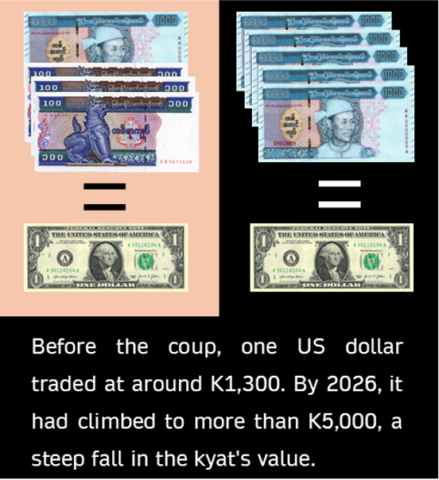
Just as the junta is trying to gain the upper hand in its domestic military crisis by stepping up airstrikes, it is trying to deal with its economic crisis – a collapsing kyat and runaway prices – only through short-term fixes, such as printing money and borrowing even from authoritarian states like Belarus.
The people of Myanmar, therefore, face not only the junta’s forced conscription but also general prices that rise day by day. Worse still, people in areas beyond the junta’s control live in constant fear, day and night, of near-daily aerial bombing.
Warning Signs of a Slide Toward State Failure
According to the latest Fragile States Index (FSI-2024) published by the US-based Fund for Peace (FFP), Myanmar currently ranks 11th in the world, scoring 1.9 points higher than even Ethiopia, and falls within the index’s High Alert category.
The FSI assesses countries across four broad categories – political, economic, social and cohesion – using 12 indicators: Security Apparatus, Factionalized Elites, Group Grievance, Economic Decline, Uneven Economic Development, Human Flight and Brain Drain, State Legitimacy, Public Services, Human Rights and Rule of Law, Demographic Pressures, Refugees and IDPs, and External Intervention. Each indicator is scored out of 10, and the higher the score, the greater a country’s instability and vulnerability.
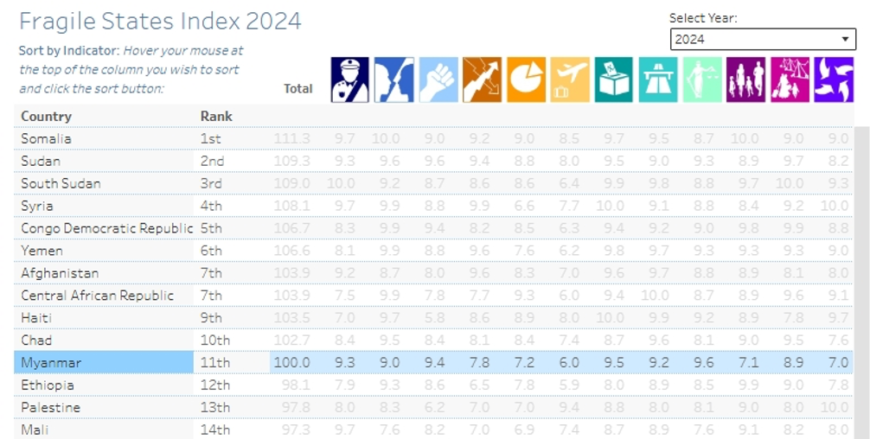
According to the FSI’s 2024 annual report,4 Myanmar’s high scores – Human Rights and Rule of Law (9.6), State Legitimacy (9.5), Group Grievance (9.4), Security Apparatus (9.3), Public Services (9.2), Factionalized Elites (9.0), Refugees and IDPs (8.9) and Economic Decline (7.8) – reflect the situation on the ground in Myanmar today.
In particular, the military’s violent attacks on civilians, arrests and torture, punishment without due process, human rights violations, airstrikes, the burning of civilian homes and infrastructure, and restrictions on freedom of expression and basic civil rights have continued from the start of the coup to this day.
In addition, disputes over political authority – weak public trust and acceptance, the lack of a credible political process, and weak representation and accountability in governance – together with rival administrations and competing claims to political legitimacy, have called into question the legitimacy of the state and the strength of its governing institutions. In particular, control over political power no longer matches public acceptance and trust, while disagreements and grievances continue to grow.
The spread of armed conflict across the country has disrupted production, trade and business. The exit of investors, shrinking job opportunities, rising prices, and the gap between household income and expenditure are all part of the signs pointing toward state failure.
Analysis
Since the coup, armed conflict in Myanmar has spread and intensified, and the junta’s airstrikes and violence have grown ever more extreme. At the same time, the exit of foreign investors, domestic firms struggling to survive across all sectors, mass money printing and soaring prices are plain for all to see.
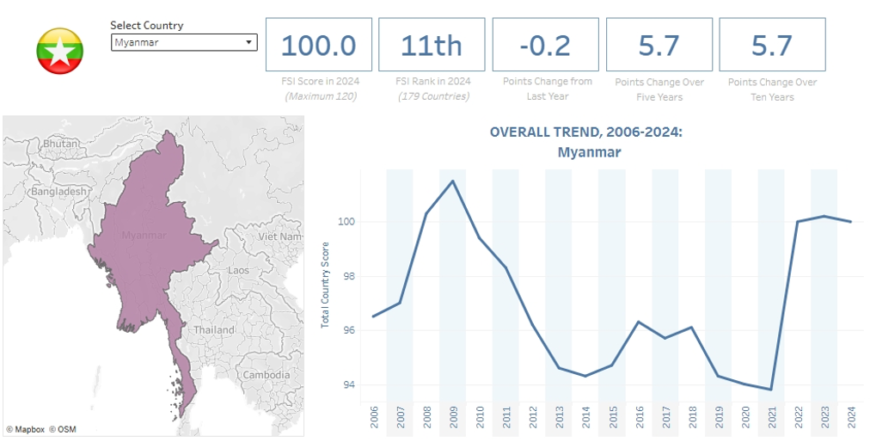
According to FSI-2024, Myanmar’s scores have risen across all 12 political, economic, social and security indicators, leaving the country in an alarmingly vulnerable position. In particular, after the coup led by Senior General Min Aung Hlaing (Ret.), the country’s index scores and global ranking reached as high as 10th place. This can also be seen as a consequence of the increasingly complex political power struggles, armed conflicts and disputes over governing authority and political legitimacy since the military coup of 1 February 2021, as well as the deepening and entrenched socioeconomic and humanitarian crises.
Given these consequences, all stakeholders, including the junta, need to take seriously the warning signs and index scores pointing toward state failure and work toward stabilizing and restoring the country. Such efforts should not prioritize ceasefires and security solutions alone; they must also address, at the same time, political power-sharing, ethnic equality, the building of a federal democratic union, the protection of human rights and the restoration of public services.
1. Japan’s ISUZU to exit Myanmar, The Irrawaddy, 16 Nov 2026
2. UK-based consumer goods giant Unilever confirms exit from Myanmar, Myanmar Now, 6 Nov 2026
3. Parliament approves junta’s record defense budget request, Than Lwin Times, 6 Nov 2026
4. Fragile States Index 2024: Annual Report, FFP, 18 Feb 2025