The SCEF: A New Collective Leadership to Watch
The National Unity Government (NUG), the Committee Representing Pyidaungsu Hluttaw (CRPH), and four Ethnic Resistance Organizations (EROs) have jointly established the Steering Council for the Emergence of a Federal Democratic Union (SCEF). According to a statement released on 30 March, the four EROs include the Kachin Independence Organization (KIO), the Karen National Union (KNU), the Karenni National Progressive Party (KNPP), and the Chin National Front (CNF).
Building on existing shared political agreements, SCEF has set six political goals. The SCEF is structured around three pillars representing states/federal units/EROs, the people, and women. In its operations, the committee will uphold the principle of “Shared Sovereignty” between the federal level and states/federal units, asserting that sovereignty belongs to the people residing within those units. The SCEF states that political decisions will be made through “Collective Leadership,” reflecting the views and perspectives of EROs, pro-democracy resistance forces, women’s groups, and people’s representatives.
Furthermore, SCEF member organizations will adopt a “one policy, one strategy” approach, grounded in mutual respect and recognition of diversity — coordinating action across military, political, and administrative sectors.
The SCEF aims to advance the current revolution to the next stage by approving transitional arrangements to form a transitional government. The SCEF also aims to coordinate military, political, federal, and institutional affairs to advance the federal democratic union-building process.
The SCEF may well prove to be a significant new collective leadership body that warrants close attention.
The Junta’s Cosmetic Changes
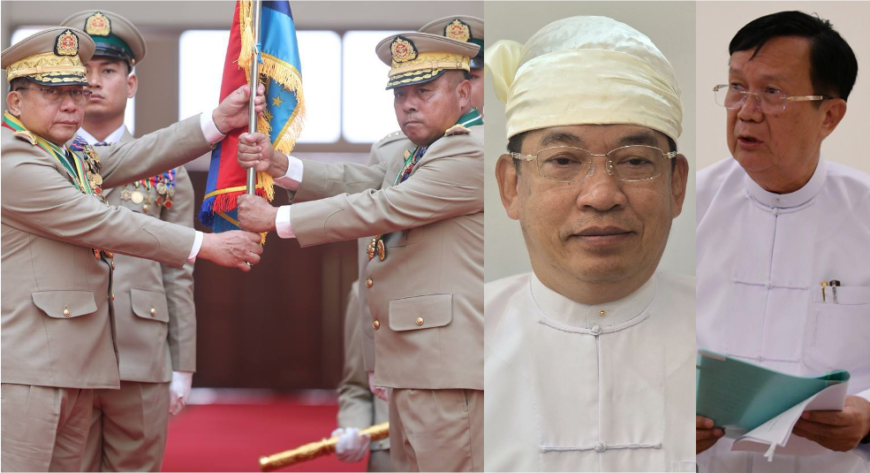
Meanwhile, following its sham election and as widely anticipated, the junta named retired Senior General Min Aung Hlaing as President. Retired General Nyo Saw, who served as Union Prime Minister after the coup, was installed as Vice President (1).
An examination of the junta’s administrative structure following the sham election reveals that the junta leader personally heads the executive branch. In the legislative sector, leadership roles were assigned to retired Brigadier General Khin Yi-USDP Chairman and former Police Chief-and General Aung Lin Dwe, a senior figure closely relied upon by the junta leader since the coup.
The junta leader has proposed a cabinet of 31 ministries to the Union Parliament, while the heads of the Union Election Commission, Constitutional Tribunal, Chief Justice, and Attorney General have been retained in their posts.
Although the junta leader has retired as Commander-in-Chief of the Defense Services, he has reportedly made arrangements to maintain control over the new Commander-in-Chief, General Ye Win Oo, and the new Deputy Commander-in-Chief, General Kyaw Swar Lin, both of whom were handpicked by him. Consequently, the shifts following the junta’s sham election show no significant changes in terms of key figures.