Introduction
The beginning of 2025 was marked by significant military and political shifts that established a unique opening for the year. These developments were driven by the increasing military momentum of resistance forces, capturing junta’s positions and towns as they fought to dismantle the military dictatorship.
As the military junta showed increasingly clear signs of defeat, other pivotal changes occurred, including changes within the National Unity Government (NUG), new political maneuvers by the United League of Arakan/Arakan Army (ULA/AA), and the convention of Ngwe Saung discussions by domestic politicians. These factors combined to create a powerful momentum that continued throughout the year, leading to new alliance formations among resistance groups and more defined post-2025 strategies from the military junta.
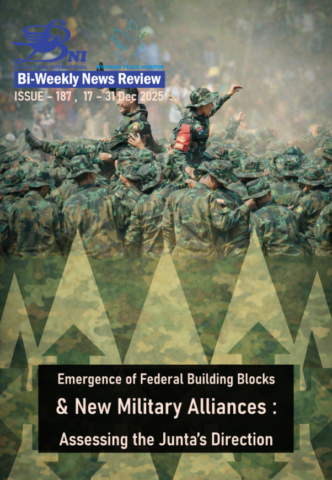
This issue of BNI-Myanmar Peace Monitor’s Bi-Weekly News Review examines findings regarding military and political formations in 2025 a year that was unique in both its beginning and its end as well as the scenarios expected to see beyond 2025.
Emergence of Federal Building Blocks and New Military Alliances
Within the movement to establish a Federal Democratic Union, the National Unity Consultative Council (NUCC) stands out at the vanguard, encompassing elected representatives, political parties, and Ethnic Resistance Organizations (EROs).
However, by the end of 2025, the NUCC’s internal dynamics shifted significantly as several key groups, including the Chin National Front (CNF), the Karen National Union (KNU), the Karenni National Progressive Party (KNPP), and the Committee Representing Pyidaungsu Hluttaw (CRPH), withdrew from the council. [1]
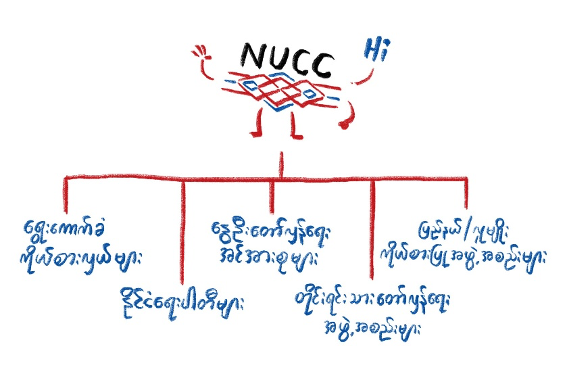
As a result, the role of the NUCC has noticeably changed, and its unifying strength has weakened.
As a notable development, a group of nine organizations, including the Women’s League of Burma (WLB), EROs, and state/federal unit councils that were members of the NUCC, jointly announced their agreement on the “Bottom-up Federalism” approach, which focuses on the strengthening of a future Federal Democratic Union, emphasizing that “a strong Union comes from strong individual states”.
On 3 February 2025, the Chin Brotherhood (CB), CRPH, NLD, NUCC, and the NUG jointly issued a declaration acknowledging and endorsing the “Bottom-Up Federalism” work plan and agreements. At the same time, the groups accepted the “Six Political Objectives” agreed upon between the Kachin Independence Organization (KIO), CNF, KNU, KNPP, and the NUG for ending the military dictatorship and building a federal democratic union. [2]
Parallel to these political shifts, various regions have made strides in establishing interim governance and administrative mechanisms based their ethnic groups and territories. The Karenni State Interim Executive Council (IEC) has successfully operationalized its administrative and judicial systems and social services.
The Ta’ang Land Council was formed under the leadership of the Palaung State Liberation Front (PSLF/TNLA) [3], while the KNU has moved toward establishing the Kawthoolei State and a Kawthoolei Government in Kawthoolei territory [4]
In central Myanmar, interim governance bodies such as the Mandalay Interim Governing Council (MIGC) [5] and Sagaing Federal Unit Interim Government have also been established through the efforts of elected 2020 lawmakers. [6]
On the military front, the formation of the Spring Revolution Alliance (SRA) comprising 19 local resistance groups across the country marked a significant close to 2025 and reflects the unifying strength of the resistance beyond 2025. [7]
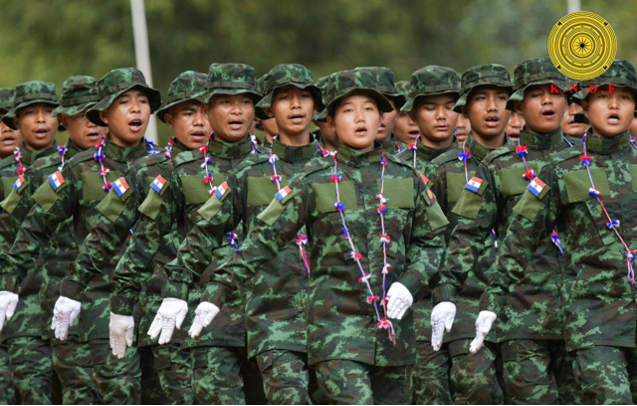
The military alliance aims to unify decentralized local groups that operate outside the direct command of the NUG or EROs, facilitating coordinated offensives against the military junta. If the three command structures ERO command, NUG command, and SRA command can coordinate, the momentum of the revolution could even become stronger.
The Military Junta: Where is it Headed?
The military coup led by Senior General Min Aung Hlaing which attempted to annul the results of the 2020 general elections has remained unsuccessful even as it approaches its fifth year.
The junta continues to face peaceful resistance throughout the country. In addition, the junta is suffering significant defeats as it faces resistance offensives from Ethnic Resistance Organizations (EROs) opposing to the coup and from People’s Defense Forces that emerged with the Spring Revolution.
The military junta has lost hundreds of military positions and over 90 towns to resistance groups, along with thousands of soldiers. It faces noticeable losses on all fronts, international pressure including from China and isolation from the international community including ASEAN. Consequently, with China’s nod, the junta has begun conducting its sham elections in three phases. [8]
In these elections, military officers, including generals who were themselves complicit in the coup, were made to contest through the Union Solidarity and Development Party (USDP). The results of the first phase held on 28 December 2025 suggests that the post-election “elected government” will likely be led by the coup maker, Senior General Min Aung Hlaing himself. Subsequently, they are expected to repeatedly use the term “elected government” in an attempt to wedge their way back into the international community through any available channels.
Meanwhile, the military junta’s daily aerial attacks and bombings across the country, forced conscription of civilians to replenish its troop strength, arbitrary arrests, and other atrocious acts show no signs of stopping. Finally, the release of President U Win Myint and State Counsellor Daw Aung San Suu Kyi, who have been unjustly detained since the 1 February 2021 coup, depends solely on Senior General Min Aung Hlaing, the coup maker.
Analysis
Examining the new alliance formations, approaches, and developments among the resistance forces in 2025, in the period beyond 2025, the shape of federal entities the federal building blocks could become more defined. At the same time, other resistance groups are likely to fully participate in the “Six Political Objectives” and the “Bottom-up Federalism” approach. Furthermore, coordinated military offensives against the military junta are likely to strengthen across the country.
For the junta, even if it transforms into an “elected government” through sham elections, its true nature will remain unchanged. Without any genuine intention to withdraw from politics, relinquish power, or engage in a genuine transition, the military regime will not change its true colors.
Moreover, regaining public trust lost over five years of military rule will remain far more challenging for the junta than reclaiming lost military equipment, bases, villages, roads, and towns.
Therefore, it is crucial that foreign governments and international organizations, including China, avoid actions, engagements, and recognition that would potentially prolong the life of the Myanmar’s junta led by Senior General Min Aung Hlaing.
Instead, they should prioritize practical approaches that can protect the security and survival of the people of Myanmar. In particular, pressuring an end to the regime’s aerial attacks would reduce public fear and increase securing more effectively the supporting the sham elections.
In the Myanmar military and political landscape beyond 2025, no significant change is seen in the junta’s rule following the elections; the junta’s terrorist acts against its own people opposing the coup will likely continue.
On the resistance front, however, common agreements including the withdrawal of the military from politics bottom-up political approaches, the emergence of regional federal entities, and new military formations aimed at dismantling the regime are already clearly visible.
Therefore, it is critical that domestic and foreign forces seeking solutions to the ongoing crisis, including the Chinese government, view and approach these realities truthfully. Ultimately, resistance actions will continue for as long as the military regime clings to power.
[1] CRPH temporarily suspends its role in NUCC, Burma VJ, 14 Jan 2026
[2] Six Political Objectives and a Future Myanmar, BNI-MPM, Feb 2025
[3] Formation of Ta’ang Land Council, Ta’ang Revolution’s Dynamics, and PSLF/TNLA’s Role, BNI-MPM, Jun 2025
[4] Formation of Kawthoolei Government and the KNU’s Military-Political Shifts, BNI-MPM, Jul 2025
[5] Formation of the Mandalay Interim Governing Council (MIGC), 28 Nov 2025
[6] Formation of the Sagaing Federal Unit Interim Government, 23 Dec 2025
[7] Appointment of Prime Minister for Interim Magway Federal Unit, 26 Dec 2025
[8] Junta elections conducted with Xi Jinping’s approval, says Chinese diplomat, Myanmar Now, 30 Dec 2025