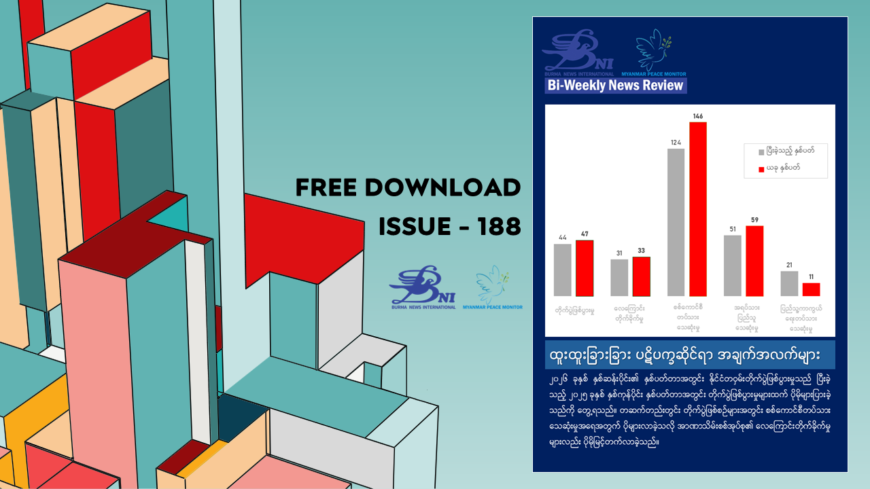
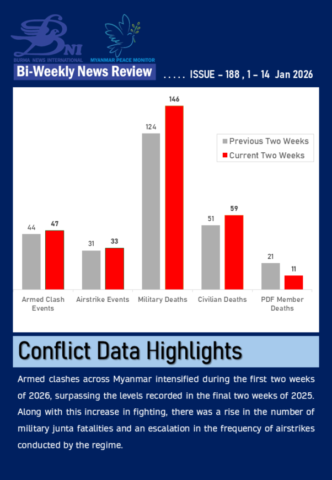
Armed clashes across Myanmar intensified during the first two weeks of 2026, surpassing the levels recorded in the final two weeks of 2025. Along with this increase in fighting, there was a rise in the number of military junta fatalities and an escalation in the frequency of airstrikes conducted by the regime.
A major engagement occurred in Arakan State between the military junta and the Arakan Army (AA). The clash took place on the Arakan Mountains crossing between Toungup and Padaung townships, specifically between Point (666) and the defense equipment factory No.16 (KaPaSa-16). Approximately 25 junta soldiers, including a Lieutenant Colonel, were killed, representing the most significant attrition of junta personnel recorded within this reporting window.
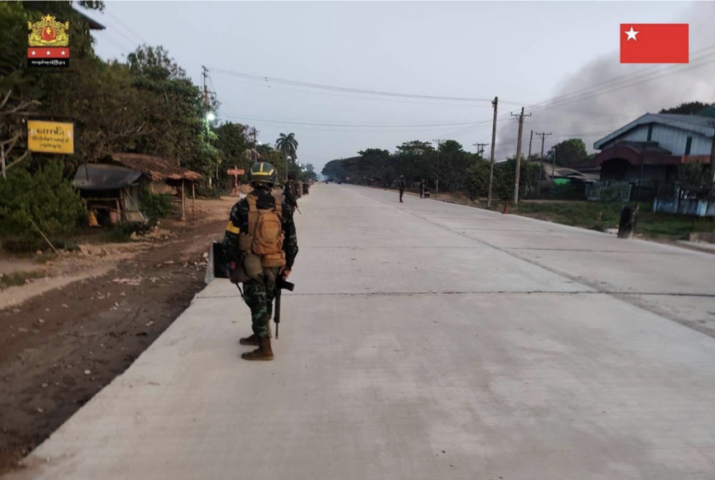
In the Bago Region, People’s Defense Force (PDF) and Special Commando battalions under the National Unity Government (NUG) attacked junta troops marching near Kyein Khar Kone village. About 20 junta soldiers, including a battalion commander with the rank of Major, were killed. The military responded on 12 January with airstrikes and heavy artillery, forcing residents to flee.
On 14 January 2026, around 7 a.m., artillery fired by Light Infantry Battalion 307 (LIB-307) killed a 78-year-old man and his 70-year-old wife in Hpa Yar Kone village; their 16-year-old grandchild was also injured.
Over the two-week period, the number of junta’s airstrikes increased, with Sagaing and Mandalay regions in Central Myanmar being the most heavily targeted.
In Sagaing Region, the junta conducted bombings across multiple townships, including Khin-U, Chaung-U, Yinmabin, Wetlet, Kanbalu, Budalin, Kyunhla, Ye-U, Mawlu, Indaw, and Katha. There events resulted in 21 civilian deaths and 56 injuries. Villages, schools, and religious sites were identified as the primary targets of these attack airstrikes.
In summary, the data from the first two weeks of January 2026 indicates that resistance offensive operations are gaining strength. Analysis by region shows that areas including Tanintharyi, Arakan, Magway, and Eastern Bago experienced five or more conflict events. Clashes were also recorded in Chin, Mon, Southern Shan, Nay Pyi Taw, Mandalay, Karen, Karenni (Kayah), Kachin, and Ayeyarwady.
The occurrence of conflict events in 14 states and regions including Nay Pyi Taw Union Territory reveals the significant geographic expansion of the resistance’s operational reach.