Introduction
In recent days, 19 resistance groups have come together and formed a fresh military alliance called ‘Spring Revolution Alliance (SRA)’ with a shared objective of bringing about a broad and robust allied force along with an effective chain of command. The alliance members have pledged and signed to implement political and military objectives, goals, and processes through unity in order to end the military dictatorship and ultimately establish a federal democratic system.
This week’s BNI-Myanmar Peace Monitor’s Bi-Weekly News Review examines the formation of the SRA, its member groups, and its nationwide geographic reach.
Formation of the Spring Revolution Alliance

The core of the alliance began in May 2025 with negotiations between seven resistance groups. The movement grew stronger, and by the first week of November, an initial meeting was held with 14 resistance groups. Following common agreements, a convention for the formation of the alliance was held from 21 to 23 November, where additional groups were invited.
During this convention, the SRA was successfully formed with 19 member groups. On 15 December 2025, the SRA officially announced that it had approved its organizational structure, set forward plans, and signed revolutionary pledges. The alliance stated it will continue to invite other Spring Revolution forces that are not yet members, in accordance with established policies.
With the aim of strategically repelling the terrorist acts of the military junta against the entire population of Myanmar, on 23 November 2025, members signed four revolutionary pledges to fight until the people’s desires for federal democracy, human rights, gender equality, justice, and peace are achieved.
SRA Members’ Geographic Reach
The 19 members of the Spring Revolution Alliance include: 96 Soldiers PDF, Bamar Army (BA), Burma Liberation Democratic Force (BLDF), Bamar People’s Liberation Army (BPLA), Chin Brotherhood (CB), Danu People’s Liberation Front (DPLF), Force for Federal Democracy (FFD), Generation Z Army (GZA), Karenni Nationalities Defence Force (KNDF), Kale Region Force (KRF), Magway People’s Defence Force (Magway PDF), Mon State Revolutionary Force (MSRF), National Liberation Army (NLA), People’s Liberation Army (PIA), Pa-O National Defence Force – Kham Kaung (PNDF-KK)/Pa-O People’s Defence Force – Kham Daung (PPDF-KD), Sagaing People’s Defence Force (Sagaing PDF), Student Armed Force (SAF), Yaw Army (YA), and Yaw Defence Force (YDF).
Examining these alliance members’ areas of operation reveals that they have the capability to deploy and connect across the entire country. The DPLF, PNDF-KK/PPDF-KD, and PIA can collaborate with local resistance groups from the Danu Self-Administered Zone in southern Shan State toward the Karenni (Kayah) border. They can extend operations as far as Nawnghkio in northern Shan State and Mogoke Township in Mandalay Region. In Karenni (Kayah) State, KNDF, FFD, and PIA are active, with KNDF leading local forces to pressure the military junta.
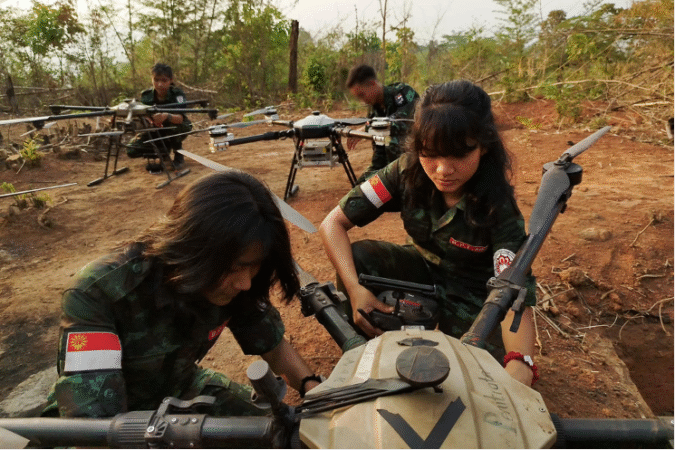
In Karen State, BPLA, 96 Soldiers PDF, and FFD have gained significant combat experience under the leadership of the KNLA. In Mon State, MSRF works effectively with other local groups and participated in “Operation Thunderbolt 2” alongside ABSDF Battalion 1, Dawei District PDF Battalion 2, and the Tavoy People’s Liberation Force (TPLF).
In Central Myanmar, over 10 SRA members are active in Mandalay, Magway, and Sagaing. Groups like the BA, BPLA, Magway PDF, and others are exerting the strongest pressure on the junta in these areas. These groups gained experience in capturing junta’s military positions and towns during “Operation 1027” and similar battles in Sagaing, Chin, Arakan, and Karen states. Notably, SRA members like 96 Soldiers PDF, GZA, KRF, NLA, and YDF assisted the Chin Brotherhood (CB) in capturing towns across Chin State.
Furthermore, SRA groups have so far received support and recognition as allies from major Ethnic Revolutionary Organizations (EROs) such as the Kachin Independence Army (KIA), Karen National Union (KNU), Karenni Army (KA), Ta’ang National Liberation Army (TNLA), Myanmar National Democratic Alliance Army (MNDAA), and Arakan Army (AA). They have launched multiple offensives against the military junta under the leadership of these EROs.
According to SRA spokespersons, the combined troop strength of all SRA members is nearly 15,000, and they believe they can deploy and operate nationwide in coordination with the resistance forces in the respective regions.
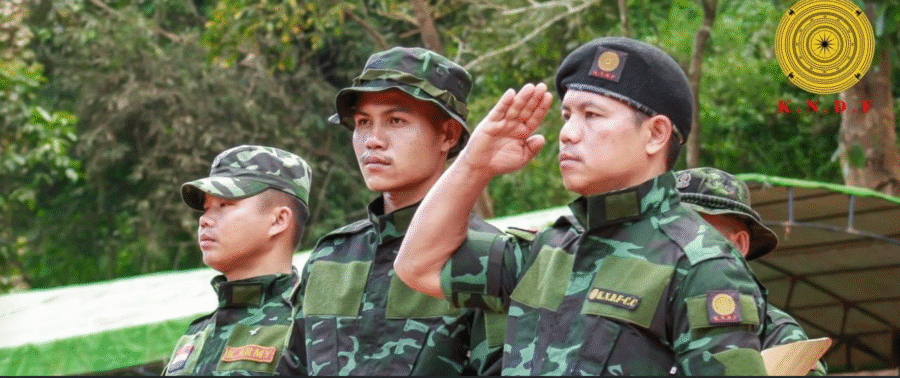
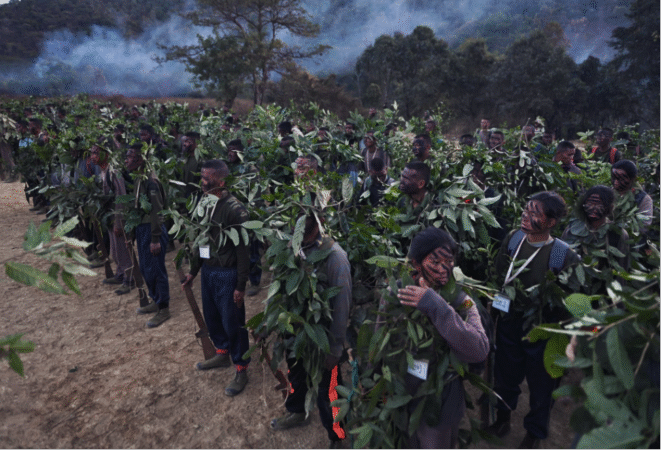
KNDF Commander-in-Chief Khun Bedu, an SRA spokesperson, stated that military plans will target the junta’s main mechanisms while minimizing civilian casualties. [1]
While the alliance seeks to expand, it specifically targets resistance groups that are not currently under the command of EROs or NUG. SRA spokesperson Ko Min Han Htet noted that they have discussed this with the NUG and some EROs, receiving welcoming views. [2] Khun Bedu believes at least 10 more groups will join as new members.
Analysis
The SRA is managed by a committee of representatives from member groups who decide on work plans and military operations. Given its consolidation of resistance groups that are not under the command of EROs or the NUG, the SRA can be described as a new collective command structure of resistance groups that will put the military junta in a tight spot.
Nevertheless, the 15 December announcement captured public interest like a ray of light in the darkness. Other revolutionary forces have shown support and a desire to join hands. The SRA opens a new path for scattered local groups to organize in a timely manner. For groups that were weakening or facing the risk of surrendering to the junta, this alliance provides new strength.
If the three collective command structures the ERO command, the NUG command, and the SRA command can coordinate their military operations in a synchronized manner, the military momentum of the Spring Revolution forces could become powerful and far-reaching. While large-scale nationwide operations may not appear overnight, this unity represents a significant challenge to the military junta as it prepares for sham elections.
On behalf of the alliance, Ko Min Han Htet pledged that the alliance would march forward until victory is achieved, as proclaimed in the slogan “We will celebrate victory through the alliance.”
[1] “We came together as an alliance so that individual groups do not end up surrendering to the military,” Khun Bedu (SRA spokesperson, KNDF Chairman), Mizzima, 16 December 2025
[2] “We believe larger-scale and more extensive operations will emerge.”, Myanmar Now, 16 December 2025.