Introduction
Four years have passed since the call to wage the nationwide ‘people’s defensive war’ in Myanmar. National Unity Government (NUG) Acting President Duwa Lashi La has stated that during this four-year period, the revolution has navigated through various political twists and turns, ups and downs, and continue to move forward in a “two steps forward, one step back” pattern.
This week’s BNI-Myanmar Peace Monitor takes a look at the shifts and progress of the armed resistance struggle after four years, based on events and data.
Report on 4th Anniversary of the ‘People’s Defensive War’
On 7 September 2025, the NUG’s Ministry of Defense (MOD) released its “Report on the 4th Anniversary of the ‘People’sDefensiveWar’.” The report highlights the losses suffered by the military junta and the territorial control achieved by resistance forces as key developments over the four-year period.
Politically, resistance forces have unanimously rejected the military’s leading role in politics, declaring they will not accept anything, including elections under the 2008 Constitution or peace talks like the Nationwide Ceasefire Agreement (NCA). Instead, the resistance forces resolutely committed to fighting for a systemic change. Additionally, the report states that the junta’s loss of public support and trust, and the loss of their primary combat forces during military conflicts, reaching a point where these losses can no longer be concealed.
By the end of 2024, the military junta had lost a total of 173 military bases, including two Regional Military Commands, one Regional Operations Command, five Military Operations Commands, six tactical operations bases, two air force detachments, 86 rear positions, 54 rear positions, and 17 border guard posts.
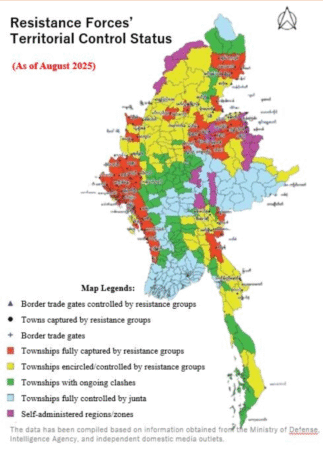
The report also states that, as of 7 September 2025, the junta lost an additional ten battalion headquarters. The report also details the losses of thousands of junta troops, police, and border guard personnel, as well as military aircraft and helicopters shot down by resistance groups. 1
In terms of territorial control, the report states that allied ethnic resistance rganizations, the People’s Defense Force (PDF), and People’s Defense Teams fully control 16% of the country’s townships and have encircled and controlled an additional 24% of townships. Ongoing armed clashes are occurring in 21% of the total townships, leaving the military junta in control of only 39% of the total townships nationwide.
Furthermore, the report highlights the strategic importance of the resistance forces’ control over key routes stretching from the eastern Chinese border to the western Indian border in northern Myanmar. It notes that resistance forces have full control of 11 border trade towns — Kan Paik Ti, Laiza, Lwegel, Namhkan, Pang Hseng (Kyu Koke), Laukkaing, Chinshwehaw, Mese, Maw Taung, Maungdaw, and Rihkhawdar — and have encircled and gained control of Tamu on the Indian border.
To date, the NUG-MOD has established 356 PDF battalions and People’s Defense Teams in 235 townships, with township-level people’s administration operational in 183 townships. The report states that they have supported the implementation of people’s administrative mechanisms in 183 townships.
However, the report also notes weaknesses in equipping its forces with weapons, ammunition, and basic necessities, including rations, which remain a major challenge for PDF battalions. It also states that there is also a need to enhance combat capabilities and improve strategic-level cooperation with allied resistance organizations beyond operational-level coordination.
Key Developments in the Resistance
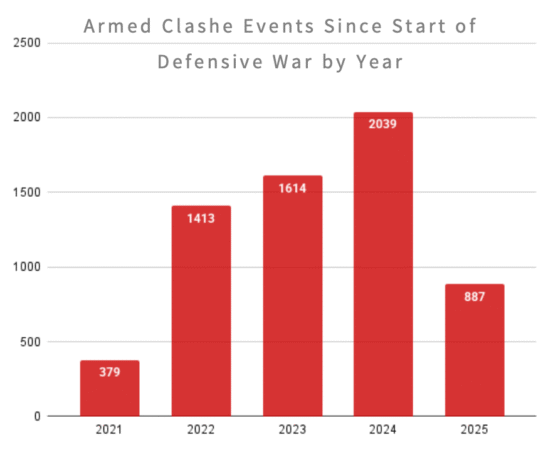
According to BNI-Myanmar Peace Monitor data from 7 September 2021, when the people’s defense war was declared, to 7 September 2025, a total of 6,332 armed clash events took place across 242 townships in Myanmar over the four-year period, with the conflict intensity increasing year by year. (BNI-MPM records armed clash events as one event per day by township. The actual number of clashes may be significantly higher.) 2
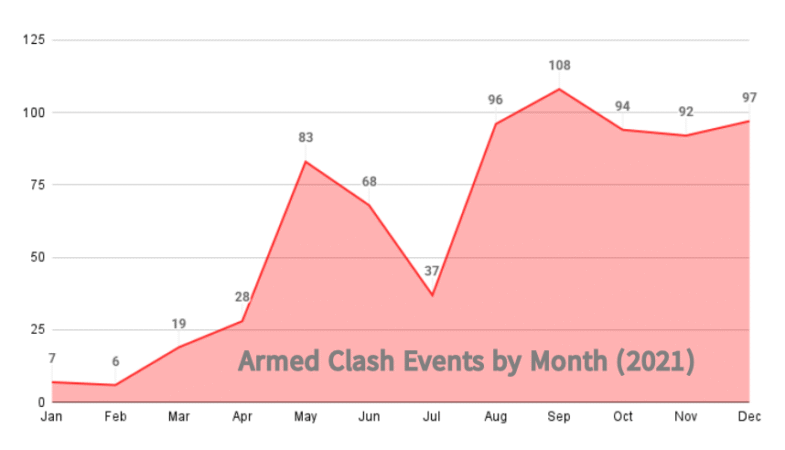
In 2021 alone, both before and after the declaration of the “people’s defensive war”, the momentum of resistance against the military junta changed markedly. Military conflicts intensified and spread across Myanmar, with the theater of war becoming much wider.
Therefore, during the four years since the declaration of the people’s defensive war, the resistance momentum has significantly intensified, placing enormous military pressure on the junta.
Simultaneously, resistance forces have gained complete control of up to 94 towns from the junta and are making comprehen -sive efforts to pressure the junta’s planned new elections through military, political, and diplomatic means.
In addition, meetings between top leaders of Ethnic Revolutionary Organizations (EROs) and People’s Defense Forces/Local Defense Forces (PDFs/LDFs) that emerged with the Spring Revolution are becoming increasingly frequent.
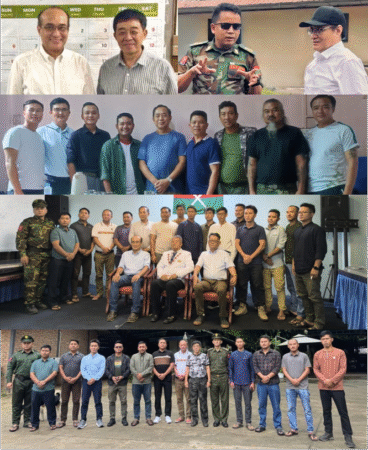
Union Minister U Yee Mon of the NUG’s Ministry of Defense stated that they have set up and deployed PDF battalions throughout all regions nationwide to conduct general offensive operations against the military junta. “A general offensive means conducting coordinated operations across the entire country in every region. To create a turning point in the revolution, this is a task we must undertake. The conditions and circumstances necessary for this effort are already in place,” U Yee Mon said.
Analysis
The momentum of the four-year armed resistance can be viewed as both intense, extensive, and rapid. The “Operation 1027,” that began in northern Myanmar, also awakened the resistance movement. Witnessing the military junta’s territorial losses, including Regional Military Commands and other military bases, along with the depletion of tens of thousands of its troops, demonstrates the momentum of the resistance.
However, while the military momentum of the resistance has been rapid, intense, and extensive, its political progress has been notably slower. Although there have been common agreements and approaches toward building a future Federal Democratic Union, the political momentum remains in a gathering phase.
The year 2025 is poised to be a unique year. We are likely to witness both the junta’s planned new elections and the resistance forces’ general offensive operations on a nationwide scale. At the same time, the military junta is conducting intensive offensive operations in areas that could threaten their planned elections and in territories lost to resistance forces, while also intensifying airstrikes.
The resistance has reached certain milestones, as Acting President Duwa Lashi La noted when describing the revolution’s progress as ‘two steps forward, one step back.’ However, unity among the resistance forces themselves has been slow to develop.
The report on the fourth anniversary of the “people’s defensive war” highlights the revolutionary forces’ preparations for a “general offensive” to dismantle the military dictatorship. The NUG’s Ministry of Defense is preparing for coordinated operations across all regions of the country to create a turning point in the revolution. The commitment to enhance unity and leadership among resistance forces, eliminate the military coup, and end military involvement in politics is evident.
Therefore, the momentum of the four-year resistance war can broadly be concluded as rapid, intense, extensive, and continuing to advance.
1. Fourth anniversary report on ‘people’s defensive war’, NUG-MOD, 7 Sep 2025
2. Myanmar Armed Conflict Dashboard , BNI-MPM, 9 Sep 2025