

The direction of the 21st Century Panglong
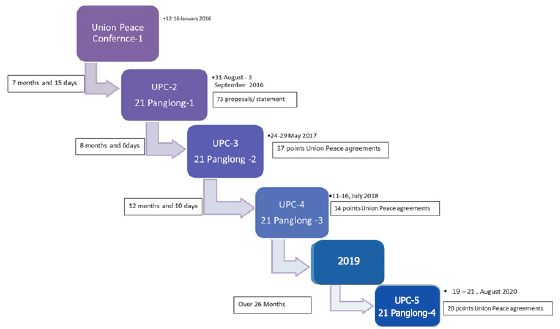
The Union Peace Conference – 21st Century Panglong, established under the Nationwide Ceasefire Agreement (NCA), has come to a standstill at 71 points of the three components of the Union Accord since the military coup on February 1st, 2021. The three major peace processes that emerged from the last and fourth round of the Union Peace Conference – 21st Century Panglong held from August 19th to 23rd, 2020 will make it difficult to calculate how long it will take to implement.
The three major topics that emerged from the fourth round of the 21st Century Panglong – the national reconciliation, internal peace, democratic transition, the establishment of a federal union and amendment to the 2008 Constitution – are the main directions of the post-2020 peace process.
State Counsellor Daw Aung San Suu Kyi, who was arrested and has been detained since the coup, said the following:
“The first step to the peace process after the 2020 peace process is the joint implementation of national reconciliation and internal peace. The second step is democratic transition and the establishment of a federal union. The third step is to implement the constitutional amendment based on the agreements reached in the first and second steps.
The first step would be to reach a ceasefire agreement with the ethnic armed organisations that have not yet signed the Nationwide Ceasefire Agreement (NCA). This would strengthen the ceasefire with the signatories of the NCA. It would promote ethnic rights in accordance with the principles enshrined in the Union Accord. It would carry out reforms towards federalism.
The second step would be to continue negotiations on the guiding principles for building a federal democratic union and to establish a unified constitution for the states. In the course of the democratic transition and the establishment of federalism, practical plans and mechanisms would support the political and security reintegration processes.
The third step would be to amend and supplement the constitution in accordance with the NCA roadmap, and involve political experts in the process.
Even though the post-2020 peace process envisions a federal democratic union, Min Aung Hlaing expressed the following:
“First, the actors involved in the peace process need to be honest. Second, we want to link the peace process with other processes. Thirdly, we must stick to clear principles. The principles of the peace process already exist. That is the Nationwide Ceasefire Agreement (NCA).”
Min Aung Hlaing and his junta signed the agreements that emerged from the Union Peace Conference – 21st Century Panglong. He has shown signs of fear in continuing with amendments to the 2008 Constitution. It can be assumed that the military coup on February 1st, 2021 is in some way related to the peace process.
The junta formed the National Solidarity and Peace Negotiation Committee (NSPNC), headed by Lieutenant General Yar Pyae. The committee has held separate talks with some ethnic armed organisations, including non-signatories of the NCA. It is also holding talks with some political parties close to the junta by including them in the Union Peace Dialogue Joint Committee (UPDJC).
Under the NCA framework, the political landscape still seems to be centered on the government, the Tatmadaw (the military), and armed ethnic organisations. It is likely that the Union Peace Conference – 21st Century Panglong has become a one-act play after the junta seized state power by arresting and imprisoning leading government figures.
Following the coup, the junta is trying to amend the 2008 Constitution, drafted by its own military. It is attempting to change the electoral system to suit its will in order to hold another election. The junta is expected to apply the principles of the NCA in full after a new election.
The junta’s peace plan seems to be a pipe dream despite references to “eternal peace.” Its actions have only led to an escalation of civil war.
The actions of groups that have emerged from the Spring Revolution aim to overthrow the junta are remarkably consistent with the direction of the post-2020 peace process. In particular, the declaration to abolish the 2008 Constitution by the Committee Representing Pyidaungsu Hluttaw (CRPH) and the peace plans of the National Unity Consultative Council (NUCC), which is composed of ethnic armed organisations, political parties, members of parliament, civil society organizations and ethnic organisations. These objectives are in line with the direction of the 21st Century Panglong meetings.
It should be noted that the direction of the 21st Century Panglong, which aims to create a future federal democratic union, is directly linked to the victory of the Spring Revolution, and that means, the victory of the people.