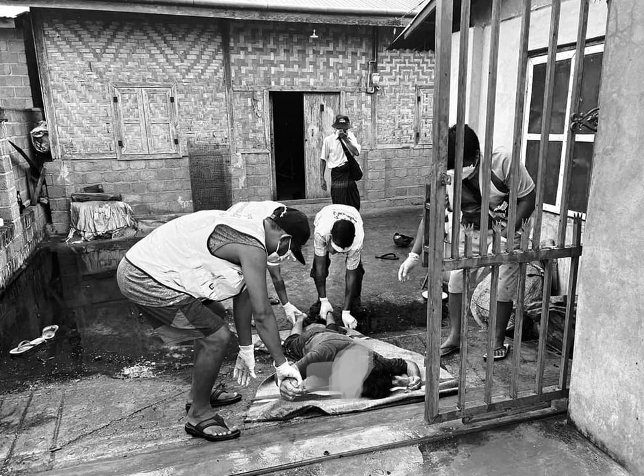
An interview with Ying Leng Harn, SHRF spokesperson, on the attacks on civilians without distinguishing between military and civilian targets during the conflict in northern Shan and the situation of trapped civilians.
The Shan Human Rights Foundation (SHRF) reports that during the second round of “Operation 1027” in northern Shan State, some residents have fled their towns and villages, while others remain trapped in urban areas.
In Kyaukme Township in particular, most residents are still trapped amidst the fighting. They are currently relying on mutual aid from civilians to survive and are facing difficulties. Due to these challenges, the SHRF has requested international assistance.
Since the beginning of the second phase of “Operation 1027”, civilians in the towns of Naungcho, Kyaukme and Thibaw in northern Shan State have been killed and injured by airstrikes, artillery shelling and gunfire from the military junta. Many residential buildings were also hit and damaged.
Network Media Group (NMG) conducted this interview with SHRF spokesperson Ying Leng Harn to find out more about the situation.
Q What are the concerns of the civilian population in the current military situation?
A: Fierce fighting is currently happening in Lashio, Kyaukme and Thibaw. People are very scared, of course. Especially because the telephone and internet connections are down. There is also no electricity, so they’re constantly in fear if artillery shells fall on their location or air strikes could take place.
Q: Which townships are currently under attack?
A: From what we have found out so far, it’s these three townships along the pipeline: Thibaw, Kyaukme and Naungcho. But in reality, the conflict is affecting many townships in northern Shan State. It includes Thibaw, Naungcho, Kyaukme, Lashio, Momeik, Mogoke and extends to the Theinni area. But, our initial statement only covers these three townships.
Q: Can you tell us which places are targeted in these attacks?
A: The military junta doesn’t seem to have specific targets. They attack any area where it suspects the presence of revolutionary forces. Whether it’s civilian areas or other places, they fire indiscriminately and carry out many air strikes. They also use heavy artillery. There are attacks with artillery and air strikes, but the air strikes are more frequent.
Q: What about the civilian population in this conflict, especially women and children?
A: Women and children are also affected. In our list of fatalities, nearly half are women. It’s not exactly half, but it’s more than half.
Q: Apart from civilian casualties, are there any reports of civilians being arrested?
A: At the moment, the junta forces aren’t directly arresting or shooting at people. This is because they’re in a defensive position within their own bases and are in a lost position militarily. So we haven’t seen many incidents of this kind.
Q: In view of these attacks on civilians and the human rights violations, what would you like to request from the military council and the revolutionary organizations?
A: Personally, I’ve no particular demands for the military council. But I’ve a request to the international community. Above all, I’d like them not to turn a blind eye to the war crimes committed by the military council in northern Shan State. I’d like to call on them to take joint action against the military junta.
Q: What is the current situation for the local people on the ground?
A: In the current situation, the local people are trapped. Especially in Kyaukme, most of the residents are trapped. They’re caught in the middle of the fighting. The artillery shelling and airstrikes are also very intense.
Q: The statement mentions that the villages along the gas pipeline are under attack. Why do you think this is the case?
A: Regarding the attacks on the villages along the pipeline, I believe that as long as the military junta rules this country, no foreign investment, including the pipeline, is safe. Fighting can break out anywhere.
But the junta can’t guarantee the safety of foreign investments. We believe that investors linked to the military council should pull out. That is why we have issued this statement.
Q: What difficulties are civilians currently facing? How are they coping with these challenges?
A: At the moment, civilians are facing high prices of goods and can’t flee. Some are hit by heavy weapons and there is no one to provide them with medical care. They’re facing these difficulties. They use various methods, such as searching for jungle routes, to escape secretly. Local youth and civil society groups are also working together to provide help.
Q: You mentioned that people are working together to help each other. What challenges are they facing in this regard?
A: So far, there have been no donations from international organizations or donors. Without outside help, we have to rely solely on the support of local people helping each other – donations from civilians to civilians. So we’re facing some difficulties. Another problem is that we also lose access to information if the telephone and internet connections go down.
In such situations, it becomes very difficult for us to provide help. Another problem is that commodity prices are extremely high. Prices have already been high anyway. When the roads are blocked, prices rise even more. This makes it even more difficult to help both the displaced people and each other.
Sent by NMG.