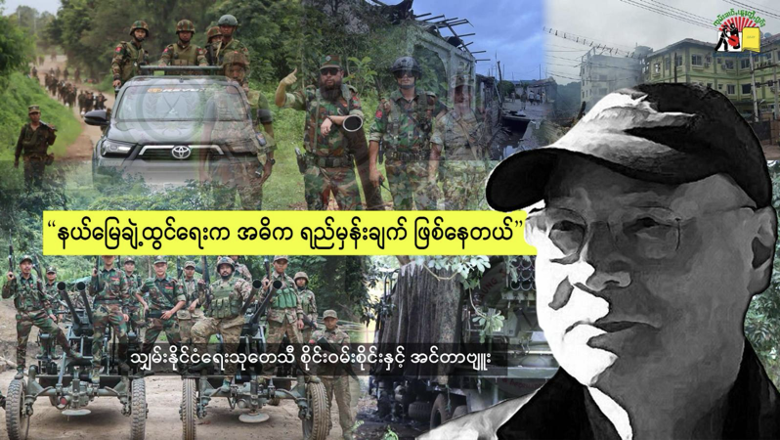
An interview with Sai Wansai, a Shan political analyst, about his view on the second round of “Operation 1027” and the ways of how to address current problems among the allied forces.
“Operation 1027,” which had been paused for over five months in northern Shan State in accordance with the Haigen Agreement between the military council and the Three Brotherhood Alliance (3BHA) resumed on 25 June as its second wave.
In this new phase, the allied forces comprising the 3BHA, Mandalay-PDF, Mogok Strategy, and Danu People Liberation Army (DPLA) are jointly conducting attacks in Naungcho, Kyaukme, Hsipaw, Mongmit, Mogok, and Lashio within the northeast command area.
The Defense Ministry of the National Unity Government (NUG) has dubbed these military actions the “Shan-Man Operation,” with participation from battalions based in Mandalay and Sagaing Region.
During the temporary ceasefire of “Operation 1027” and its subsequent resumption for the second round, military tensions have surfaced among ethnic armed groups belonging to the Federal Political Negotiation and Consultative Committee (FPNCC) in northern Shan State, primarily concerning territorial control.
The Shan News interviewed Shan political researcher Sai Wansai, about peaceful co-existence among ethnic groups in northern Shan State, his view on “Operation 1027” and how to deal with the current problems between the allied forces.
Q: Operation 1027 was initiated with the objectives of combating the military dictatorship and eliminating the Kyar Phyant (online scams). Now what we see is like a revolution for the control of their own territories. In the second wave of the operation, we have seen more conflicts between ethnic groups. What is your view on the current problems?
A: The current problem doesn’t seem to resolve easily. Because four groups—Ta’ang National Liberation Army (TNLA), Kachin Independence Army (KIA), Shan State Progressive Party (SSPP) and Myanmar National Democratic Alliance Army (MNDAA)—are involved in it. Among them, the TNLA is the main one. The TNLA is fighting with the MNDAA, the SSPP/SSA and the KIA. The problem is that territorial expansion is the main goal of the TNLA. Despite claiming in their letter that their attacks target the removal of the junta, the reality diverges from this assertion.
As a matter of fact, the TNLA’s goals are the establishment of Ta’aung State and territorial expansion. The primary goal of rooting out the union level army and building a federal democratic union is not included in its first agenda. So, if the four conflicting groups can’t sit together and reach a common goal, the conflict won’t be easily resolved. This is what I want to covey to the groups.
Q: How should they solve the current problems? The civilian population will suffer the most from the conflict. How should ethnic armed groups solve them? Could there be another agreement similar to “Haigen Agreement”?
A: To resolve the current conflict, they must abandon their pursuit of territorial dominance. Afterward, they must establish a shared objective of coming together to build a multi-ethnic country where all individuals can interact and prosper together. Following this, the groups need to forge their own path through collective discussions.
In summary, we must have the objectives: (1) abandoning the pursuit of territorial dominance, and (2) adopting a shared goal of peaceful and harmonious coexistence. With these steps taken, they can come together for dialogue and negotiation. The likelihood of the next round of the “Haigen Agreement” will depend on the compromise reached between the 3BHA parties involved in the operation and China. The process of compromise is multifaceted. It encompasses various aspects such as establishing effective communication between nations, addressing the military’s current authority, and recognizing territories controlled by ethnic groups. This issue cannot be easily resolved. Despite pressure from China, it seems unlikely that the 6th Haigen meeting will take place.
Q: As I mentioned earlier, there have been military conflict between the TNLA and other groups. How far can this problem continue to grow?
A: What happens next depends on the rationality of the four organizations currently involved. If they can see the big picture, they can prevent what will happen next. By doing so, they can then proceed to dialogue about fostering harmonious coexistence. It depends on their innate nature.
In general, they need to give up the ambition for territorial control and instead focus on achieving a shared goal of harmony. What happens next will depend on those two things. If they do not accept these two things and do not discuss them, they will continue to fight. The public will also suffer. Also, they will not achieve their desired goal.
Q: Could “Operation 1027” lead to the establishment of a federal union? What are the advantages and disadvantages?
A: The trajectory of “Operation 1027″ and its potential to advance the establishment of a federal democratic country are questions that remain uncertain at this time. Because it depends on how far the second round of the ongoing ” Operation 1027 ” goes. The NUG has dubbed it the “Shan-Man” operation. This is merely a title. In reality, there doesn’t seem to be an active effort to make significant advances on the battlefield. I’m not denying their participation. They are indeed involved, but the intensity of their actions has not yet reached a significant level. Therefore, it’s challenging to predict how the second round of “Operation 1027” will unfold at this moment.
Q: “Operation 1027” halted for 5 months. Meanwhile, there were also problems with ethnic armed groups. Now the second round of Operation 1027 has begun. Could this initiative mark a decisive battle against the military dictatorship? Do you perceive a path towards federalism?
A: We can say that we may or may not perceive the path towards creating a federal union. What we can affirm is that at least the joint operation by the Bamar Revolutionary Group in the plains and the TNLA shows promise. It’s a little bit difficult to say whether or not this will develop.
For example, the Bamar People’s Liberation Army (BPLA) led by Maung Saung Kha and the Burma National Revolutionary Army (BNRA) led by Bo Nagar participated in the first round of “Operation 1027”. However, they are not participating in the second round of the operation.
Their absence from participation indicates skepticism towards the TNLA’s claim of rooting out the military regime. Consequently, it appears that the Burmese revolutionary forces in the plains and the 3BHA lack the unity seen in the first round of the operation.
Q: Thank you for your answer.
A: Thank you.
Sent by Shan News