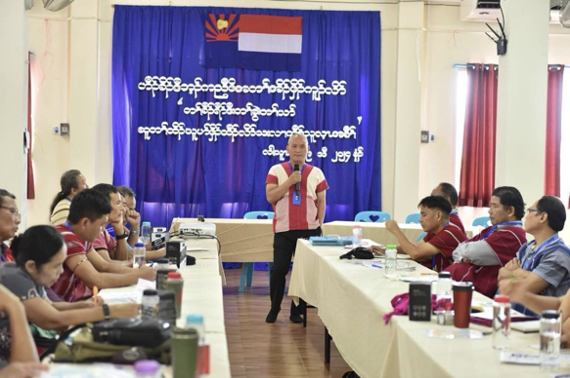
An interview with Saw Albert Cho, spokesperson for the International Karen Conference (IKC), about the action plan adopted at the conference
The International Karen Conference (IKC) took place from 6 to 8 June 2024, on the border between Thailand and Myanmar. It brought together representatives from the Central Executive Committee of the Karen National Union (KNU), representatives from the Karen National Liberation Army (KNLA), representatives from local border-based and international Karen organizations, and Karen social organizations to find a solution to political challenges facing the Karen people.
The conference adopted five action plans: (1) establishing a political system with leaders elected by the people, (2) building a competent military under unified command, (3) securing necessary human resources, (4) promoting socio-economic development while ensuring accountability and legal compliance, and (5) meeting the needs of internally displaced people.
The Karen Information Center (KIC) conducted this interview with Saw Albert Cho, spokesperson for the International Karen Conference (IKC), to learn more about the implementation of these action plans, the reasons for including certain plans, and the progress made in securing human resources.
Q: When do you expect the five action plans adopted at the conference to be implemented, and how will they be implemented?
A: For each of the five points, the respective committees have discussed and determined how to proceed. Some actions are already underway. For example, regarding human resources, there’s already a committee in place. The recruitment committee includes international Karen representatives, the KNU, and international CPOs and CSOs.
This committee is responsible for finding and recruiting human resources. They will carry out the recruitment process. The committees for all five action plans have started their discussions and begun the implementation. I can’t give any specifics yet on what they’re doing.
Q: Can you explain what the first action plan means?
A: It reflects the political aspirations of the various representatives who attended the conference. They want a future where leaders are directly elected by the people through voting. It’s also about transition. Our Karen revolution is currently in a transitional phase. During this time, change is happening one after another, and the aim is that the people will eventually be able to choose their own leaders through elections. This is an expression of their political aspirations. After the revolution, there would be elections. The representatives present share this desire for a system in which people can elect their leaders directly. Of course, this will take some time.
Currently, there are limited stable areas within the KNU-controlled territory. Conducting elections requires a stable environment. As I mentioned earlier, our priority should be to create the necessary conditions for elections to take place. The first action plan can be seen as a demonstration of the political will and aspirations of the participants.
Q: Can you explain the purpose of including this point in the action plan?
A: The purpose is to bring about change quickly. The changes are happening now. It would be good if we could implement these action plans alongside these changes. If people vote themselves, there will be political participation. The aim is to drive this forward and refine the process so that this can happen.
Q: The conference is being described as a first step towards the reunification of all Karen people. Why can this be said?
A: This is indeed the first step. If you look at this conference, it has brought positive results. International Karen communities, local CPOs and CSOs on the border as well as KNU and KNLA representatives participated. By holding such events, we can better understand their perspectives. As the name suggests – a conference – it leads to greater unity.
Understanding each other’s views leads to better mutual understanding. This is the first step, and if we continue with further steps, there will be even greater understanding between all Karen peoples.
Q: Another issue is securing the necessary human resources for Karen organizations. How will you proceed in this regard?
A: I can’t say exactly how the committees will start this process. But it could be something like the “Welcome Home” program. The idea is to bring the existing resources back into the country to participate in the revolution and fulfill the needs of the revolution. They will work on implementing such ideas.
Q: Do you have a message for the new generation of Karen professionals and intellectuals around the world?
A: As a young person myself, I realize that we have reached a time when we can start rebuilding. During this reconstruction phase, we need many human resources and professionals. We need many educated young Karen people to return.
Only when they return can we take new steps forward. It would be ideal if they focus on Karen national affairs when they return and take a nationalist perspective for reconstruction. We now have some stable areas in our territory. When we start reconstruction in these areas, we need ample manpower to proceed quickly and correctly.
So I address Karen professionals abroad: although our Karen revolution has lasted 75 years, changes are now underway. There are opportunities to return and settle down. Come back and let’s shape the future of the Karen people together.
The self-determination of the Karen people depends on the Karen themselves. If the Karen do not return, who will do it for us? So I would like to say to the professionals and the youth abroad: please come back with a focus on the self-determination of the Karen people.
Sent from KIC.