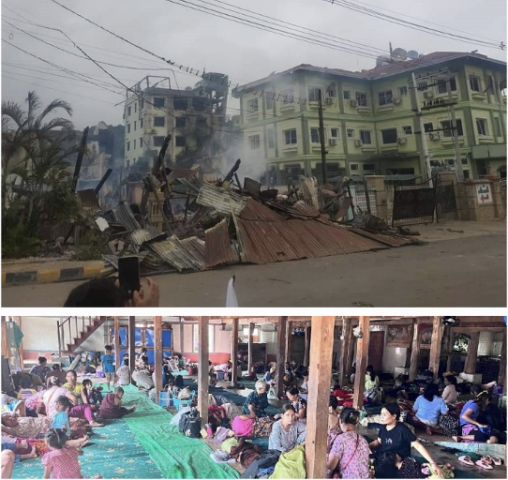
An interview with a person involved in rescue operations in Kyaukme, about the difficulties and challenges the social organizations are facing while helping the IDPs in northern Shan State.
Fighting has escalated since the Ta’ang National Liberation Army (TNLA) launched an offensive against the military council’s camps based in Kyaukme in Shan State as part of the second round of “Operation 1027” on 25 June. The TNLA has taken control of departments and offices under the military council in the town.
Since its inception until July 20th, the list compiled over nearly a month indicates that at least 80 civilians have been killed in the conflict. There is an urgdent need of food and medicines for 15,000 locals who fled to the town and surrounding villages.
Shan News interviewed the person who is engaging in rescue operation in Kyaukme, about the difficulties and challenges the social organizations are facing in the delivery of aid to the IDPs in Kyaukme.
Q: Please tell me about the current situation in Kyaukme.
A: Although they have declared a ceasefire and there is no fighting on the ground, these days there is fighting on the ground and airstrikes. When the fighting is raging on the ground, people don’t know where to flee to. They are in trouble as there are battles wherever they seek shelter. The people who can afford to pay money have fled to Taunggyi and Mandalay.
All the people in Kyaukme cannot work. So, they have to rely on social organizations. Currently we provide them with one Pyi of rice, a bottle of edible oil and 10 eggs. It’s been almost a week since our last distribution. However, we are driving around to donate to the elderly as we are concerned that these items may not be reaching those who are most in need.
Q: The people have to flee amid the ongoing fighting. How many people remain in the town?
A: Now that the fighting is going on in the town and in the villages again, people who fled to the village have returned to the town. Upon their return, they are finding their homes devoid of food. We donate rice as they have the houses to live in and lack food to eat. We are helping them as much as we can. It has been nearly one month. They can do nothing for their living since fleeing on 25 June.
This situation makes it even more difficult for daily wage earners. We are providing them with assistance to the best of our ability, as they tearfully inform us of their lack of rice and food.
Q: They fled to the villages due to the fighting in the town. At that time, where did they flee to? Currently, how many IDPs are there in the vicinity of Kyaukme?
A: During our first aid distribution at 27 monasteries, we identified over 12,000 internally displaced persons (IDPs) there. This list specifically accounts for IDPs in monastery camps, excluding those seeking refuge with relatives. Currently, we are unable to estimate the number of populations in the town. Fighting has been taking place across the entire town. People flee to the villages out of fear when fighting breaks out. Then, they return to the town. So, it is very difficult for us to compile the list of populations.
Q: What about aid and funds available for providing the IDPs? How do you manage them?
A: Between 25 June and 1 and 2 July, we were able to raise a significant amount of funds. We have received a fund of around 20 million Ks. Donors are unable to make donations two or three times. We have to do our activities by using our remaining funds as fighting has been taking place everywhere since that day. Currently, we have spent around 20 million Ks from the association’s funds. There is around 2 million Ks left. After that, we are thinking of taking a break after the use of the remaining fund.
Q: What age groups make up the majority of the IDPs? What difficulties are the IDPs facing?
A: The difficulties faced by IDPs a major source of their concern. And they have no stable place to settle. Their livelihood is very difficult. The elderly who struggle to relocate may be unable to move at all. They have little resilience left to relocate to different places, even if they have the opportunity to do so two or three times. As a result, some of the elderly have passed away. There are many difficulties. Agriculture is the major business here. Most of the people here are daily wage earners. It makes the people more difficult. Another point is Kyaukme is not a major economic zone. It relies on agricultural and livestock products. For example, poultry farming, particularly chicken egg production, is affected because chicken feed supplies are currently unavailable. It also makes the workers more difficult. There are no exports or imports. Those working in the agricultural sector also faces difficulties. They have to seek assistance from their relatives and organizations as they are facing difficulties on all fronts.
Q: Most of IDPs are women and children. What is the status of the healthcare services for the IDPs during the rainy season?
A: All doctors, nurses and health staff have moved to their relatives’ houses when fighting occurred. The people here have no access to healthcare. In emergencies such as accidents, they resort to using traditional medicines available locally. They must also manage treatments themselves for conditions like diarrhea. The patients with heavy accidents have to be sent to Taunggyi, Mandalay and Namlan. Those who can afford it can do it. The transportation cost for a round trip is around 1.2 million Ks.
Q: What are the casualties resulting from artillery shelling and aerial bombings in the town?
A: According to the list as of 5 July, the number of civilians killed has reached 59. We cannot effectively help the injured. Reports of civilian deaths continue to come in every other day or every two days. have been unable to effectively compile a list of civilian casualties. So far, we are helping those who are within our reach. We deal with the death cases immediately. The doctors refuse to accept the injured patients and unload them from the ambulance. The doctors treat the patients on the ambulance. The presence of the patients on the ambulance makes us difficult as we have to drive all the way.
Q: What about the damage to houses? For instance, are there the cases that those injured or killed in their houses cannot be pulled out immediately? How do you deal with it?
A: We help as much as we can when there is a death. No matter how difficult it is. We carry the bodies from the village, town and house, as soon as we are informed. We immediately help when there are civilian casualties. Now, there are many people who suffer from hypertension and diabetes likely due to dietary habits, living conditions, and overall health factors.
For instance, the patients suffer blood pressure spikes when heavy shells explode near their houses. When they can’t take medicine for high blood pressure, they lose consciousness. They die when they cannot get medicine from hospital, clinic, doctors and nurses. Four or five people have died due to shell explosions in close proximity. They died without any physical injuries.
Q: How many organizations are currently providing assistance in the town? What is the level of cooperation among them? What challenges and difficulties are you facing as you provide aid amidst the ongoing conflict?
A: We need to maintain a humble demeanor to ensure smooth passage through the entry and exit points of the town. We prioritize accessible locations for our operations. The associations are helping the people as much as they can. Currently there are about three associations. The establishment of our association aims to serve the public interest. We have to do our work despite the sounds of bombs and gunfire.
We ask the public about their difficulties to ensure our aid reaches those in real need. We first go to the places that are in need of aid most. We go to the places where the elderly cannot go outside on a priority basis. The situation is dire for many people. Our members promptly assist those who are completely without food.
Q: Is there anything else you would like to add?
A: What I want to say is that now fighting is taking place. We would like to urge armed forces to refrain from attacking displacement camps and monasteries during their operations involving heavy shellfire, aerial bombings, and ground fighting. Now all the people are facing difficulties on multiple fronts.
Sent by Shan News