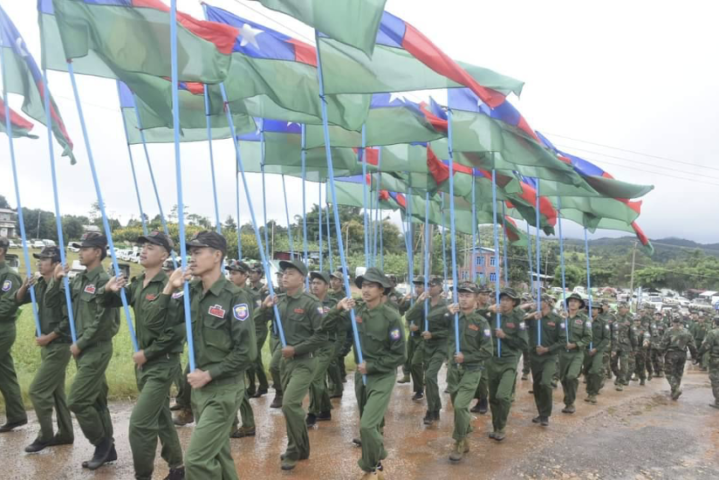
An interview with a woman spokesperson of the Pa-O Youth Organization (PYO) on recruitment of thousands of new soldiers by the PNO/PNA, the will of Pa-O youth, and the security situation in the region.
The Pa-O National Organization/Pa-O National Army (PNO/PNA), a militia based in southern Shan State, announced that they have recruited over 30,000 new soldiers. They achieved this by conducting three military trainings within three months, starting from August.
Local residents report that the PNO/PNA forced young people to attend basic military training under the pretext of regional defense and security. They also made those who had never undergone military training wear uniforms and participate in graduation ceremonies to showcase their strength.
Shan News conducted this interview with a woman spokesperson of Pa-O Youth Organization (PYO) to learn more about the forced recruitment of thousands of new soldiers by the PNO/PNA, voices of Pa-O youth and the security situation in the region.
Q: As PYO, an organization working on Pa-O youth issues, what do you say about the recent frequent displays of thousands of troops by the Pa-O militia, the PNO?
A: The recruitment of soldiers isn’t a new issue. It started in mid-2022. We observed that PNO/PNA began recruiting soldiers about a week after the Hsihseng battle, even before the Myanmar military announced the conscription law. Regarding the current regional force demonstrations, this isn’t a sudden development. We’ve seen a significant increase in such activities since the Hsihseng battle. It’s important to note that not all people called to military graduation ceremonies are soldiers; they’re all locals. Some haven’t even undergone military training but are included in these demonstrations.
The recruitment process involves forced conscription and there was a call-up for military service as well after Hsihseng battle. A week after the Hsihseng battle, they issued an announcement for military service. Later, they ordered that those aged 18 to 35 must serve in the military. In reality, we see many youths under 18, including students. Some recruits are even over 35. Some are sent to the frontlines without proper training. PNO/PNA consistently uses the pretext of regional security for these recruitments.
We’ve observed that when local people get involved, PNO/PNA often presents it as a choice between them and the military council, saying, “If you don’t join us, your only option is the military.” They also promote the idea that “the military is the people, and the people are the military.” While they claim it’s for regional security, we see it as an effort to maintain PNO/PNA’s power. Most of those attending military training aren’t doing so willingly, but because they can’t avoid it. The pressure is so intense some are threatened with expulsion from their villages if they don’t attend training. In some cases, families of those who don’t attend are registered, with threats of being summoned later. This pressure is a significant factor in pushing people to attend training and graduation ceremonies.
Q: We see many Pa-O youth and middle-aged people participating in PNO/PNA’s military displays. Is this because of their personal wishes or orders? What have you observed?
A: The percentage of youth participating voluntarily is very low. The majority are there under coercion. Some are persuaded with the promise that they only need to attend training and participate in the military displays without being sent to the front lines. Most are under pressure and have no choice but to attend. Recently, we’ve heard unconfirmed reports that trainees have to pay for their own uniforms for the graduation ceremony. This is happening at a time when people are facing extreme hardship. Some families have to send two or three members, which is very costly for them.
Q: How would you respond to PNO’s claim that local trainees won’t be sent to the frontlines and are only for local defense?
A: We have many instances [that contradict] this claim. After the battle for Hsihseng, many were sent to the frontlines in southern Shan State. Many have fallen in battle. Although they recruit under the pretext of regional security, in reality, we see people being sent to areas outside of southern Shan State. Even if they say trainees won’t be sent to the frontlines, how much can PNO/PNA guarantee this? They say one thing but do another.
We believe that if ground battles intensify, they will likely use these trained individuals. We’ve seen that wherever there’s a military presence, conflicts arise. If PNO/PNA continues to fight alongside the military council under the guise of regional security, there’s a high risk that these forcibly recruited Pa-O locals will be sent to the front lines. In fact, they’re already being sent.
Q: PNO/PNA is conducting training and recruiting soldiers in the Pa-O region. Do you think this will truly protect the Pa-O region? Are they being used for the military council’s power retention and the personal interests of PNO/PNA leaders?
A: That’s partly true. Consistently, there’s a notion that PNO/PNA’s power will remain stable only if the military’s power persists. Therefore, under the guise of regional security, they recruit soldiers to protect their interests. This has been consistently criticized.
Q: How are ordinary Pa-O civilians suffering because PNO/PNA is forcing them to buy uniforms with PNO militia badges? What potential dangers might arise from possessing these uniforms?
A: This mainly affects combat situations. Normally, we are local civilians. But, if those with military uniforms become members of an armed force, people may face threats. For local civilians who have recently attended PNO/PNA’s military training graduation, although they are typically civilians, they face great danger. Whether they’re sent to the frontlines or simply moving about, being identified as a member of an armed group is extremely risky. This issue requires careful consideration. It depends on the situation. As PYO, we will need to continue monitoring this closely.
Q: Thank you for taking the time to answer these questions.
Sent by Shan News.