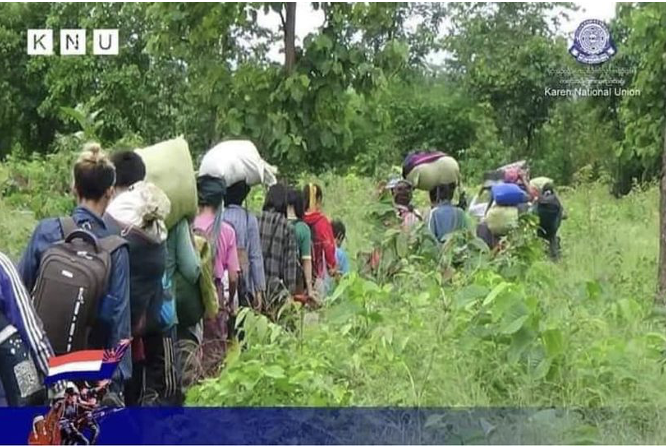
An interview with a KNU spokesperson for Mone Township on the current military situation in Mone, and the health and living conditions of displaced civilians.
In early December 2023, the Karen National Liberation Army (KNLA) and allied forces attacked and captured military junta camps, police stations, and security checkpoints in Mone Township, Nyaunglebin District – the Karen National Union (KNU) Brigade 3 Territory in Bago Region.
The junta launched a counter-offensive to retake their camps, using not only ground attacks but also excessive air support. The junta’s offensive resulted in civilian casualties and damage to houses, monasteries, and public buildings.
After the junta’s counteroffensive and reoccupation of Mone town and the surrounding villages, local residents were forced to flee to safety. As the junta continues its operations in Mone Township, locals are unable to permanently return to their homes.
Karen Information Center (KIC) conducted this interview with the KNU spokesperson for Mone Township to learn more about the current military situation in Mone, as well as health and living conditions of the displaced local residents.
Q: First, please tell us about the current military situation in Mone town.
A: There is no fighting on the ground, but the junta is shelling the town with artillery day and night. In Phyu Township, Light Infantry Battalions 439 and 307 are active. In Mone, there is Light Infantry Battalions 439 and similar situations in Kyaukkyi and Natthankwin areas. The junta forces usually carry out raids in villages near the towns. Although there is no fighting, the junta has carried out targeted artillery attacks on villages in Mone. This has caused the civilian population east and west of Sittaung River to suffer on a daily basis.
Q: What’s the situation in Mone town after the capture of the junta camps?
A: Shortly after the capture of the camps, the junta reinforced its troops and then re-entered the town. They retook their positions in IB-590 and IB-599 in Mone where they are staying today. Most of the residents are still outside the town; only those close to the military live in the town.
In the administration, it’s just some civilians who get along with the army. But since most of the civilians are in hiding, the administration can’t do much. There are occasional exchanges of fire near the town. Civilians aren’t allowed to use the main road in Mone. Since the camp capture, no ordinary local civilians have been traveling there.
Q: Please tell us about the situation of the displaced people from Mone.
A: Most of the people are in the forest. Some are living in makeshift huts at the foot of the mountains. Since the capture of the camps, some have fled to the west bank of the Sittaung River; others are hiding near their workplaces at the foot of the mountains.
The number of displaced people from Mone town alone is in the hundreds of thousands. There are many wards. As for their livelihoods, some who are close to relatives near the town are doing well. Those displaced in the forests face difficulties in times like this.
Q: What is the health situation of the displaced people in the forests during this rainy season?
A: As far as their heath is concerned, they are struggling with diarrhea, dengue fever and mosquito bites, especially those living in makeshift shelters. During the rainy season, the water that comes down from the mountains becomes muddy and unclean when it rains heavily. Also, now that it is the rainy season, there are a lot of mosquitoes.
Q: What is the KNU doing to address this situation?
A: The KNU’s health teams are providing assistance. Since people first started fleeing the conflict, the emergency relief team in Mone Township has been providing food and shelter up to this day. The health department is also providing health-related assistance. But, there is still a need. During the rainy season, displaced people find it difficult to get both basic necessities and medical treatment.
Q: We’ve heard that the transportation of medical supplies was already a problem in Mone Township. Is the situation still the same now?
A: At this time, the transportation of medical supplies is very difficult. It is difficult to order medicine from the town and bring it back. Medicine is only available in places like Taungoo or Phyu. When coming back from these areas, we have to pass through military checkpoints to reach our area. At these checkpoints, medicine is completely restricted. Even for rice, they only allow one bag per motorbike.
Q: What about livelihoods and commodity prices in the area?
A: Prices have been rising since the coup, and now they’ve increased even more. The prices of food, medicine, oil – everything has gone up. Cooking oil, to give just one example, has gone from about 70,000 to 170,000 kyat. In Mone Township, as a precautionary measure, we have instructed villages both east and west not to sell all their rice to the traders, but only enough to cover their labor costs.
We have also asked each village to prepare and store about 2,000 baskets of paddy, depending on their situation. The plan is for the KNU’s emergency relief team to buy this back at market price when needed and distribute it to the displaced people. But, some farmers sell everything to traders. So the rice that is sold for 70,000 kyat ends up costing over 100,000 kyat when it has to be bought back elsewhere.
Q: Please tell us about the travel situation in Mone town.
A: It is no longer easy to live in Mone Town. Even shopping for food is not easy. To shop [for groceries], people have to go all the way across Taungoo and shop in other villages at the foot of the mountain. People from Natthankwin village tract on the east bank also have to go there to buy groceries. When we go there, they ban the transportation of medical supplies and check people.
Sent by KIC.