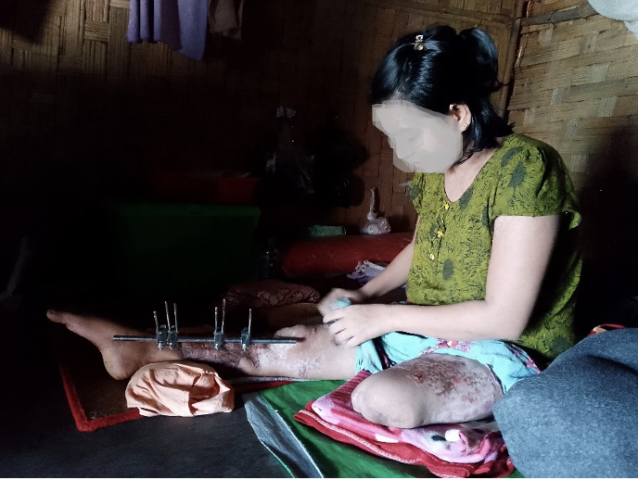
An interview with Ma Khaing Khaing Mar, a displaced woman from Hna Ma Dar village in Paletwa Township, about the hardships and needs faced by displaced persons with disabilities
In the conflict-intensive Arakan State, hundreds of thousands of civilians have been forced to flee their homes. They are facing various hardships, including severe shortages in basic necessities, food security, and healthcare.
Among the displaced people are children, elderly, and persons with disabilities, who are bearing an even greater burden of these hardships in securing their basic needs.
To learn more about the current challenges and needs faced by displaced persons with disabilities, Development Media Group (DMG) interviewed 21-year-old Ma Khaing Khaing Mar, a displaced woman from Hna Ma Dar village, Paletwa Township, who is currently taking shelter at the Kawi Yadanar IDP Camp in Kyauktaw.
Q: Please tell us about your current living conditions in the IDP camp.
A: Living with many people is difficult, especially during cooking times when the strong smells affect my wound. I can’t even stay away from these smells because I’m unable to walk. I have to smell lime to cope with it. Also, I can’t walk to the toilet. I have to use plastic bags in my room. Even in the room, I don’t feel secure because the bamboo walls and doors are in poor condition.
Q: Could you tell us about how you became disabled?
A: We were originally displaced by earlier fighting. After nearly six years, we were finally allowed to return home. We went back to our village in February 2024. When we returned, our houses were destroyed by military council soldiers. So we had to cut bamboo and wood to rebuild our homes.
After living in the village for over four months, I went to collect firewood at Zedi Mountain, where junta soldiers had previously camped on the opposite side of the village. Nothing happened on the first day. On the second day, while returning after collecting firewood, I stepped on a landmine. My left leg was severed, and the bones in my right leg were broken. That caused my current condition.
Q: How did you end up back at the Kyauktaw IDP camp after returning to your village?
A: At first, I received medical treatment in Paletwa town while staying in the village. When that wasn’t enough, the doctor recommended that I go to Kyauktaw for treatment. I had lost one leg and had broken bones in the other. They said going to Kyauktaw would be better because there’s an orthopedic specialist there.
I came hoping that my remaining leg might recover. For treatment, I need to visit either monthly or biweekly. Since I can’t walk, getting up and down is very difficult. Because of the long distance, the travel expenses are too high for me to afford, so I ended up staying here instead.
Q: What is your current medical treatment situation and the condition of your injury?
A: I have to go for regular check-ups monthly, sometimes every two weeks. In previous months, I managed to go fairly regularly by asking relatives for help. The wound itches, and there’s pain and coldness. I need to apply medicine for these symptoms. However, sometimes I can only apply a small amount of medicine because I don’t have enough money to buy more.
Now the doctor says this might be my last visit to the clinic. But I don’t have a single kyat. I’m worried about what to do. Sometimes when the wound hurts and I’m worried about not having rice to eat, I think it might be better if I just died.
Q: Please tell us about the challenges you’re currently facing.
A: When I was struck by the mine, some groups came and provided financial assistance. But now I’m not receiving any support anymore. In previous years, we used to receive monthly support at the IDP camp. Now that’s gone too. Everyone, including myself, is struggling with basic needs. We really need support and assistance.
Q: How are you managing your healthcare and family’s living expenses?
A: Before my injury, my husband could go out to work. Now he has to handle all household duties and take care of me, so he can’t work anymore. We’re really struggling. Our son is only nine years old, so he’s too young to help. Before, my husband used to work as a casual porter.
When my husband could work, he earned about 30,000 kyats. We could manage with that. Now, even if he tries to work after finishing household chores, he’s often late because of having to care for me, and by then all the work is taken. He only earns 3,000-4,000 kyats per day. We’re surviving on money given by relatives.
Q: Have you experienced any physical or psychological security concerns while staying in the IDP camp?
A: I’m scared because military jets fly overhead almost daily. Others can run if something happens, but I’ll be left behind. I can’t move. If they bomb, I’ll die because I can’t escape. If I had both my legs, I wouldn’t be this scared. I could run and hide somewhere. Now I can’t go anywhere without someone’s help.
Q: Is there anything else you’d like to add?
A: They [military council soldiers] misused military weapons. They planted mines on the paths used by civilians, which is why I became [disabled] like this. They’re also targeting and attacking with aircraft. They are fighting with whoever they want to fight.
It would be better if they didn’t harm civilians. Now they plant mines in areas where people live and work. Because of this, even after the fighting stops, we can’t work there. We relied on the forests for our livelihood – gathering firewood and bamboo shoots for food. Now nobody dares to go to the forests, so everyone is struggling.”
Q: Thank you for answering our questions.
Sent by Aung Htein (DMG).