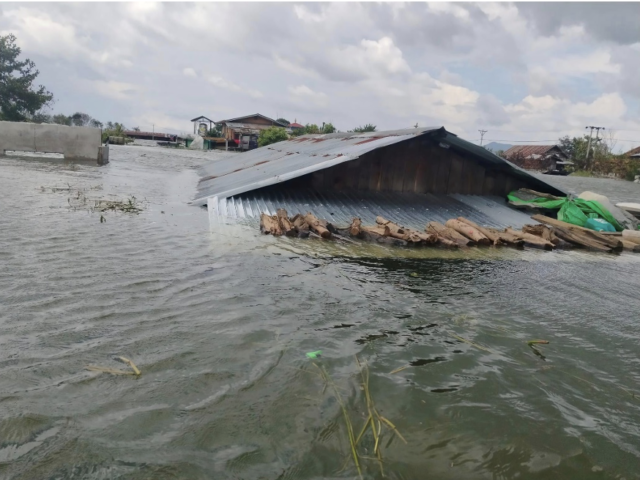
An interview with Khon Matthias, Head of the IEC Department of Humanitarian and Rehabilitation, on the current state of post-flood rehabilitation efforts.
From 9 to 13 September, continuous rainfall across Myanmar caused flooding and landslides. In Karenni (Kayah) State and the Shan-Karenni border area, the flooding resulted in 24 deaths and affected nearly 30,000 people.
Regarding flood relief efforts for local residents, the Karenni State Interim Executive Council (IEC) announced on 14 September that they are coordinating with social organizations to carry out rehabilitation work.
To learn about the difficulties, challenges, and needs encountered in the rehabilitation process, as well as the current state of preventive measures for potential flooding in the future, NMG conducted this interview with Khon Matthias, Head of the IEC Department of Humanitarian and Rehabilitation.
Q: Which townships in Karenni State were most affected by the recent floods? And what challenges are you currently facing in carrying out rehabilitation work?
A: Currently, the townships most affected by flooding are Demoso, Loikaw, and Shadaw. In Loikaw, as everyone knows, the Moebye Dam has overflowed. As a result, three to five villages below the Moebye Dam still have houses submerged. Some wards in Loikaw are still flooded. The water hasn’t receded yet. Also, in the eastern part of Loikaw, the Wan Ngawt area was also affected. An IDP camp near the Htee Se Khar Creek that was flooded. One village was also flooded. In that area, four people died after being swept away by the water. That’s the situation there.
In the Demoso area, the water in the Pun Creek has receded a bit. However, because the Pun Creek has a strong current, it’s a bit difficult to establish connections between IDPs on both sides of the creek. There was also one person who died after being swept away there. In Hpruso, two villages were submerged. Now the water has receded a bit. However, it’s still somewhat difficult to reach two villages in the east. The flood-affected people in those areas are somewhat far from other villages, so there have been some relocations.
Q: What is the current situation regarding rehabilitation efforts?
A: Regarding rehabilitation, currently, there are difficulties in traveling and communicating between different areas when trying to provide aid and rescue. Firstly, because of the flooding, it’s challenging to travel through areas to provide assistance. Secondly, there are military operations blocking some routes. So, being cut off makes it difficult to reach certain areas to provide aid. As a result, when we can’t conduct search and rescue operations immediately, we have problems like people unnecessarily being swept away by the water within a day or two.
We also face difficulties with transportation and rescue equipment. We don’t have search and rescue gear, which makes our flood relief efforts difficult. We don’t even have basic equipment like motorboats that we could order. So that’s quite challenging. As for rehabilitation, we’re currently only at the stage of gathering people in emergency centers. Providing proper resettlement is still challenging.
This is because in some areas, like Shadaw and eastern Loikaw, there are almost no resources on the ground. For example, if we want to resettle people, there are hardly any materials available locally to buy for shelters. When providing aid, it’s difficult to purchase emergency dry rations. They’re simply not available. There are no resources in the local area. Because of this, we face challenges in quickly rebuilding and providing immediate assistance.
Q: What are the main needs for rehabilitation at the moment? And how long do you think the rehabilitation period will last?
A: For rehabilitation, the primary need is resettlement. We need materials for building temporary shelters. We need roofing materials and basic construction supplies. Although they have food rations for this week, almost everything has been flooded. Their crops and almost all their belongings have been washed away. In some flooded villages, people have lost their belongings or had them damaged.
Because their farmlands are destroyed, they will face more long-term difficulties with their livelihoods. So we need to provide support for rebuilding these. Besides this, some people in villages and camps had to flee with just the clothes on their backs, especially in flooded camps and villages. Therefore, they need everything from kitchen utensils.
The rehabilitation period will take some time. At the moment, it’s still difficult to travel between different streams and areas. If another storm hits in the meantime, these efforts will be significantly delayed. Also, the lack of sufficient support so far means that rehabilitation efforts will take longer. For them to resettle in even the most basic shelters like huts in their respective areas, it will take at least 2-3 months.
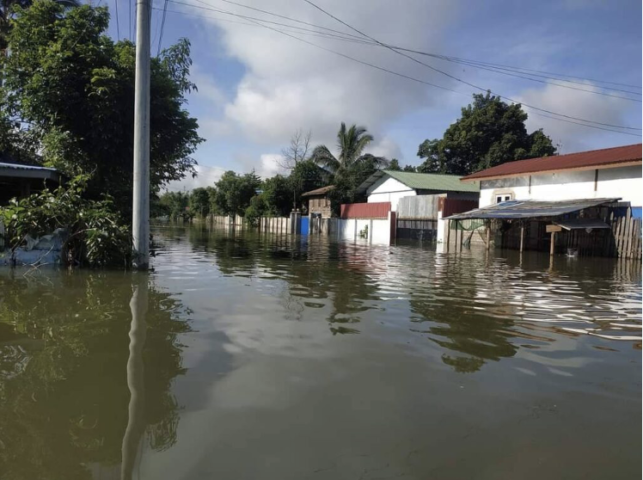
Caption – Some flood-affected homes of local residents in Loikaw.
Q: How far have the rehabilitation efforts progressed? What preparations have been made in light of the reports of another storm?
A: Currently, we’re repeatedly warning those who need to relocate. By warning, I mean we’re asking them to move from their original locations to other areas. We’re doing this consistently. We’re giving warnings and also continuously working on resettlement. As for rebuilding, it will be quite challenging. Even for the people affected by this first wave, we still haven’t been able to reach some areas to provide resettlement.
For example, in eastern Loikaw, only the local groups, administrations, and our department heads are working together to solve problems. We don’t yet have large organizations coming in to provide comprehensive rescue and aid efforts. This is true for both Loikaw and Hpruso. Even in Demoso, where we have 6-7 camps along the Pun Creek, we still can’t reach Camp 7. They can’t come to us either. We can only check on their situation by phone.
We haven’t even been able to start rehabilitation for some of the flood-affected people yet. So if another wave hits, rehabilitation will become even more difficult and delayed. The challenges of difficult access that I mentioned earlier are significant obstacles for organizations, groups, and individuals trying to assist with rehabilitation efforts.
Q: You mentioned earlier that the military junta’s troop movements during the floods led to delays in the delivery of humanitarian aid. Can you confirm where these incidents took place?
A: Primarily, if we’re talking about the route of these troop movements, we’re referring to the Union Highway. They were deployed in the Loikaw area which connects southern Shan State, and in areas leading to Loilen Lay and Hsihseng, and then as far as the entrance of Loikaw. And then from Loikaw up to the Union Highway that goes to Demoso. The military column is currently stationed on the Demoso-Ngwe Taung (102) section of this highway. Because the military column is there, we can use these routes to travel to the eastern part of Loikaw and Shadaw if we go by land.
But, there are military columns on these routes now. They have advanced and haven’t withdrawn yet. Because they’re there, we can’t travel. If we’re talking about other routes, it would be the water route I mentioned earlier. That is the Pun Creek. The entire Pun Creek is in between. So, [the rehabilitation efforts] are hindered by both the creek and the military columns. This has created difficulties for us in rescuing flood victims in the eastern part of Loikaw township and in Shadaw.
Sent by NMG.