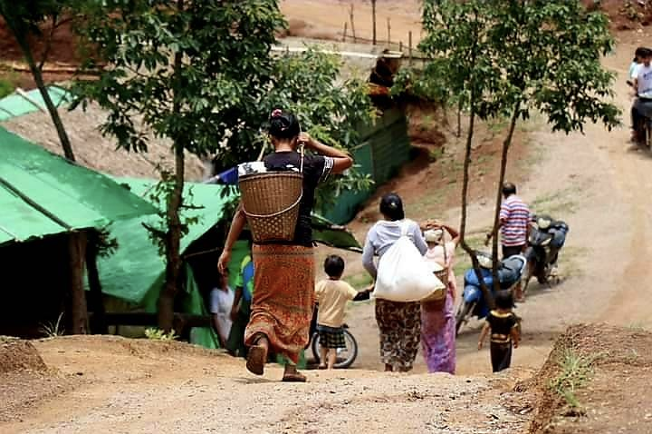
An interview with Ko Shine Lin, the person in charge of Yaung Chi Oo IDP camp in Hpruso Township, about the current needs and challenges in the camp.
The local population in Karenni (Kayah) State has been displaced for over three years due to the conflicts that erupted in the region after the military seized power in a coup.
While the internally displaced persons (IDPs) are living in camps, those responsible for the camps are managing not only their living and food arrangements but also their safety and health.
As the displacement period prolongs, the needs and crises are worsening due to rising commodity prices and a decline in the number of donors, according to IDPs and those in charge of the camp.
Kantarawaddy Times conducted this interview with Ko Shine Lin, the person in charge of the Yaung Chi Oo IDP camp in Hpruso Township, to learn more about the current needs and challenges in the camp.
Q: What areas do the displaced people in the camp come from?
A: Most of them are from San Pya 6 Mile village tract in Demoso Township. There are over 100 households and over 400 people.
Q: As the person in charge of the camp, how do you take care of the basic needs of the entire IDP camp? How do you manage it?
A: They are farming on a small scale. Some receive rice from their family members who are away. Those who are really struggling receive support from organizations.
Q: How long has the IDP camp been around? How many times did you have to move before you settled in this place?
A: We have been in this place for over a year now. Before we came here, we moved twice. So including this location, we had to move three times for the whole camp. Some people within the camp have moved even more times, like five or six times. There are people who came from different areas after moving four or five times. But as a whole, they had to move three times before they settled here.
Q: Why did you have to relocate multiple times? What was the reason?
A: The reason was that the junta carried out military raids and fired artillery, so we had to move from one place to another.
Q: What challenges did you face as the leader of the entire displaced group when you moved from one place to another?
A: One of the biggest challenges was transportation. There were no adequate means of transportation and even if we had some vehicles, there was a lack of fuel and cash, which made things very difficult. Even with some vehicles and fuel, it was difficult to transport elderly people, pregnant mothers, immobile people and children. The poor road conditions made it even more difficult.
Q: Given that the current IDP camp is in a remote area, do you feel safe? Is there still a concern that you’ll have to move again?
A: This place is safer compared to other places. The only concern is airstrikes. We haven’t seen any artillery attacks or ground attacks here. Air strikes are the only concern. We have even set up a school here, up to high school level, so that’s the main concern.
Q: Have you made preparations to protect yourselves as much as possible against airstrikes?
A: At the moment we have dug bunkers for both the school and the displaced people to protect ourselves from air raids. We have dug bunkers in the schools. Each displaced household has also built its own bunker at home. But if it does happen, there’s not much we can do. We have done our best to prepare as many defenses as possible.
Q: How do you take care of supplies in the IDP camp, as it’s quite difficult to reach this place due to poor transportation?
A: We haven’t made any special arrangements for transportation. But for food shopping, we gather people at least once a week. We rent a car together and drive off. That’s how we do it. We take care of buying rice and other groceries. For personal stuff, they have to arrange their own transportation. But even that is a challenge.
Q: Do people here farm for their food? In some IDP camps, the residents rent out their farmland. What is the situation here?
A: The locals here allow farming, but it’s a bit far away. We can do slash-and-burn farming. But because the terrain is different, there are some difficulties in clearing the land. On the plains, we didn’t need to fence our land. Here we can only have what we can protect with fences. And even then, sometimes cattle eat the paddy. Many people try to grow as much as possible, but the yield is low. We do it because we have no other choice.
Q: What about the education? What are the challenges?
A: In terms of education, we have classes up to high school here. The main difficulty is communication when we travel for school matters. Recently, donors have cut their support for stationery and school supplies, so we don’t have enough for the high school classes. We can no longer work as smoothly as in previous years.
When we need something for the children’s education, we sometimes have to collect money from the children to buy necessary items. We feel bad about that because they’re displaced people who have no income, only expenses. We want to further improve education, introduce different subjects and methods, but as I said before, we lack resources on the ground. We lack the necessary equipment and support, so we do what we can with what we have.
Q: As for religion, how many different religions are there? How do people of different religions live together?
A: Most of them are Christians. There are one or two groups of Buddhists. So we only have one Christian church. We celebrate important dates and holidays on religious occasions. People from other religions also participate. Everyone joins together. We don’t separate based on religion.
Q: Are there any other difficulties?
A: The displacement has been going on for a long time, so we’re facing a lot of difficulties. Getting enough food is a major challenge. The area we’re in is very rugged, and the weather can be quite harsh. When it changes, it has a big impact on people’s health. We’re using a lot of medicine to try to cope. And the bad roads are also causing problems for our vehicles.
Sent from Kantarawaddy Times.