Introduction
As the Spring Revolution continues, the determination of resistance forces to end the military dictatorship remains steadfast. Now approaching its fifth year, the armed struggle has made significant progress, marked by the seizure of towns and bases, and even the capture and control of the junta’s Regional Military Commands. However, in terms of coordinated operations, only sporadic efforts have been observed, highlighting the urgent need to achieve coordinated action through unity and collective strength to end the military dictatorship.
For the military junta, their plan is to stage a sham election as a last resort to salvage their failed coup process, aiming to deceive the international community and the public by forming a “civilian” government of former military officers. To this end, they are designating everyone who opposes this sham election— whether through words, actions, or even in thought, labelling them as disruptors and saboteurs of the election and imposing severe punishments. While unable to hold their sham election even in urban neighborhoods, they are attempting to expand territory by committing indiscriminate airstrikes on areas controlled by resistance groups for the sake of their sham election.
This issue BNI-Myanmar Peace Monitor’s Bi-Weekly News Review takes a closer look at the military formations and coordinated movements of resistance groups likely to be seen after 2025, as well as the military junta’s probable moves following the upcoming election.
Military Formations of the Resistance Groups
Initially, the formation, command, and strength of the People’s Defense Force (PDF) battalions and People’s Defense Teams (PaKaPha) under the Ministry of Defense (MOD) of the National Unity Government (NUG) will be presented.
On 18 December 2025, during the 8th session of the Union Parliament convened by the Committee Representing Pyidaungsu Hluttaw (CRPH), Union Minister from the NUG Prime Minister’s Office, Dr. Zaw Wai Soe, explained their new military organization, new command structure, and national-level defence strategies. From 2021 to 2024, resistance operations in areas of operation such as Military Region No. 1, the Southern Military Region, and the Central Military Region were conducted under the leadership and command of Ethnic Revolutionary Organizations (EROs). In 2025, the process of consolidating all PDF forces under a single unified command was implemented, he stated.
Currently, the PDF Headquarters directly commands five districts in northern Sagaing Region, Magway Region, and Mandalay Region within Military Region 1. In the Southern and Central Military Regions, 10 regional commands have been reorganized, with 1 division and 359 battalions directly commanded by the PDF Headquarters. In addition, a PaKaPha headquarters has been established, and a total of 277 PaKaPha units—at township, district, and regional levels—have been formed and deployed nationwide. These PDF battalions and PaKaPha units are being assigned responsibilities through the NUG-MOD in areas of public affairs and defense, as presented by Dr. Zaw Wai Soe.
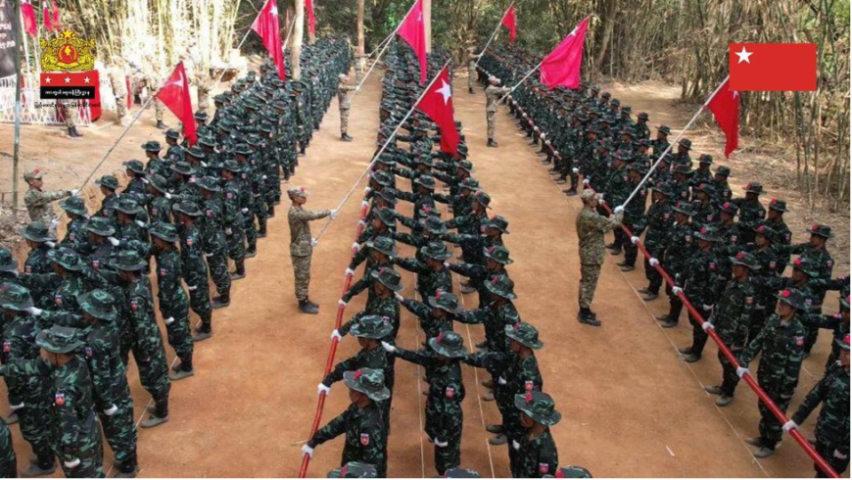
In essence, based on an estimated minimum strength of 210 personnel per battalion for the 359 battalions directly commanded by PDF Headquarters, the minimum troop strength is approximately 75,000. When combined with the forces within the 277 PaKaPha units, the total troop strength can be said to be no less than 100,000. The National Strategic Defense (NSD) approved during the PDF ‘Senior Commanders’ Conference’ in August 2025 outlines objectives to be achieved in 2026, including expanding and defending controlled territories, penetrating new operational areas, conducting urban guerrilla operations, launching targeted offensives, strengthening coordinated joint operations, and carrying out psychological warfare, as stated by Dr. Zaw Wai Soe. [1]
Union Minister Dr. Zaw Wai Soe also mentioned plans to complete the strengthening of collective operations and psychological warfare by 2026. Additionally, while combat operations are being carried out in Magway and Sagaing through cooperation with allies, a joint command system has been established with the All Burma Students’ Democratic Front (ABSDF), including the formation of coordination and ground command teams.
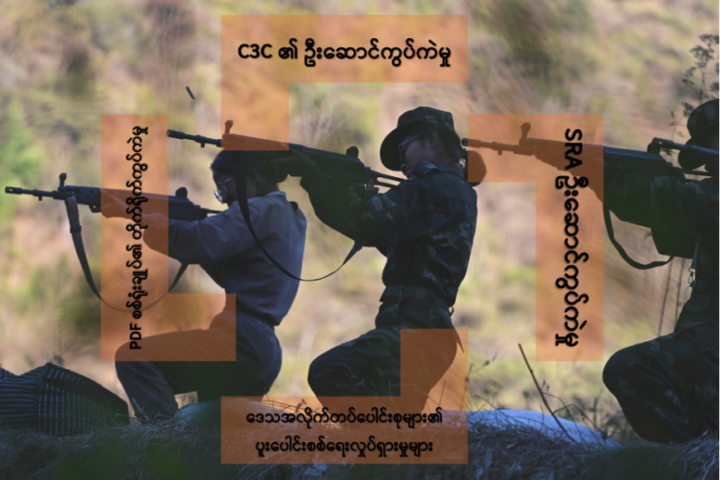
Upon examining the command structures of the resistance forces, various forms can be observed: direct command by the NUG-MOD : leadership by the Central Command and Coordination Committee (C3C) [2] , jointly established by the NUG-MOD and four EROs; command by the Spring Revolution Alliance(SRA) [3], comprising 19 groups; and joint command models by other regional allied forces. Therefore, it is anticipated that synchronized offensives combined with these new organizational structures of the revolutionary forces will likely be witnessed in 2026.
Likely Post-Election Moves by the Junta
As is widely known, Phase 1 of the junta’s sham election will be held in 102 townships on 28 December. Phase (2), covering 100 townships, is scheduled for 11 January 2026. However, the junta’s Union Election Commission has announced that elections cannot be conducted in up to 2,931 wards and village tracts across these 202 townships in both phases. [4]
By township, elections will be completely impossible in a total of 56 townships:
17 townships in Shan State, 10 in Sagaing Region, 10 in Arakan State, 5 in Magway Region, 4 in Kachin State, 4 in Chin State, 3 in Karenni (Kayah) State, and 3 in Mandalay Region, as announced as early as 14 September 2025. Furthermore, there are up to 103 townships where elections can only be partially held, meaning that in a total of 159 townships, a complete election could not be conducted. [5] (Note: A Phase (3) is mentioned for 72 townships, but no specific date has been announced yet.)
The boastful claim by junta leader Senior General Min Aung Hlaing of holding elections nationwide has, based on the above facts, clearly gone down the drain. Nevertheless, even for this incomplete sham election, the junta has charged 229 civilians including children with violations under their enacted election protection law for allegedly opposing or disrupting the process. Under this election law, s, which carry penalties ranging from a minimum of three years in prison to the death penalty, sentences have already been handed down to some individuals, including artists. [6]
In essence, the military junta is likely to use their incomplete sham election as a pretext to convene elected representatives in the first quarter of 2026 and transition into a nominally elected government. The junta chief himself appears to expect and trust that the military-backed Union Solidarity and Development Party (USDP), dominated by candidates who have shed their military uniforms, will secure the majority of seats.
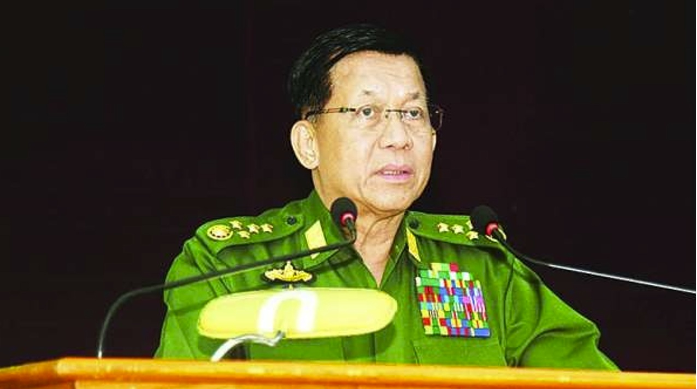
On 20 December 2025, during a meeting with officers, other ranks, and their families in the Magway military cantonment, junta leader Senior General Min Aung Hlaing issued the following directive:
“During the election period, you should vote for those who can work with the Tatmadaw [military], who adhere to and uphold our ‘3 National Causes’, and who are knowledgeable about politics, economy, and defense.” [7]
It is beyond doubt that the junta, following their sham election, will attempt to expand their presence in the international community by using an “elected” parliament and government as a front, even if no one truly accepts them. Simultaneously, the junta’s allies including China, India, and Thailand, who remain tied to them by various interests may praise and recognize these steps taken by the junta.
Analysis
The steps taken by the military junta following their sham election will not create any significant new political landscapes, and the pathways to escape the multifaceted crises in Myanmar – stemming from the military takeover remain absent. Nationwide airstrikes, forced conscription through arbitrary arrests to bolster depleted ranks, and other terrorist acts by the junta show no signs of abating.
Meanwhile, new formations, command structures, and signs of unity among resistance groups aimed at ending the military dictatorship are gaining momentum to spread and exert influence across the entire country. Therefore, the resistance’s military plans targeting the junta are the more likely to grow stronger in 2026.
In conclusion, the year 2026 will continue to see coordinated resistance offensives by forces across the nation, alongside the violent acts, including airstrikes, perpetrated by the military junta under the guise of an elected government.
[1] 8th session of the Union parliament (first day), CRPH, 18 December 2025
[2] Deciphering Myanmar’s Peace Process – A Reference Guide (2023-2024), Page 40, BNI-MPM
[3] Spring Revolution Alliance: Forging Victory, BNI-MPM, December 2025
[4] Junta announces elections won’t take place in 2,931 wards, village tracts, DVB, 6 Dec 2025
[5] 2025 election – record number of areas where elections cannot be held, BBC, 13 Dec 2025
[6] Over 200 civilians, including minors, arrested by junta under election law, Mizzima, 18 Dec 2025
[7] Junta chief urges to vote for candidates who can work with military, Mizzima, 21 Dec 2025