Introduction
The three-day working visit of Timor-Leste’s delegation, led by their Minister of Foreign Affairs and Cooperation, to Myanmar has raised questions about the diplomatic approaches of the National Unity Government (NUG) Ministry of Foreign Affairs. The Government of Timor-Leste (East Timor), which had previously faced pressure from the military junta to the extent of expelling its chargé d’affaires from Myanmar, once recognized the NUG as a legitimate government by inviting the NUG Foreign Minister and delegation to attend its new government’s inauguration ceremony, positioning itself as a democratic ally for the Spring Revolution.
This week’s BNI-Myanmar Peace Monitor’s Bi-Weekly News Review examines the foreign engagement strategy of the NUG Ministry of Foreign Affairs and progress in the international arena, based on events and data.
NUG’s diplomatic progress after four years
Among the six strategic approaches for the revolutionary period adopted by the NUG on 16 April 2021, foreign relations approach is listed second in priority. The NUG Ministry of Foreign Affairs, headed by Union Minister Daw Zin Mar Aung, has declared its commitment to pursuing an independent, active, and non-aligned foreign policy, building partnerships with countries that support efforts to end authoritarian rule. It also aims to cooperate with ASEAN member states, neighboring countries, and nations that support Myanmar’s democracy and development efforts.
The NUG Ministry of Foreign Affairs, working to gain international recognition for the NUG, prevent international recognition of the military junta, and obtain practical international assistance including humanitarian aid, has appointed representatives in nine countries: ASEAN, Australia, Czech Republic, India, Japan, South Korea, Norway, France, and the United Kingdom, according to the NUG’s 4th anniversary report. The report also mentioned that a diplomatic office of the Republic of the Union of Myanmar was opened in Dili, Timor Leste, in June 2024, with a deputy chief of mission appointed.
Through official invitations from relevant governments, organizations, and individuals in various countries, the NUG Foreign Minister has attended meetings in 13 countries, while the Deputy Foreign Minister has conducted meetings and discussions with government, parliamentary, and departmental officials from the United States and other countries. At the United Nations, Ambassador U Kyaw Moe Tun continues to hold the position of Myanmar’s permanent representative to the UN consistently raising issues about international attention to Myanmar’s situation and human rights violations against the Myanmar people with facts and incidents.
The NUG Ministry of Foreign Affairs has also stated in the NUG’s 4th anniversary report that it will make adjustments based on changes in domestic politics in relevant countries to further expand diplomatic relations with the international community, including neighboring countries, to gain greater international recognition and effectively protect the interests of Myanmar citizens. 1
The Timor-Leste Case: A Lesson to Learn
East Timor was the second country after the Czech Republic to officially recognize the NUG as a legitimate government and conduct public relations. On 1 July 2023, it officially invited the NUG Foreign Minister and delegation to attend and celebrate the new government’s inauguration ceremony in Dili.
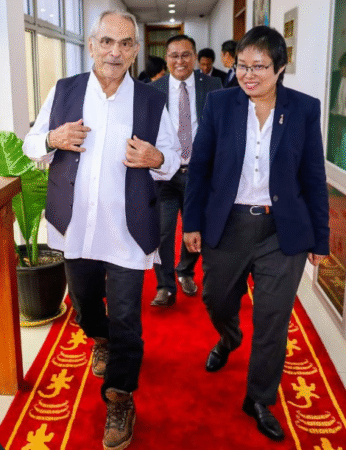
According to a statement from the NUG Foreign Ministry, the delegation led by NUG Foreign Minister Daw Zin Mar Aung met with East Timorese government leaders including President José Ramos Horta, Prime Minister Xanana Gusmão, Minister of Foreign Affairs and Cooperation Bendito Freitas, and Parliament Speaker Ms. Maria Fernanda Lay during their five-day visit from 1-5 July 2023. They discussed continued cooperation between the two countries and political agreements. 2
As a consequence, on 15 August 2023, the junta’s Ministry of Foreign Affairs the East Timorese chargé d’affaires in Yangon to leave Myanmar, claiming that East Timor was supporting and maintaining relations with the NUG. The East Timorese government rejected the junta’s action and announced on 27 August that it would continue to stand with the Myanmar people. It also urged the junta to peacefully seek solutions to the crisis while adhering to human rights standards.
The junta, however, stated that it wanted East Timor to reconsider its position and approach regarding Myanmar affairs, and even wrote to the ASEAN rotating chair objecting to East Timor’s recognition as an ASEAN member state. The East Timorese President responded that Myanmar’s junta’s objection was unreasonable and would not be effective. On 23 August 2023, the East Timorese President and Prime Minister also stated that they would not join ASEAN as long as ASEAN could not pressure Myanmar’s military dictators and resolve the Myanmar issue.
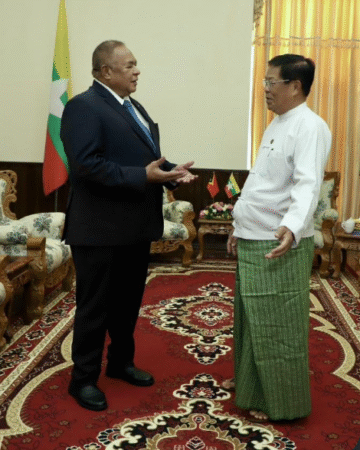
Then, in the third week of September 2025, a delegation led by Timor-Leste’s Foreign Minister visited Myanmar and met with the junta’s Foreign Minister, U Than Swe. The junta’s Foreign Ministry issued a propaganda statement on 18 September 2025, stating that during the meeting, the junta informed them that they would not allow the opening of offices by anti-regime organizations or anti-regime activities, and that Timor-Leste had offered to open an embassy in Dili. 3
Mr. Bendito Freitas’s statement, however, indicated that his three-day visit to Myanmar was a working visit at the government level, solely made to acknowledge the support of ASEAN member states, including Myanmar, for Timor-Leste’s efforts to join ASEAN in the near future. Mr. Bendito also stated that they exchanged views on regional cooperation, peace, stability, and bilateral cooperation. 4
Nevertheless, that the Timor-Leste government—a recognized democratic ally of the NUG and the Spring Revolution—was compelled to engage with the junta at the government level, provides a significant lesson for the NUG Foreign Ministry.
Analysis
The NUG Ministry of Foreign Affairs—the diplomatic front of the Spring Revolution—has had some success in its mission to end the military dictatorship and build a federal democratic union. This includes gaining engagement and recognition from Western European countries, like the United States, and achieving public engagement from ASEAN, under Malaysian Prime Minister’s leadership.
However, these countries and international organizations continue to engage with the junta, sometimes discreetly and sometimes publicly, making the NUG Foreign Ministry’s primary objective of “preventing international recognition of the military junta” an unfulfilled and ineffective endeavor.
these countries and international organizations continue to engage with the junta, sometimes discreetly and sometimes publicly, making the NUG Foreign Ministry’s primary objective of “preventing international recognition of the military junta” an unfulfilled and ineffective endeavor
The junta, ostracized by the international community, is gaining footing in the international circles, including ASEAN, with the support of neighboring China, and is also seeking recognition from governments like the US under President Trump. Moreover, it is using various methods to pressure anti-junta resistance forces, including the NUG, by extending its reach to neighboring countries such as Thailand, Laos, India, and Bangladesh. Unavoidable engagements like those of the East Timorese government with the military junta serve as lessons to be learned.
The NUG Ministry of Foreign Affairs must strive to present the complete picture of all aspects political, military, administrative, financial, and public relations of all revolutionary forces including the NUG on the international stage, seeking attention from international governments and organizations. It must also strive to take responsibility for resolving issues faced by overseas Myanmar citizens who support the Spring Revolution but cannot yet escape the pressure and control of the military junta.
Foreign governments, including neighboring countries like China, India, and Thailand, are already making calculations based on interests and engaging more heavily with the military junta. They are prepared to support new elections that the military junta will organize. Furthermore, attention to the Myanmar issue has significantly decreased amid global political changes.
In conclusion, while the NUG Ministry of Foreign Affairs has achieved some success across international circles, including the ASEAN, over the past four years, it must now develop new, practical approaches and conduct a thorough review of diplomatic strategy, adapting it to both the changing domestic political landscape and the evolving priorities of foreign governments.
Critically, future efforts must emphasize showcasing the unity and collective strength of all resistance forces to the international community.
while the NUG Ministry of Foreign Affairs has achieved some success across international circles, including the ASEAN, over the past four years, it must now develop new, practical approaches and conduct a thorough review of diplomatic strategy, adapting it to both the changing domestic political landscape and the evolving priorities of foreign governments
1. Four-Year Performance Report၊ NUG၊ 16 April 2025
2. Press release regarding Foreign Minister Daw Zin Mar Aung’s official visit to Timor-Leste, NUG-MFA, 10 Ju 2023
3.Meeting between Union Minister U Than Swe and the Minister of Foreign Affairs and Cooperation of Timor-Leste, The Mirror, 19 Sep 2025
4.H.E. Mr. Bendito dos Santos Freitas’s Facebook, 19 Sep 2025