
Introduction
The first anniversary of “Operation 1027”
On 27 October 2024, Maung Saungkha, commander of the Bamar People’s Liberation Army (BPLA), shared a message via social media, saying: “One thing I want to inform the people is that the BPLA will soon establish a presence in the Anyar region and begin operations.” He also expressed confidence that the people of Ayar would welcome them.
Burma News International (BNI) – Myanmar Peace Monitor’s (MPM) Bi-Weekly News review for this week reviews “Relocation of BPLA Troops and the Anyar Military Front” based on the facts and events.
Relocation of BPLA Troops and Background
The BPLA was established on 17 April 2021 (the 1st day of the Myanmar New Year). The BPLA has decided to bring justice to many people who lost their lives during the military coup, fight tyranny and chauvinism and fight the junta in collaboration with other ethnic armed resistance groups in order to establish a federal system which guarantees equality and self-determination.
The BPLA’s five political goals are: 1. the downfall of the dictatorship and the liberation of all the people from oppressive rule, 2. ending the doctrine of racial supremacy and realizing equality and self-determination, 3. building a new federal state that guarantees democracy and human rights, 4. incorporating the Bamar Federal Unit (or Bamar State) into the new federal union as a full member, and 5. protecting the freedom and safety of the public. The BPLA seeks to form alliances with organizations that share the common goal of dismantling the junta and ending the terror it is inflicting on the public.
The BPLA, which chose to take up armed struggle after failing to achieve justice through peaceful protests against the dictatorship, was founded by youths from the General Strike Committee of Nationalities (GSCN), along with artists, human rights activists, student unions, and regional strike leaders. The group was also supported by the Karen National Liberation Army (KNLA) and the Arakha Army (AA) in its formation. 1
According to the military structure of the BPLA, two key military regions have been established: No. 107 Military Region in Karen State and No. 203 Military Region in northern Shan State. Camp commanders have been assigned to each region, and battalions have been formed to carry out operations. In addition, the BPLA plans to expand its control into areas such as Sagaing, Magway, and Mandalay—regions with a significant Bamar population—while working to protect the human dignity, freedom, and security of the people. 2
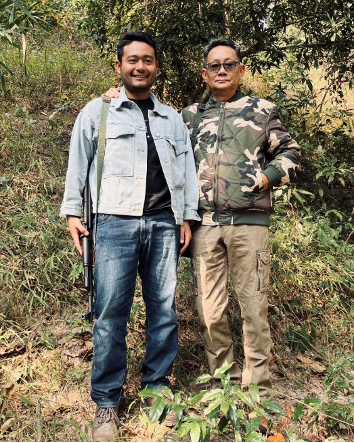
Regarding the relocation of BPLA Troops to the Anyar region, Commander Maung Saungkha warned that:
“When we establish ourselves in the Anyar region, we intend to build positive relations with both Ministry of Defense/ People’s Defense Force (MOD/PDF) battalions and other forces not under the MOD, working together to advance the revolution as quickly as possible. The BPLA will implement a step-by-step approach to represent the Bamar ethnic group and earn the recognition of the Bamar people. One thing is clear: the BPLA is not an army under the National Unity Government/Ministry of Defense (NUG/MOD). However, we promise to consistently seek collaboration with all local forces in the Anyar region, with a focus on unity.”
Could more war clouds gather in the Anyar region?
According to BNI-Myanmar Peace Monitor records, between 1 February 2021 and 5 November 2024, there were a total of 5,559 armed clash events across Myanmar. Of these, 1,832 events occurred in the Anyar region, which includes Mandalay, Magway, and Sagaing regions, as well as the Nay Pyi Taw Council area.). This means that 33 percent of all fighting during the military coup took place in the Anyar region. Sagaing, in particular, saw the most intense and widespread military conflict. When examining the armed clashes by year and month, it is evident that the level of fighting in Anyar—spanning Sagaing, Magway, and Mandalay—has continued at a pace similar to other regions of Myanmar.
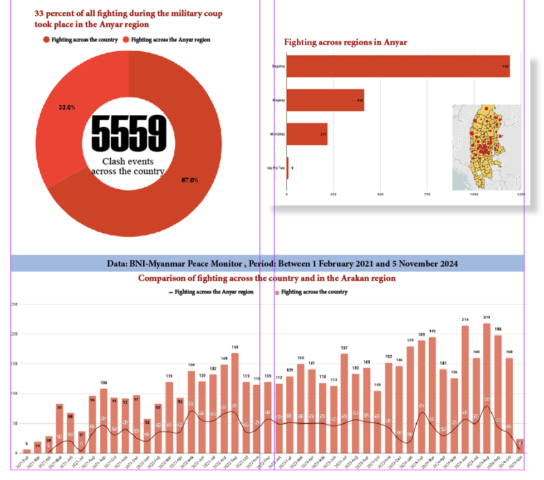
In the Anyar region, 99.5 percent of the fighting has been between Ethnic Revolutionary Organizations (EROs) , the People’s Defense Forces/Local Defense Forces (PDFs/LDFs), and the military council. Only 0.5 per cent of the conflict has been between the revolutionary forces themselves. Notably, this occurred between the Shanni Nationalities Army (SNA) and other revolutionary groups in Banmauk Township and Homalin Township in the upper Sagaing region.
The Anyar region—which includes Sagaing, Magway, and Mandalay—forms part of the No. 1 Military Region, where defense forces, led by the Kachin Independence Army (KIA), are conducting offensives against junta troops. So far, the defense forces have succeeded in capturing several towns from the military council, including Khampat, Shwepyiaye, Mawlu, Kani, Myothit, and Pinlebu in Sagaing Region, as well as Singu, Mogok, Tagaung, and Tabeikkyin in Mandalay Region. In these newly controlled areas, the National Unity Government (NUG) and revolutionary forces are collaborating to establish administrative and judicial mechanisms to govern the towns under their occupation.
Joint operations involving hundreds of PDFs/LDFs, PDF battalions under the NUG, various ethnic revolutionary forces, and columns from the All Burma Student’s Democratic Front (ABSDF) have been clearly visible in the Anyar region. These forces are actively engaged in resistance against the junta troops.
As a result, some view the deployment of BPLA troops, under the leadership of Commander Maung Saungkha, to the Anyar region as a significant strengthening of the revolutionary forces. However, others are concerned about the potential for conflict between different factions, depending on military operations and control of strategic areas.
Review
The BPLA troops participated in “Operation 1027 ” against the military council troops in the northern Shan State, under the leadership of Three Brotherhood Alliance (3BHA). Under the military leadership of the Karen National Liberation Army (KNLA) in the Southern Military Region, the BPLA is also fighting alongside other groups under the Joint Operations Command (JOC).
The recolation of the troops of the BPLA into the Anyar region, which believes that the emergence of a Bamar state or a Bamar federal unit is necessary to build a federal democratic country with political equality, is seen by many as a significant military reinforcement for the revolutionary forces in the Anyar region, which are fighting to end the military dictatorship. It is important to be aware that there may be political differences.
As a result of the relocation of BPLA troops, armed conflicts may intensify and spread further across the Anyar region, which includes Sagaing, Magway, and Mandalay. It needs to monitor the relocation of BPLA troops to No.308 Anyar Military Region and the Anyar military front.
In light of these developments, BPLA Commander Maung Saungkha has conveyed the following message to the public:
“We want to make it absolutely clear to the public that the belief we must have a Bamar state, and that we alone represent it, is entirely wrong. In reality, if we can resolutely resist the military council by forming alliances with the existing forces in the Anyar or Bamar region, there is no reason why the Bamar region cannot become a truly liberated area.”
1 Policy Position, the emergence of BPLA, BPLA, 4 January 2024
2 Policy Position, military strategy, BPLA, 4 January 2024