Introduction
It is often said that ‘Myanmar is just a tool in China’s hands’. They often view the Chinese government in a role or position from which it can manipulate the Myanmar’s military junta at will and exert pressure on the ethnic resistance organizations.
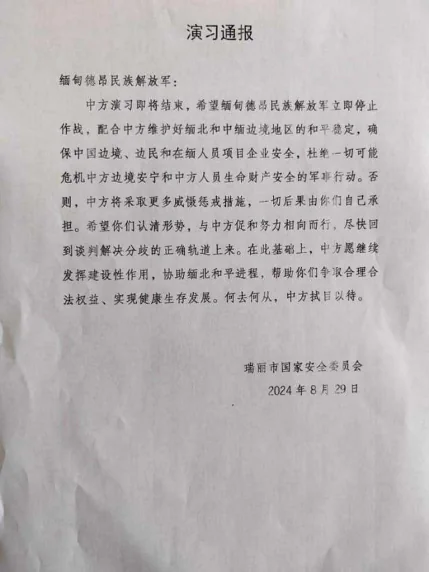
On 29 August, in reference to the Shweli National Security Committee’s warning letter to the Palaung State Liberation Front/ Ta’ang National Liberation Army (PLSF/TNLA), some concluded that “this threatening letter is quite serious and it is proof that China will not accept the fall of the military dictatorship under any circumstances.”
This week, Burma News International (BNI)-Myanmar Peace Monitor’s bi-weekly news review focuses on the Chinese government’s threatening letter to the TNLA, the Chinese government’s efforts to promote the military junta, and its stance towards the resistance forces, based on facts and events.
Chinese government’s threatening letter to TNLA
The Chinese-language warning letter by the Shweli National Security Committee to the PSLF/TNLA dated 29 August 2024 warns the PSLF/TNLA “to stop fighting immediately to maintain peace and stability on the Myanmar-China border and protect the lives and property of Chinese citizens”. The letter goes on to say that if the warning is not heeded, various forms of pressure will be applied, and the PSLF/TNLA will be held responsible for the consequences.
Additionally, the letter expresses hope that the PSLF/TNLA will quickly return to the right track to jointly promote peace, resolve differences and participate in the peace process and that the Chinese government will help realize appropriate legal rights and interests.
Although it has not yet been confirmed whether the warning letter was sent to all members of the Three Brotherhood Alliance (3BHA) involved in “Operation 1027”, PSLF/TNLA spokesperson Lwe Ye Oo and PSLF/TNLA General Secretary Major General Tar Bone Kyaw confirmed that they have received the letter.
China’s efforts to promote the junta
Since the third week of July 2024, the activities of Chinese Foreign Minister Wang Yi and the Chinese Ambassador to Myanmar have been observed more frequently in relation to safeguarding China’s interests within Myanmar. In particular, China’s moves in August were clearly seen as accommodating the military junta and applying pressure on the resistance forces.
At a press conference in Beijing on 25 July, Chinese Foreign Ministry spokesperson Mao Ning said: “China is closely following the situation in northern Myanmar. We call on the relevant parties in Myanmar to engage in dialogue and negotiation, cease hostilities as soon as possible and resolve differences peacefully, especially to ensure that China’s security is not harmed, and to protect the safety of residents in the border area as well as China’s projects, businesses and personnel in Myanmar.” 1
Starting from 12 August 2024, the newly appointed Chinese Ambassador to Myanmar, Ms. Ma Jia, began her duties at the Chinese Embassy in Yangon. Mr. Wang Yi, who is a member of the Political Bureau of the Central Committee of the Communist Party of China and also China’s Foreign Minister, met with junta chief Senior General Min Aung Hlaing in Nay Pyi Taw on 14 August.
According to a statement released by the Chinese Embassy in Myanmar, Mr. Wang Yi stated the following: China upholds the principle of non-interference in the internal affairs of other countries; China firmly supports the military junta’s “Five-Point Roadmap” for the democratic transition under the 2008 Constitution; China opposes the instability and armed conflicts in Myanmar, and condemns the outside interference in Myanmar’s internal affairs; China opposes any statements or actions that aim to divide China-Myanmar relations or defame China.
According to reports, Mr. Wang Yi also met with Deputy Prime Minister and Foreign Minister U Than Swe and retired Senior General Than Shwe in Nay Pyi Taw.
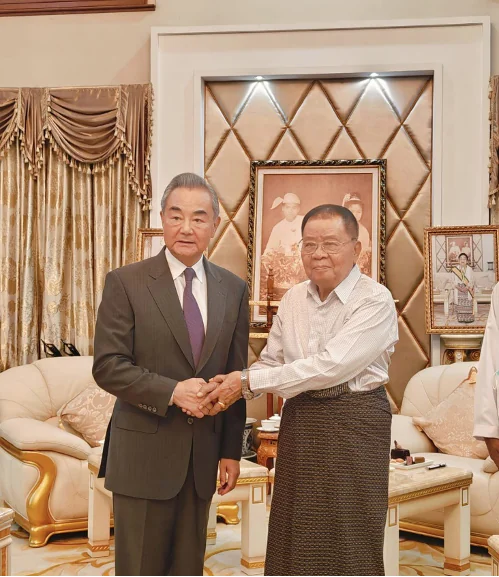
Retired Senior General Than Shwe was quoted as saying, “China has provided valuable support to Myanmar in defending against foreign intervention and maintaining internal stability, and it is expected that China will continue to provide such support.”
On 16 August 2024, the junta’s foreign minister was allowed to attend the informal meeting of the foreign ministers of China, Laos, Myanmar and Thailand in Chiang Mai, Thailand. 2
Mr. Wang Yi’s proposals during this meeting indicate that the Chinese government is making efforts to accommodate the Myanmar military junta on both regional and international levels. Mr. Wang Yi suggested that the military junta’s third version of the ‘Five-Point Roadmap’ should be considered. 3 This roadmap aims to “successfully hold a free and fair multiparty democratic general election, ensure nationwide stability and the full implementation of the rule of law.”
At a meeting between Mr. Wang Yi and Ms. Julie Bishop, the UN Special Envoy on Myanmar, in Beijing on 20 August, Mr. Wang Yi reiterated China’s principle of non-interference in internal affairs and its expectation that the Myanmar peace process and the military junta’s new Five-Point Roadmap will be effectively implemented, in line with ASEAN’s Five-Point Consensus on Myanmar. 4
According to our findings, the new Chinese Ambassador to Myanmar, Ms. Ma Jia, has also continuously met with ministers from various departments of the military junta, including the junta chief. On 30 August, at the 3rd quarterly China-Myanmar Media Forum in Yangon, the Chinese side clearly opposed any attempts to drive a wedge between China-Myanmar relations and external interference in Myanmar’s internal affairs. They also spoke in support of stability, reconciliation, and development in Myanmar.” 5
China’s stance towards the resistance forces
On 17 July 2024, Chinese authorities closed the Chinshwehaw border gate in Laukkai Township, the Pang Hseng and Kyin San Kyawt border gate in Muse Township, which is controlled by the Myanmar National Democratic Alliance Army (MNDAA), and the Nawng Tawng border gate in Namkham, which is controlled by the Ta’ang National Liberation Army (TNLA). 6 On 24 August, the Chinese government also closed the Man Hkar gate in Nam Tit, which is controlled by the United Wa State Army (UWSA), and tightened controls at the remaining major gates of Hsaw Hpar and Pangsang, restricting the movement of goods. 7
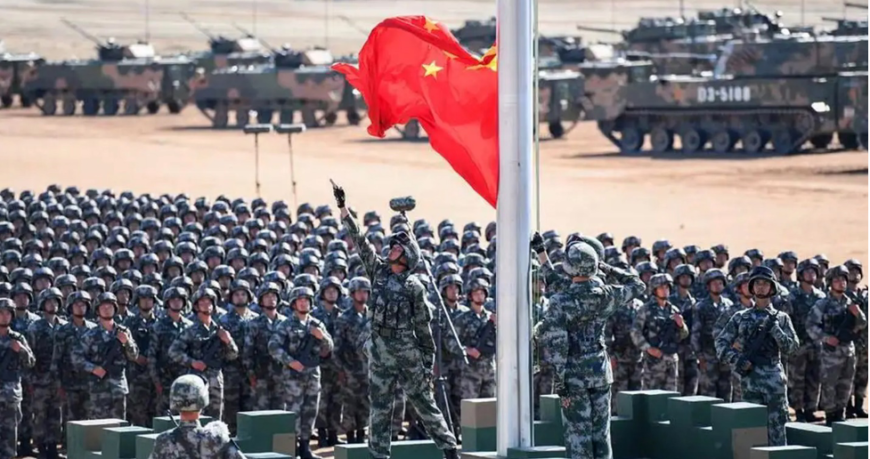
From 27 to 29 August, the Chinese People’s Liberation Army (PLA) conducted military exercises in four locations bordering northern and eastern Shan State, including Shweli, to test its multi-dimensional blockade and joint attack capabilities, and to ensure border security and stability. On 29 August, the “Shweli National Security Committee” sent an unmarked threatening letter to the TNLA the last day of the military exercises.
On 31 August, the National Unity Consultative Council (NUCC) strongly condemned this threatening letter as a violation of the sovereignty of the Myanmar people and called for the withdrawal of this demand. 8
Review
Regarding Chinese government’s threatening letter to the TNLA, the Chinese government officials, including the Chinese Embassy in Myanmar, have neither openly admitted nor denied sending the letter. Instead, Chinese Foreign Ministry Spokesperson Mr. Lin Jian stated that “China will continue to play a constructive role in the peace and reconciliation process in Myanmar, and will work to de-escalate the situation in northern Myanmar.” 9
After the first phase of ‘Operation 1027,’ the seizure of bases and towns by the resistance forces, along with the losses suffered by the military junta, has kept the Chinese government busy. Protecting the interests and security of the Chinese government and Chinese citizens in Myanmar, including border trade, has become a pressing issue. As “Operation 1027” revived in its second phase after the collapse of the Haigeng Agreement and the resistance forces now control around 80 towns, some of China’s major economic projects in Myanmar have also come under the control of the resistance forces.
According to National Unity Government (NUG) Defense Minister U Yee Mon, “All of China’s projects, including oil and gas pipelines, are now in the areas controlled by the resistance forces. … The PDF fighters are doing their best to secure and protect all international investments, including China’s projects, in accordance with the NUG’s policies and guidelines. So we hope that China will take a practical approach in dealing with the situation in Myanmar.” 10
The Chinese government’s recent approach of “maintaining stability and security along the Myanmar-China border and protecting the lives and property of Chinese citizens” can be seen as both exerting pressure on and making threats against the resistance forces, while also promoting the military junta’s presence on the international stage. Moreover, the Chinese government continues to disregard the will of the people of Myanmar, who reject the military coup, and appears to be concerned about the potential fall of the military regime, as evidenced by its restless activities.
1 Foreign Ministry Spokesperson Mao Ning’s Regular Press Conference on 25 July 2024
2 Informal talks between foreign ministers of China, Laos, Myanmar, and Thailand, Chinese Embassy in Myanmar, 16 August 2024
3 State Administrative Council’s Five-Point Roadmap, NPE, 31 August 2024
4 Meeting between Mr. Wang Yi and Ms. Julie Bishop, UN Special Envoy on Myanmar, Chinese Embassy in Myanmar, 21 August 2024
5 Ambassador Ms. Ma Jia introduces spirit of the 3rd Plenary Session of the 20th Central Committee of the Chinese Communist Party to Myanmar media, Chinese Embassy in Myanmar, 20 August 2024
6 China shuts down MNDAA and TNLA-controlled border gates, Shan News, 18 July 2024
7 China shuts down UWSA-controlled Nam Tit border gate , Shan News, 27 July 2024
8 NUCC strongly condemns China’s warning for immediate ceasefire, AFP, 31 August 2024
9 Foreign Ministry Spokesperson Lin Jian’s Regular Press Conference on 30 August 2024
10 Interview with NUG Defense Minister U Yee Mon (Video), Irrawaddy, 1 September 2024