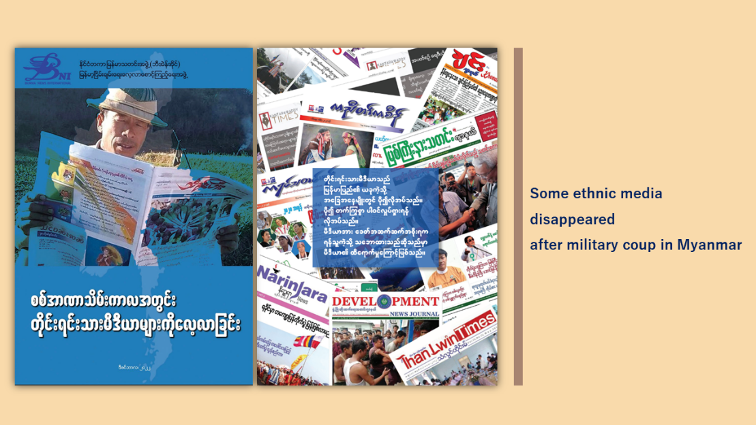
Burma News International (BNI) – an organization composed of ethnic media – said some ethnic media outlets in Myanmar disappeared due to the security situation and survival difficulties after the military coup.
The news organization said this at the launch of two analysis papers, “A study of ethnic media following the 2021 coup” and “Does the military misuse peace talks for the perpetuation of dictatorship?” held in Chiang Mai, Thailand, at the end of December.
BNI Finance Committee Chairman Sai Meng said, “Many media outlets have stopped. In Chin State, for example, there were 16 news media, but now 10 of them have disappeared. Even in our Shan State, many news media, mainly based in Taunggyi, are no longer able to produce news. Some editors are in prison. Some have been arrested. There are many independent journalists who have become unemployed. There are many such cases,” he said.
BNI has not yet been able to record the number of disappeared news media and will try to include the figure in the analysis papers that will be prepared later, said Shwe Yee, who is in charge of BNI’s peace monitoring team.
“In our research, we could not give the exact number of ethnic media that disappeared [after the military coup] and those that are still operating. Our paper focuses mainly on the difficulties and challenges of today’s media, especially ethnic media. But one thing we were able to point out in the paper is that ten of the 16 news outlets in Chin State have disappeared and only six of them are still working online,” she said.
After the coup, the military council shut down the publishing rights of the free-writing media, and journalists were arrested and jailed. In addition to the intimidation, freedom of expression has been restricted, some news outlets have been closed, and most journalists have lost their jobs, BNI said.
The BNI said that news agencies and journalists cannot work as freely as they used to and are constantly watched by the military, so they do their news work while hiding from danger.
BNI Managing Director Daw Tin Tin Nyo said, “The areas where ethnic media are present are very limited. The junta authorities know exactly who is in which media and what they are doing. Therefore, it is hard for them to survive in such a situation. There can be a lot of challenges. No matter how passionate they are about their work, they can be arrested at any time. Their lives and families are threatened. That can lead to media companies being shut down or them having to stop working.”
She went on to say that financial difficulties are among the reasons why media outlets shut down or journalists have to stop producing news.
“If funders stop supporting them or their support is limited, especially for ethnic media that are already financially weak or have had problems from the beginning, they can disappear at any time. Despite the uncertain future, ethnic media continue with their work. Overall, there is a possibility that the media, especially small media and ethnic media, can disappear at any time,” she added.
Therefore, BNI calls on international donors to continue their support so that the ethnic media do not disappear and can report on traditions, economic and social aspects of ethnic people and human rights violations against them,
Sent by NMG.