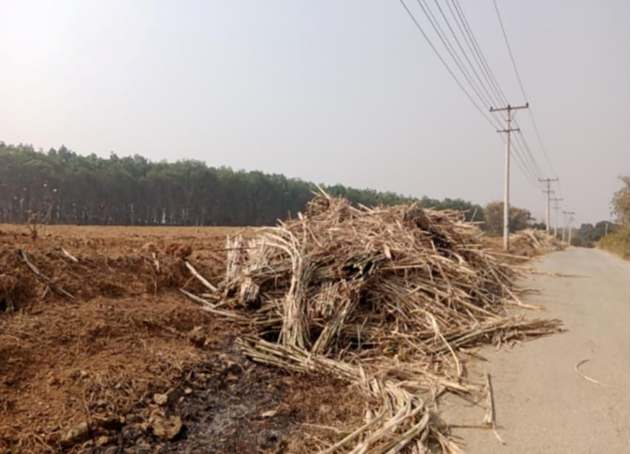
Locals say the Myanmar National Democratic Alliance Army (MNDAA) is forcibly leasing public lands to cultivate tissue-cultured bananas in the urban areas and villages of Theinni Township, Shan State.
A local woman said, “Since the first week of March, the MNDAA has been forcibly renting public lands in Theinni town and villages to grow tissue-cultured banana plants. They are doing this without the people’s consent, saying they would plant the bananas even if locals didn’t agree to rent the land at the price they offered. One acre of hilly land is rented for 200,000 Kyats per year, while plain land is rented for 500,000 Kyats per year. They also insisted on a 5-year contract.”
She added that the rent will be paid every two years.
Regarding the issue of leasing public lands, the MNDAA also threatened to forcibly confiscate the land if the people refused to lease it.
The residents of Theinni and the surrounding villages primarily cultivate corn and paddy. The local woman also expressed that if the land is leased to the MNDAA, it will be difficult for them to survive without any land to live on, said a 40-year-old local woman.
“The MNDAA is plowing the land with large tractors. The people don’t dare to oppose them because they are armed. The people need to carefully choose whether to generate income or fall into a trap. If they do this, we will have no more land to cultivate, and it will also destroy our economy,” said the local woman.
In addition, an eyewitness reported that the MNDAA forces are renting land owned by locals under a 15-year contract to plant tissue-cultured banana plants in Nam Pawng village, Lashio Township, in northern Shan State.
“The MNDAA is planning to grow tissue-cultured banana plants not only in Theinni but also in other areas under its control. In Nam Pawng village, landowners are being forced to sign a 15-year lease. Villagers said that they would grow the plants for their stable food supply. No one dares to oppose them, as they will forcibly proceed if locals refuse to lease their lands,” he said.
Tissue-cultured bananas are primarily exported to China. The cultivation of these bananas involves the use of chemicals, pesticides, fertilizers, leaf sprays, herbicides, and chemical spray bottles.
Theinni residents say that if the MNDAA rents public lands for five years and cultivates them, the soil will be damaged, making it impossible to grow other crops or rice afterward.
“The soil here is very good. If the MNDAA uses too much fertilizer for the banana plantations, it will damage the soil. After five years, the land will no longer be suitable for growing other crops. Locals are also concerned about the deaths of domestic animals and potential outbreaks of diseases,” said a farmer from Theinni.
“If these pesticides are not disposed of properly, people could be poisoned,” he added. He also mentioned that the cultivation of tissue-cultured bananas has already caused issues in Kachin State.
The MNDAA took complete control of Theinni town in early January 2024. A ceasefire agreement between the MNDAA and the military council came into effect on 18 January, following the seventh round of talks in Kunming, mediated by China, said Foreign Ministry Spokesperson Mao Ning at a regular press conference on 20 January.
Sent by Shan News