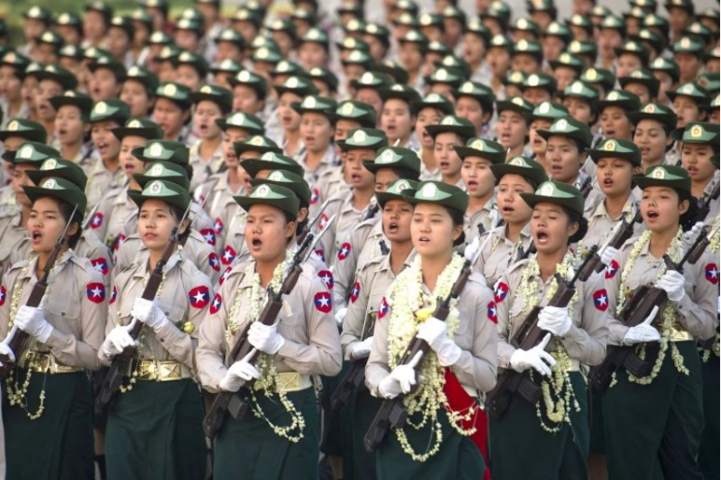
Concerns have been growing among women, particularly those working in factories and workplaces, following reports that the military junta opened a military service training program for women on August 10.
However, Dr. Khaing Khaing Soe, spokesperson for the Office of the President under military leader Min Aung Hlaing, said that the reports about a military service training program for women are false.
According to an August 9 statement by the Myanmar Military and Security Studies Group (MDS), the reported women’s military service training program is expected to accept and train recruits at No. 4 Warrant Officer and Sergeant Training School in Hmawbi, as well as at Rakhine Military Training Center No. 4 and several other military training schools.
At present, in some townships in Yangon, families are reportedly paying between 10,000 and 40,000 kyats per month to local administrators to prevent men from being conscripted. These payments are placing an additional financial burden on families struggling to meet their daily living expenses.
“If people are now also required to pay money to prevent women from being conscripted, it will create even greater difficulties for families trying to make ends meet,” said Ma Thida, an official from a labor union.
Ma Thida added, “At the moment, regarding military conscription, what we are hearing from factories, particularly in the garment industry, is that when their male family members are taken for military service, families have to provide money every month to prevent them from being conscripted. Now that women may also be subject to military service, people are wondering what will happen if the women are taken away. There may be young children and elderly parents left at home who depend on them. Families are already struggling with the rising cost of living. On top of that, people are asking whether they will have to pay money to the ward administrators to avoid conscription, or whether they will have to go to the military and plead with them not to be conscripted. We are hearing many such concerns. Workers also see this as something very frightening.”
Yangon is home to numerous garment factories and companies, and many workers work overtime until 9 or 10 p.m. to support themselves and their families.
Ma San Yu, a garment factory worker, said workers are increasingly concerned about their safety because of reports about the possible conscription of women.
“Regarding security, garment factories are currently requiring workers to do overtime until around 9 or 9:30 p.m. If something happens while workers are returning home, factories may not provide protection. Their attitude is essentially that if workers are taken, then so be it. Factories prioritize getting their garments produced and their products shipped on time. They do not pay attention to the safety of their workers.”
In Yangon, there have reportedly been incidents of men being forcibly arrested or taken away for military service. Some people have gone missing or been detained, while large amounts of money have also reportedly been collected in connection with conscription.
At the same time, there have been efforts to recruit men who are willing to serve in the military, with reports that, in some wards, individuals are being asked to pay between 6 million and 10 million kyats.
Given Myanmar’s current circumstances, Ma Thida from the labor union said that there is no immediate need to conscript women and that not requiring women to serve in the military would provide them with a safer life.
She added that, in the aftermath of the military coup, people are already struggling with the rising cost of living and trying to survive on low wages.
Against this backdrop, the possibility of military conscription for women has become another source of fear and anxiety for the public.
IMNA