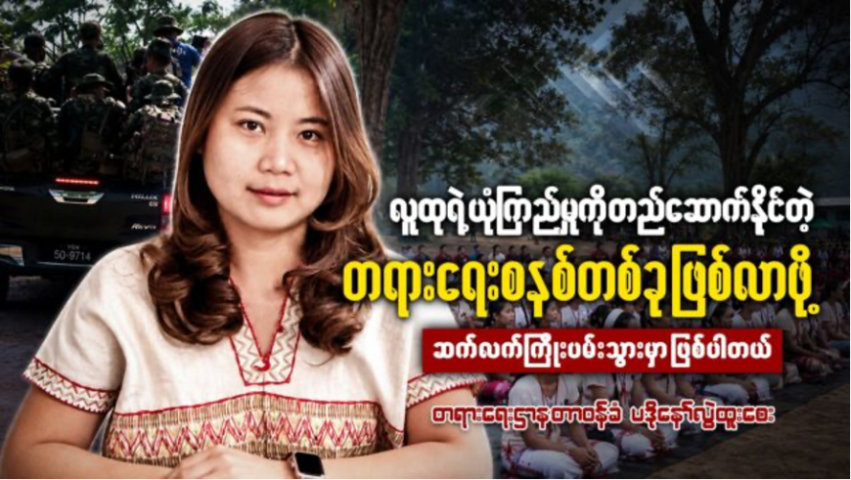
The First Kawthoolei Justice Forum was held from 1 to 3 June, bringing together more than 170 representatives from Karen organizations across all sectors, with the aim of building a justice system in Kawthoolei that the public can trust and rely upon.
Karen Information Center (KIC) spoke with P’doh Naw Lwal Htoo Say, head of the Karen National Union (KNU) Department of Justice, regarding how justice challenges arising during the current revolutionary period, including issues related to security, socioeconomic conditions, land, and mining, are being addressed, the critical role of women in the justice process, and the ways in which communities can participate in building the rule of law within the territory.
Q: Could you explain the main purpose behind organizing the Kawthoolei Justice Forum at this particular moment when the revolution is intensifying?
The forum was held to strengthen justice and the rule of law in the Kawthoolei region, to enhance coordination among relevant organizations, and to collectively identify practical solutions to the challenges that communities are facing. During the current revolutionary period, we are seeing an increasing number of challenges related to security, socioeconomic conditions, land, natural resources, and justice. These issues cannot be resolved by the Department of Justice alone. The forum was therefore organized so that relevant departments, committees, civil society organizations, and community representatives could come together, discuss these challenges, and chart a path forward collectively.
Q: Could you share the key outcomes and shared commitments reached at the forum?
The primary outcome of the forum was reaching a shared understanding on how to strengthen justice and the rule of law in the Kawthoolei region. In particular, shared commitments were reached in key areas including strengthening the rule of law, protecting community rights and security, land and natural resource management, increasing the participation of women and youth, and improving coordination among relevant organizations. Beyond that, the forum was not merely a one-time discussion – it was also a starting point for establishing ongoing regular coordination, information-sharing, and collaborative action going forward.
Q: We learn that online scam operations spreading across the Kawthoolei region were a significant topic of discussion at the forum. What decisions were reached on this issue?
Online scam operations have emerged in recent years as a deeply concerning problem in the Kawthoolei region. This is not simply a matter of financial fraud – it is interconnected with human trafficking, illegal operations, and a range of other criminal activities. We are also seeing some online scam centers attempting to portray themselves as generators of local employment and contributors to regional development. This risks normalizing illegal operations as if they were legitimate businesses, which – whether directly or indirectly – amounts to enabling criminal activity.
The impact of this problem extends beyond the economic and social spheres. It affects the rule of law, public security, human dignity, and the ongoing work of building the rule of law in Kawthoolei. For these reasons, it was recognized that this issue needed to be included in the forum’s discussions in order to collectively seek solutions. It should be noted, however, that online scam operations were not the sole focus of the forum. The discussions centered primarily on the interplay between economic conditions and the rule of law, within which online scam operations were given particular attention as a critical challenge currently threatening the economy, security, and the rule of law.
The forum formally recognized this issue as a challenge that undermines the rule of law, human dignity, and public security. As a result, participants agreed to strengthen public awareness efforts, inter-organizational cooperation, and community protection measures.
Q: It is understood that the impacts of mining operations were also discussed openly at the forum. How serious has the mining situation become in the Kawthoolei region? What decisions were reached on how to address it?
The main concern from the forum’s discussions was that unregulated mining operations can cause significant environmental damage, with resulting consequences that extend to communities’ livelihoods and daily lives. In particular, because land and natural resources are directly tied to communities’ livelihoods and cultural ways of life, it was recognized that mining must not be viewed solely through an economic lens, but must instead be approached from the perspective of community interests and long-term sustainable management. The forum agreed that land and natural resource management must be conducted on the basis of community participation, justice, transparency, and accountability.
Q: What challenges currently exist within the KNU’s justice system, and what reforms do you believe are needed to make it more systematic and comprehensive?
At present, the Kawthoolei region continues to face ongoing conflict, displacement, population movement, and security challenges. Amid these conditions, communities still face difficulties in accessing justice and obtaining legal services. In addition, given that the Kawthoolei region has multiple administrative, security, and justice organizations operating within it, stronger coordination among these bodies is essential. Continued efforts are also needed to build a justice system that is responsive to the evolving needs of communities and changing circumstances on the ground. To that end, we will continue working to strengthen legal policies and procedures, build the capacity of justice personnel, improve public access to legal services, and develop a justice system capable of earning the trust of the people.
The forum also reinforced a shared understanding that justice and the rule of law are not the sole responsibility of any single organization. They require the collective participation of relevant departments, justice bodies, civil society organizations, and communities alike – and that only through such collaboration can a justice system that is genuinely effective and beneficial to the public be built. At its core, our goal is to develop a justice system that commands public trust, remains accessible to all, and delivers justice more effectively.
Q: The forum agreed that land and natural resource management should be carried out with community participation and transparency. But when conflicts of interest and land disputes arise on the ground, what practical mechanisms will be put in place to translate this commitment into action?
This is a very important question, because community participation, transparency, and accountability are not sufficient as commitments on paper alone – practical mechanisms for implementation are essential. One of the key agreements reached at the forum was that decisions on land and natural resource matters should not rest with a single department or organization, but should instead involve regular consultation among relevant departments, local communities, civil society organizations, and other stakeholders.
Going forward, there is therefore a need to strengthen regular consultation platforms, information-sharing mechanisms, and collaborative working processes. In particular, when decisions are being made concerning land and natural resources, mechanisms must exist to ensure that the voices and perspectives of local communities are heard at the earliest stage, that concerns can be raised, and that these are systematically conveyed to the relevant authorities. Our view is that the most critical factor in resolving land and resource-related disputes is building the trust of the communities involved. To achieve that trust, we will continue working to strengthen systems that make transparency, accountability, and community participation a practical reality.
Q: How significant is the role of women’s organizations, including the Kawthoolei Women’s Network, in the justice process? And what was discussed regarding strengthening protections for women?
Women’s participation is something we see as absolutely central to the justice process. That is why, from the very planning stage, the forum was deliberately designed to prioritize women’s participation and leadership. To give some concrete figures: of the 177 total participants at the forum, 77 were women. Four of the ten panelists across the three panel discussions were women. Women’s organizations and women leaders themselves also played active, leading roles throughout the discussions.
In terms of strengthening protections for women, our view is that it is not enough to see women only as beneficiaries; they need to be people who have a seat at the table in decision-making processes, and who take on leadership roles. With that in mind, the forum placed particular emphasis on ensuring that the voices of women, youth, and more vulnerable groups are better reflected in discussions on justice and governance. At its core, I would say that this forum reinforced a shared understanding that when it comes to building justice, women must not merely be participants, they need to be leaders.
Q: Finally, what would you like to say to the people living in the Kawthoolei region to encourage them to know their rights and participate in the rule of law process?
Justice and the rule of law are not the responsibility of the Department of Justice alone; they are a shared responsibility. And in that shared responsibility, the most important actors are the people themselves. Success can only be achieved through the active participation of communities. That is why I want to encourage the public to understand their rights, to seek peaceful resolution of disputes, and to actively engage in community affairs. The voices and participation of the people are essential to building justice. Only through collective action can we build a more just and trustworthy future for the Kawthoolei region.
KIC