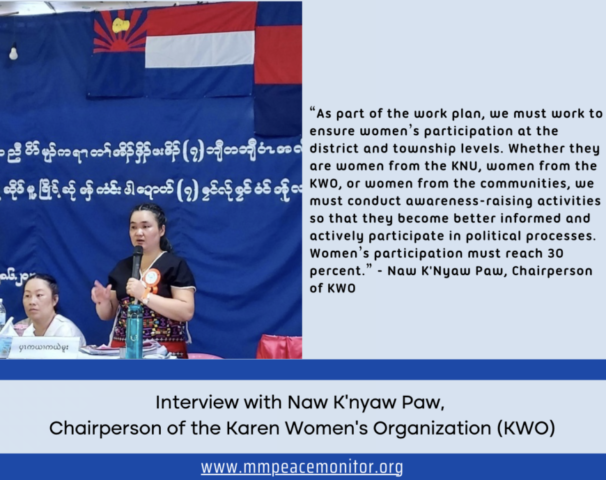
Following the 8th Congress of the Karen Women’s Organization (KWO), the fourth meeting of the Central Standing Committee was convened last March in a location within a Karen National Union-controlled territory.
This interview with Chairperson Naw K’nyaw Paw covers the organization’s future plans, perspectives on the establishment of “Kawthoolei,” and the current situation in refugee camps.
Q: What were the main topics discussed and decided upon during the 4th Central Standing Committee meeting of KWO?
A: We need to think and consult together about building a Kawthoolei State. The KNU has been talking about building a Kawthoolei State for a long time. As the Karen Women’s Organization, we have participated in those meetings. Various new drafts and documents have also been put forward. According to the latest situation, there are plans to rename and designate it as the Kawthoolei Government Council instead of the Kawthoolei State. We had to provide input, consult, and discuss our views and positions on this matter. We discussed this with the General Secretary. They are likely to take women’s voices into account.
Q: If the Kawthoolei State is to be built, what kinds of changes do you expect to see?
A: What I think is that the general public all want a Kawthoolei government. If we build the Kawthoolei State and form the Kawthoolei Government Council, it will open up a pathway where not only people from the KNU, but also people from other organizations can participate and contribute across sectors, whether as a woman or as a youth. This is one positive development. However, in the top leadership and political sectors, the KNU’s internal working processes will remain unchanged.
Q: Could you briefly tell us about the activities of KWO throughout 2025?
A: Looking back at the whole of 2025, we commemorated the 40th anniversary of KWO by recognizing women. We were also able to publish profiles of women. We spoke out so that the general public learns more about the Karen Women’s Organization. This is one of the outcomes we achieved.
Another one is that we established the Karen Women’s Network. After forming the network in collaboration with the KNU, we saw other ethnic organizations also joining. I see this as a positive outcome. We also had the opportunity to engage directly with communities and visit the refugee camps to assess their situation. This, too, was among the outcomes we achieved.
Regarding the refugee camps, we met with Thai authorities. It was not only our organization, but together with other groups, we advocated for refugees to be allowed to leave the camps for work. The Thai official authorized and made decisions on this.
We were able to organize advanced political training courses, as well as training for young Karen women leaders and advanced political training. This was a major success for us. Providing training so that people from the KNU, as well as women from various townships, can gain more knowledge about political processes.
Q: Since you mentioned the refugee camp issues, could you tell us about the latest situation in the refugee camps?
A: On the refugee issue, because support has decreased, we have been advocating for refugees to be allowed to leave the camps for work. Some have been able to go out and work without major difficulties. However, the current Thai authorities have set stricter conditions. Permission to work outside the camps has been granted only to those between the ages of 18 and 30. They haven’t granted permission for those above 30. In most cases, people are recruited by agricultural companies. While this is a positive development, challenges remain, such as inadequate wages and the absence of official documentation or formal certification.
At present, refugees may only leave when companies arrive to recruit them. We need to continue working so that they have the freedom to choose and go for the jobs they want. Another important point is enabling them to learn the Thai language. Since they will be working inside Thailand, they need to know the language. Teachers, medical staff, and camp leadership should not be compelled to seek outside employment; it is essential that sustained support be provided to them. We are also hearing that Thai authorities want to provide practical training in the refugee camp clinics and link them with hospitals and medical facilities so that services can continue. This would be a significant change for the refugees.
Q: Could you also talk about plans for refugees from the camps to resettle in third countries?
A: There are no major resettlement programs to third countries at the moment. However, some individuals can still go if they have relatives who can sponsor them in countries such as Australia, New Zealand, and Canada. Resettlement pathways to the United States remain closed, leaving no opportunities there at this time. Some people have gone to other countries, but there are no major programs anymore.
Q: Could you share KWO’s work plans?
A: As part of the work plan, we must work to ensure women’s participation at the district and township levels. Whether they are women from the KNU, women from the KWO, or women from the communities, we must conduct awareness-raising activities so that they better informed and actively participate in political processes. Women’s participation must reach 30 percent. We must prioritize efforts to enable women to take leadership roles and participate in various departments.
In addition to providing training at the district and township levels, we need to continue offering political training. As an organization, we must further strengthen and expand our activities. Specifically, we must also advocate for increased female participation in the military sector, where their involvement is currently low. We need to put more effort into the weak areas. Regarding school support, we still need to seek more resources as current support is insufficient. Some children want to go to school but cannot. We must continue working on this. We plan to keep collaborating closely with KECD (Karen Education and Culture Department).
The most important thing is that we must carry out advocacy. We need to raise more voices. The reason is that there has not been sufficient advocacy for the recognition of our people and our nation. In addition to ethnic armed organizations and other ethnic groups, we women are working on the ground in practical ways — both politically and militarily. What we need to demonstrate in practice is that the military council is violating human rights, and we must urge others not to support them. We must push for economic sanctions, cutting off revenue streams, and arms embargoes. It will become more difficult in the future. The military junta has already held elections and acquired a degree of legitimacy. Therefore, we and others must conduct advocacy and urge organizations, countries, ASEAN, and the UN to take action. This is what we must do moving forward.
They (the ethnic armed groups and women’s organizations) need to show the international community that they are actively working on the ground in both political and military efforts. As for the junta, we must continue speaking out so that other countries see the true nature of their policies. This is the most important task.
Q: Women’s voices and rights in the military sector are still limited. Could you explain this?
A: In the military sector, women’s voices are few. However, they are gradually increasing. In some leadership positions, there is still a mindset that women cannot work in the military. In military training, women are often sidelined. Even in the political sector it has taken many years, in the military sector, it will likely take even longer. In the military, the prevailing attitude is often that women are incapable of performing military roles, do not need to participate, and have no place in the institution — regardless of how much time passes. Therefore, recognition and participation of women in the military sector is still very limited.
Q: What are the impacts on women caused by air and artillery strikes during the conflict?
A: By the end of 2025, junta airstrikes in Kawthoolei territory had claimed more than 1,300 lives. Among them, more than 500 were women. In terms of injuries, out of more than 3,000 injured, over 1,200 were women. It is clear that women are being directly affected. In most cases, women and children suffer the highest impact. The consequences include fatalities and conflict-related displacement, which lead to psychological trauma and disruptions to food security, healthcare, and education. Because people have to hide in the jungle, they face various problems such as mosquito bites and skin infections due to unclean drinking water. Another issue is the psychological burden on mothers, particularly pregnant women, including excessive anxiety, sleep deprivation, and inadequate nutrition, all of which endanger both mother and child. Fear and trauma compound these effects in numerous ways.
Sent by KIC