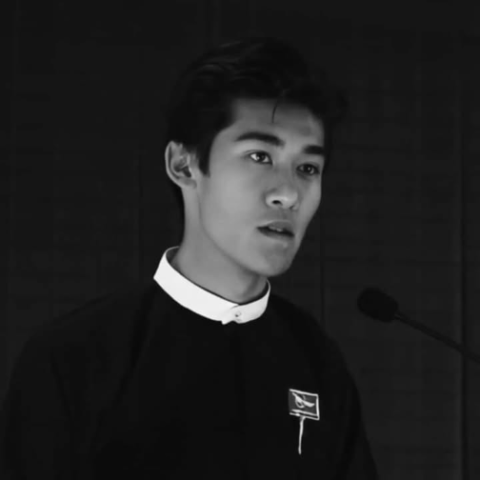
An interview with Ko Min Han Htet, a central committee member of the Student Armed Force (SAF) regarding the reasons behind its formation, its primary areas of military operations, and its alliances with ethnic resistance forces.
The Student Armed Force (SAF), a student-led armed group, has been training in areas under resistance forces, gaining military experience alongside victories. Now, the armed group is preparing to penetrate central Myanmar.
Narinjara News conducted this interview with Ko Min Han Htet, a SAF central committee member, to learn more about the reasons behind establishing the armed group, its key areas of military operation, its collaborations with ethnic resistance organizations and its perspectives on the genuine federal union demanded by ethnic nationalities.
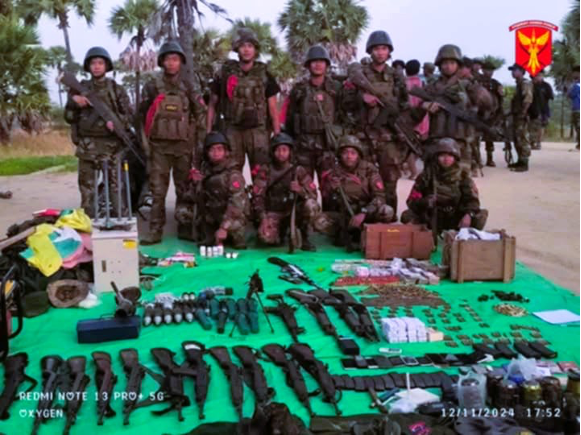
Photo – SAF
Q: First, we’d like to know about the reasons behind the formation of the Student Armed Force (SAF).
A: The reason we formed the Student Armed Force is rooted in the demands of the revolution. From the early stages of the revolution, we ourselves came to realize and feel that this revolution could not succeed through non-violent means. We learned this truth at the cost of our lives and our blood. That’s why we established the Student Armed Force. Here, we are students who come from student unions. Because of that, we drew on the strength of the student community to envision a solid organization—one with strong chain of command, an armed force led by students.
That’s why we formed the Student Armed Force in the military region of our allied group. Moving forward, we aim to consolidate even further, both in principle and in practice. At that point, we’re also working to make sure that the voice of the student community can emerge as one, and that the strength of the students can be united into a single force. To sum it up, the Student Armed Force came into existence because of the revolution’s demands. We believe that only through an armed struggle can we overthrow the military dictatorship. That’s why we gathered student strength and formed what we now call the SAF.
Q: In the past, when an armed force was established, it was commonly referred to as “Tatmadaw” (military). Now, you refer to SAF as “Tattaw”. Could you also explain the intention behind choosing this specific term?
A:There’s no particularly special reason behind it. We consider the terms ‘Tatmadaw’ and ‘Tattaw’ to have essentially the same meaning. However, since our predecessors, like the All Burma Students’ Democratic Front (ABSDF), used ‘Student Tatmadaw,’ we wanted to make a clear distinction. That’s why we opted for ‘Tattaw’ instead of ‘Tatmadaw’.
Q: What is the main goal of SAF? Is it solely to overthrow the military dictatorship? And after the military dictatorship falls, what political goals do you have in mind?
A: Our political vision is centered on the liberation of the people and the construction of a new nation. Throughout our struggle, we have consistently held onto the slogan of ‘liberation of the people and building a new nation’ as we fight. Within this, we see two key points. The first is the liberation of the people, which means uprooting the military triad (military regime, pillar of support for the military, and military bureaucracy)—completely dismantling the entire military dictatorship system. That’s our initial goal. But, we don’t believe that the revolution is complete just because the military dictatorship falls. That’s why we need to continue and build a new nation. This is because history offers us many lessons. Take the independence era, for example. People fought for independence, but after achieving it, the country was engulfed in civil war.
When we’re fighting the military dictatorship, our common enemy is singular, and the differences or divisions among us aren’t so apparent. But once that common enemy is defeated, if we don’t want resistance forces or ethnic groups to turn against each other—leading to disagreements or even pointing guns at one another—we need to negotiate, discuss, and reach common agreements to collectively build a new nation. When building this new nation, students also need to play a role in supporting, guiding, and being present in that process. That’s why, first, we aim to fight militarily until the entire military dictatorship collapses. Then, together, we must build a new nation. We believe the revolution will only be complete once a new nation is established.
Q: Another point is that the aspiration of ethnic groups can be roughly understood as “shaping their own destiny.” There are statements from ethnic groups saying that after the military junta falls, they will govern their own regions and shape their own futures. What is SAF’s stance on this?
A: We fully support the right of ethnic groups to shape their own destinies, and we stand together with them in solidarity. Within SAF, we’ve even proposed ideas up to the level of a confederate system for ethnic regions. What we mean is that we will work together to build a federal union collectively. However, if there are regions or ethnic groups that choose to stand as a confederation instead, we will continue to support, encourage, and assist them. The situation after independence, where civil war broke out, is a case in point. Our differences of opinion arose from how we would structure and establish this union.
If we keep thinking within the framework of the existing union structure, we’ll need to consider how to address the existing disagreements and inequalities. What I mean is that SAF holds the view that the current concept of a ‘union’ has never truly existed. Even before independence, way back in history, there was no such thing as a union. Various territories existed separately—each with its own region, its own king, its own empire. Then the British colonized us, and just before they granted independence, we decided to form a union and take independence together. That’s how the union came into being. But that union wasn’t one formed out of genuine willingness—it was created just to achieve independence together.
So, if one ask whether it has worked in the long term, the ongoing civil war and the lack of equality among ethnic groups are proof that it hasn’t. The union, as it stands, lacks a strong union spirit. We believe there has never been a true union. That’s why, in the post-Spring Revolution era, instead of continuing to think within the framework of the existing union, we see the rights of ethnic groups to shape their own destinies, govern themselves, form a confederation, or even establish a new independent nation as something we have no reason to oppose or object to. We view these as rights that ethnic groups absolutely must have.
Q: Currently, where is SAF carrying out its military operations? What kind of joint operations are you conducting with allied forces? And which area is SAF’s primary operational territory?
A: We are conducting military operations in Sagaing Region, Magway Region, and the western part of Myanmar. Within those areas, we are collaborating and working jointly with our allies. As we’ve announced in the past, we are also preparing to penetrate and operate in central Myanmar.
Q: I’ve also heard that SAF is an allied group of the Arakha Army (AA). Why did you form this alliance? And what is the current relationship with the AA like?
A: There are many reasons why we formed an alliance with the AA. When we began organizing the SAF, it was within the AA’s military region. With their assistance, we were able to establish the SAF from its inception. In our strategy, if we are to penetrate central Myanmar, we need to be able to launch coordinated offensives from all directions surrounding the central plains of Myanmar. Here, as the SAF, we chose the western front as our operational theater.
When we penetrate central Myanmar, our primary military targets include Magway Region —particularly the Ka-Pa-Sa (defense industry factories). These are critical lifelines for the military, and we need to neutralize them. For this reason, we selected the western front. Our intention was to break into central Myanmar through this western theater. That’s why we formed an alliance with the AA and have been fighting alongside them.
Another point is the AA’s military expertise. They’ve demonstrated to us how to wage an armed resistance—what kind of mentality is required, what systems to use, how to fight with strong discipline and obedience to orders. These are aspects we need to take as examples. Because of this, we’ve partnered with the Arakha Army, maintaining a strong allied relationship. And we will continue to engage in battles together moving forward.
Q: I’ve heard that SAF received training from the AA and even directly participated in the town-seizing offensives in Arakan State. Could you also share your experiences from the Arakan battles?
A: We didn’t just gain combat experience; we also acquired broader military knowledge. We consider these past four years as a period of gathering experience. What I mean is, we learned how to fight a war, how to manage logistics, how to enter and secure a territory, how to conduct reconnaissance, and so on. With the experiences we gained over these four years, we plan to advance into the plains.
There were comrades who fought alongside the AA. There were sacrifices, and there were also bonds formed. What I’m saying is that every inch of ground we fought for was won with our blood and lives. We’ve come to see firsthand what we must sacrifice and how much we need to give up to achieve the goals we desire. That’s why we need to strive to carry these valuable experiences from the past four years into the plains. We will bring these good experiences with us as we move into the plains.
Q: Right now, there are ongoing battles in Magway Region, Bago Region, and Ayeyarwady Region—areas connected to the Arakan State—against the Ka-Pa-Sa (defense industry factories) and other ground forces. Could you also tell us about that situation?
A: In the western parts of Magway Region, we’ve been positioning ourselves to penetrate and advance. However, it’s difficult to provide details.
Q: SAF has been fighting alongside the AA, and we’ve seen their combat skills in action. How long do you think the military council can hold out in Arakan State?
A: In the town-seizing offensives, the AA has demonstrated significant superiority—superiority in military weaponry and in strategic planning. These are incredibly strong advantages. Among them, the most critical factor we’ve observed is the psychological aspect of a soldier. In Arakan, the military council is losing the war, and each of their soldiers carries the feeling of defeat.
On the other hand, the AA soldiers, no matter when they seize a position, have the mentality that they will win. This means the situation where the military council must withdraw from Arakan is getting very close. Their ability to hold out is undermined by differences in morale and strategy. We believe the military council’s resilience won’t last long. Even with airstrikes and attacks from their navy, they’re still losing, so we see no way for the military council to continue holding out much longer.
Q: What is the relationship between SAF and the NUG (National Unity Government) like?
A: In all the military regions where we are based, we have NUG battalions, units, as well as People’s Defense Forces (PDF) and People’s Administration Teams (PAT). Beyond military operations, we also collaborate on civilian and community affairs. These are our ground-level joint efforts. Also, we maintain a good relationship with the Ministry of Defense.
Q: As a final question, as a member of SAF’s central committee, what message would you like to convey to the people of Myanmar?
A: At this moment, our armed resistance is gaining momentum. Soon, we’ll see offensives and town-seizing battles even in the plains. For this reason, the people need to prepare in advance to confront these challenges. I want to urge this seriously. Another point is that we must not easily trust the words of the military junta, which keeps dragging our country back into the cycle of coups time and again. Right now, there’s a lot of talk about holding elections or engaging in negotiations. This is the junta looking for a way out for itself. It’s crucial that we stick to our resolve not to give them such an escape and face them head-on. I want to emphasize this strongly.
One more thing: no matter how difficult or exhausting it gets, our people need to push through with unwavering determination. What I mean is that we should view the current revolution as an opportunity. History has shown us this before—unresolved issues, like having military representatives in parliament, left us in a stagnant, unresolved state. What we’re gaining in this period is the chance to dismantle all these conditions through the current revolution. So, even if it’s tough, tiring, or morale is low, I urge the people to see this as an opportunity and overcome it.
Sent by Narinjara.