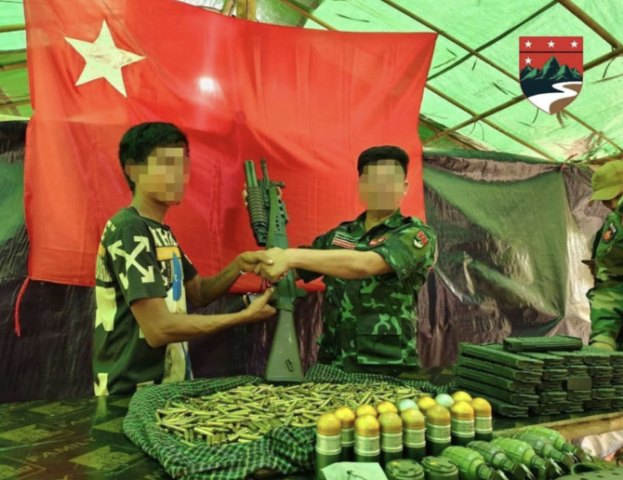
An interview with Chan Mon, a young Mon soldier who was forcibly drafted into military service while traveling back from Thailand to Mon State for a visit and later chose to surrender to the Dawna Column
Since the first round of military training, the military council has been using any means necessary to recruit citizens for military service. This includes individuals with close ties to the military council, those who can be recruited through financial means, migrant workers, and young people arrested for various reasons, all of whom are being sent for military training.
Across the country, 5,000 people are being conscripted into the military per batch. According to data from local monitoring groups, military recruits from all regions, including Mon State, are being forced to go directly to the battlefield after completing their training.
Chan Mon, a young Mon man who had been living in Thailand, returned to Mon State for a visit. He became one of the victims of forced recruitment when he was arrested by the military council and forcibly conscripted into military service. Chan Mon was then sent to Ye Tagun village, located near Ahnankwin village on the Mon-Karen border, where fighting is escalating.
Chan Mon, a young Mon soldier, escaped from military service and surrendered to the Dawna Column. In an interview with the Independent Mon News Agency (IMNA), Comrade Chan Mon shared the challenges he encountered during his military training and the circumstances surrounding his decision to surrender.
Q: How were you forcibly recruited into the junta forces and sent for military training?
A: I was arrested in Kawthoung when I returned from Thailand. They told me I would be detained for about seven days because I didn’t have an ID card. I don’t have a Myanmar ID card since I was born in Thailand. This was my first time visiting my home country. After the seven days, I was transferred to another location and forced to undergo a three-month training. I had no desire to be there. I constantly thought about going home, but I couldn’t escape from their grasp.
Q: How did you manage to escape from the military council’s control and join the Dawna Column?
A: After graduating from training, I was initially sent to Kyaik Khami and then transferred to Yetagun village near Thanbyuzayat. My group consisted of seven friends. I had been planning to defect, as some of my friends had connections with people from the Dawna Column. Finding a way to escape wasn’t easy, and we had very little time to make a move. I waited for the right opportunity. One day, I saw my chance. The captain went to town that day, and our team of seven was assigned guard duty. If we hadn’t fled that day, we would have had fewer chances to escape. So, we all made a plan.
After lunch, we slipped away into the forest. While we were staying in the village before we fled, I always asked the Mon people which village we could reach using certain roads, and if the junta soldiers would dare to follow us if we took those paths. We didn’t have to wait long on the road—about an hour and a half to two hours. There was no need to be overly concerned. The Dawna Column had already told us what to do once we connected with them. When they arrived to pick us up, we were instructed not to carry any guns. The junta soldiers were following us, armed with guns, and we had planned to shoot if there was an encounter. However, they didn’t follow us directly but tracked us using a drone. We managed to escape because the resistance force was there to welcome us early. I’m always grateful to those from the Dawna Column for their support.
Q: What did you learn during military training, and how many Mon youths were there in attendance?
A: The military taught us everything about handling guns and weapons. They confiscated all our mobile phones, so we couldn’t contact our families. I escaped on the day they returned the phones, and that’s when I was able to get in touch with the resistance force. There were around 7 to 8 Mon people in the training. They didn’t allow Mon people to gather together, and they sent them to different locations. It’s happening regularly. In the place where I stayed, I was the only Mon person.
Q: Please share your experiences you went through at the military training school.
A: We were made to scrape rubber, stand guard, dig holes, and fetch water. They assigned us all kinds of tasks, and there was no time for rest—no breaks at all. If we made the small mistake, we were beaten and tortured.
Q. What made you decide to surrender to the Dawna Column, and what challenges did you face on your way here?
A: I became disillusioned with the Bamar army because they are torturing the local people by taking up arms. That’s why I decided to join the Dawna Column, to fight back and protect our Mon region. I won’t return to Thailand just yet—I’m committed to joining the fight. I wasn’t sure how many Mon armed forces there were, but I defected to this group because my friends had connections with them. It’s even better that they’re Mon forces. The group I joined is also well-organized, and I have no difficulties with accommodation or food.
Q: “Which message would you like to share with your fellow military graduates?
A: Don’t feel sorry. One day, we will fight to liberate the Mon people and our comrades still trapped in the army. Right now, we are nearly fully prepared and ready for that battle.
Sent by IMNA