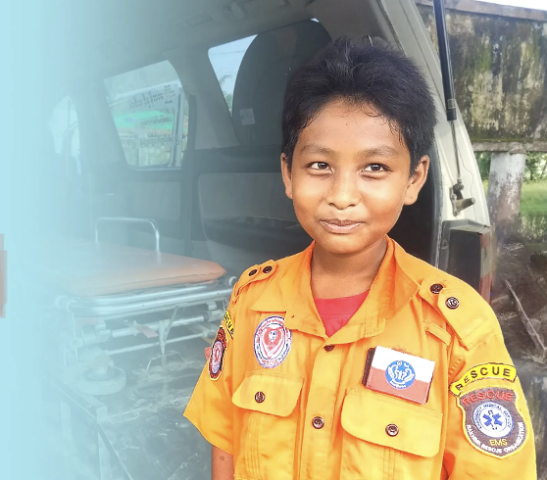
An interview with 13-year-old social worker Maung Htay Aung Hein, who provides social assistance amid conflict
In Arakan State, a 13-year-old youth is actively engaged in social work amid ongoing conflicts. Most people involved in social assistance are typically adults aged 18 and above.
To learn more about his motivations for engaging in humanitarian work at such a young age, and the challenges and difficulties he faces, Narinjara News interviewed Maung Ko Latt (aka) Maung Htay Aung Hein from the Phyusin Yinkhwin Foundation in Ponnagyun.
Q: First, please introduce yourself with your name and age.
A: My name is Maung Htay Aung Hein. People also call me Ko Lat. I’m 13 years old.
Q: What grade are you in currently, and what are you doing these days?
A: I’m a Grade-5 student. Currently, I’m volunteering with the Phyusin Yinkhwin Foundation. I’ve been helping with this organization for about three years now, since I was 10 years old.”
Q: What motivated you to do this humanitarian work?
A: At first, as a young person, I was just interested in seeing the ambulance driving and people wearing uniforms transporting patients to hospitals. Later, when I saw how much support our organization provides to the region, I realized this was meaningful work and essential for our community. That’s why I continued with social work.
Q: Do your parents allow you to do social work at such a young age?
A: Yes, they do. They allow it because instead of just staying at home, I’m doing work that benefits our community.
Q: What challenges do you face doing social work during this conflict period?
A: We need vehicles above all when we work during the conflict period. The internet being down is one issue. There are also things we can’t post due to security concerns. Without the internet, our page isn’t active, which means we don’t receive organizational donations. When vehicles break down, we have to send them to repair shops.
When patients call for help and our vehicles are broken down, we have to ask for help from nearby social groups, connected people, or financially stable organizations. Some respond to help, while others block us. These are some of our challenges. During this period, we often see patients in difficult situations, and sometimes we can’t even reimburse their fuel costs.
Q: What do your parents do for a living currently? Where are they?
A: My father drives a motorcycle sidecar. My mother doesn’t have a job. My parents are currently displaced by the conflict.
Q: How do you feel doing social work while your family is displaced by the conflict?
A: I’m happy – not because I’m separated from my family, but because I can help people. But when I think about it from another perspective, I feel sad. I feel small and insignificant sometimes. Because even though we’re providing help and support to others, I can’t provide even a penny for my own family.
Q: What drives you to continue doing this social work?
A: What drives me to do humanitarian work is what I’d call ‘the people’s call.’ The people’s call includes both requests for help from the public and their words of encouragement – these give me strength. Even just hearing a simple ‘thank you’ from each patient’s family member after we transport them along a route gives us strength.
Q: What are your hobbies? What do you want to be when you grow up?
A: When I grow up, I want to be an online vlogger.
Q: Lastly, is there anything else you’d like to add?
A: I’d like to request help from international donors. The winter here now, the displaced people need warm clothing and blankets. For warm clothing alone, each family needs at least three pieces of clothing, which costs about 100,000 kyats. So I’d like to request assistance for the displaced people.
Sent by Narinjara News.