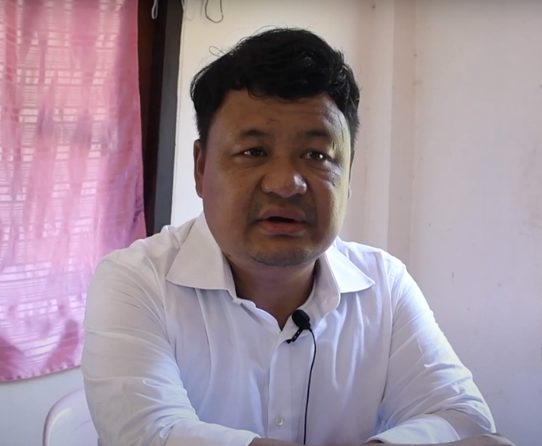
An interview with Philip, Head of the IEC Health Department, on the seasonal flu outbreak in the IDP camps in Karenni State, as well as the status and challenges of the IEC’s healthcare provision.
Local internally displaced persons (IDPs) in Karenni (Kayah) State report that there are widespread cases of seasonal flu and skin diseases during the rainy season. Due to the ongoing military conflicts in the region, there are difficulties in transporting medicines, and people cannot afford to go to hospitals or clinics or buy medicines because of financial constraints. As a result, locals and IDPs say they resort to traditional medicines for treatment.
The Kantarawaddy Times conducted an interview with Philip, head of the IEC Health Department, to discuss how the Health Department of the Karenni State Interim Executive Council (IEC) is ensuring the population’s access to healthcare, the challenges they face, seasonal flu outbreaks during the current rainy season, and their collaboration with international organizations to provide vaccinations for displaced children, particularly as most IDPs have been living in mountainous areas for an extended period, increasing their need for healthcare.
Q: Given the high number of seasonal flu cases during the rainy season in Karenni State, what measures is the IEC taking on the ground?
A: We currently have hospitals and clinics in the state. So does almost every township. Our main focus there is to educate people about seasonal flu. We educate both individually and in small groups. For example, if four or five people have similar flu-like symptoms, we educate them as a group. Sometimes, if it’s just one person, we educate them individually. For example, we advise drinking lots of hot water, inhaling steam and so on. We offer this supportive treatment free of charge in our hospitals and clinics.
Q: How do you ensure that people have access to the medicines they need?
A: We work with partner organizations to procure medicines. In addition to UN organizations, we also work with INGOs to procure medicines. But it is not only these organizations, but also some private individuals who help us. They know it’s difficult, they hear about the situation and they want to help. Some buy medicines and send them to us. We collect them and distribute them in our region. There are people who help with medicines, but that is not enough to cover all our needs.
This is because the healthcare system in our region has completely collapsed. As the health department of the IEC, we are trying to rebuild the health system from scratch. The demand is very high, but the help we receive is limited. So right now we are struggling to provide services in the midst of these challenges, with a very high need and limited support.
Q: What challenges are you facing in providing health services to the public?
A: The challenges include all the things I mentioned earlier. Among other things, financial support is critical. We need funds for transportation, for vehicles and also for medication for treatment. So if I had to name one main problem, it would be the lack of sufficient medication and financial support. As for the rest, as I have already mentioned, we have everything. But we still have concerns.
Q: How is the IEC coordinating with health organizations in Karenni State?
A: We’re currently working with some organizations, especially on coordination. the IEC only has one hospital under its direct control, there are about 10 secondary hospitals locally that are run by different ethnic health organizations (EHOs) and can treat second level diseases. Some are under the CED, others under the DSO and so on.
At the moment we’re coordinating with these organizations. But, in developing detailed health plans and action plans, we anticipate closer coordination and cooperation discussions to ensure better access to healthcare for the population in the future.
Q: How do you coordinate with the NUG health ministry?
A: Our IEC health department is in regular contact with the NUG Ministry of Health (MOH). We receive support from them for our secondary hospital, including medicines and equipment.
Together with the NUG Ministry of Health, we’re implementing the systems that should be in place in a state according to the federal chapter of a federal unit. We also work in coordination with the Union Government or the Union Ministry of Health as you might call it.
Q: Are you coordinating with the NUG health ministry on regular vaccinations for children? How are you working on it?
A: We coordinate directly with the NUG. But in terms of technical support, such as transporting the vaccines, storing them in our own containers, keeping them safe, administering them and preventing possible side effects, we rely on the NUG-MOH’s EPI Change Program. But when it comes to implementing these programs in our region, we can do that with our own plans. So there are aspects where we coordinate with the NUG MOH.
Q: Have you received support from international organizations for vaccines for children?
A: We can’t expect much from within the country. This is because international organizations based in Nay Pyi Taw can’t do anything without the approval of the Nay Pyi Taw government. No matter how much they want to help, if they’re prohibited from doing so, they can’t do anything. This is what we found out during our recent discussions.
Some of these international organizations have told us about their situation. The answer is: if the military council doesn’t agree, the organizations in the country can’t do anything. Even if they want to help, they won’t dare. That’s how I would put it. We’re trying hard to get support from international organizations.
Q: To what extent can you say that the IEC is providing access to healthcare for the people of Karenni State?
A: We’re trying to cover the whole of Karenni State. But some IDPs are hiding in small groups where they feel safe. In some of these areas, especially those that are far from the IDP camps, there may only be three or four families living together in groups. We haven’t yet reached such places. We can’t reach them all yet. The people are very scattered. We aren’t yet able to station medical staff everywhere to provide services. But we’re working on setting up clinics and hospitals in larger camps and villages where most of the people live.
Sent by Kantarawaddy Times.