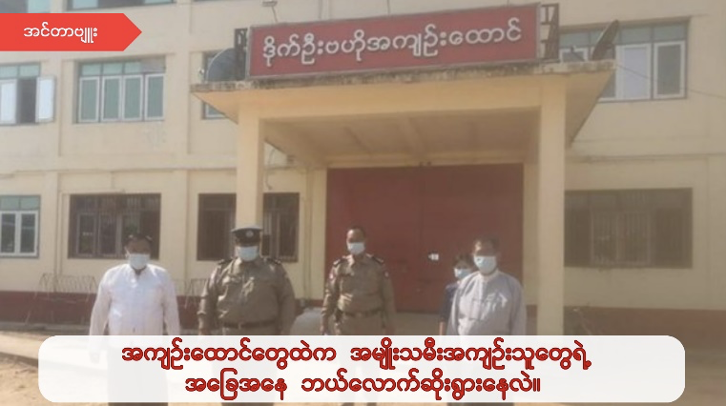
An interview with Ma Zue Zue May Yun, Women’s Organization of Political Prisoners (WOPP), about the oppressive conditions for female prisoners in prisons.
After the military coup, prisoners in prisons across Myanmar, especially female prisoners detained on political charges, are being mistreated by prison staff.
Most notably, in June, female political prisoners who were transferred from Kyaikmaraw Prison to Daik-U Prison were physically assaulted by prison authorities. As a result, five female political prisoners were injured but denied medical treatment. In addition, in one particularly notable case, over 30 female political prisoners were placed in solitary confinement.
Than Lwin Times conducted this interview with WOPP spokeswoman Ma Zue Zue May Yun to learn more about the oppression and torture faced by female political prisoners in the prisons under the Correctional Department, as well as their access to medical care, visitation rights, restrictions on receiving parcels and other conditions.
Q: First, please tell us about the current situation of prisons in Myanmar.
A: Regarding the prison situation in Myanmar, we have heard that the prisoners are being transferred in June. Political prisoners are also being placed in solitary confinement and tortured.
Q: Please tell us about the situation in the notorious Daik-U prison.
A: There was an incident in Daik-U prison last year. Political prisoners were taken out of prison and killed. In this notorious Daik-U prison, prisoners are denied medical treatment and tortured. The injured political prisoners, both men and women, have no access to medical care. They are held in solitary confinements. As the prison is in a remote location, it is very difficult for the prisoners to get basic necessities.
Q: What kind of oppression are the female prisoners facing after being transferred to Daik-U Prison?
A: Currently, political prisoners transferred from Kyaikmaraw Prison to Daik-U Prison are forced to stand trial and face additional charges. They are also threatened and beaten, and injured political prisoners are held in solitary confinement without medical care.
Q: What is the situation regarding medical care for prisoners in the prisons under the junta’s control?
A: The situation of political prisoners in terms of access to medical care under the junta’s control is well known to the public. Once they are in prison, they are deprived of proper access to basic necessities such as food, clothing and medical care.
Even in this period of supposedly greater openness, expired drugs are administered to political prisoners in all prisons, including Daik-U. Even in emergencies, medical treatment is delayed.
They have no regard for human life. In terms of medical treatment, paracetamol is given for stomach problems and only antibiotics are administered for serious illnesses. They only use this one type of treatment for everything.
Q: What about the human rights violations and oppressive control by prison authorities against female prisoners under the junta’s control?
A: The oppression and human rights violations by the prison authorities against the female prisoners in the prisons under the military council’s control are quite obvious. They used to cover up their despicable acts, but now they do it openly and audaciously.
We call Myanmar our motherland. But the mothers, children and women in Myanmar – especially young women – are not only disregarded but also raped by the junta soldiers. They torture and harass vulnerable women. In the prisons, female political prisoners are not even allowed to bear a pin.
In their prison administration, women who are not even allowed to bear a pin are physically assaulted by strong men. These men, when they take off their uniforms, are just normal people. Why do these strong men need to beat them? We think this is extremely uncouth behavior.
Q: What problems are they facing due to the restrictions on prison visits and the delivery of parcels?
A: As for the restrictions on prison visits, it has become more difficult for family members to send parcels than before, even after the conscription law was enforced. The families of political prisoners are also facing many difficulties.
There are hardships both inside and outside prison. It is a time when not only the families of political prisoners but also the public are facing hardships. While the families and people outside are struggling to make ends meet, inside it is even more difficult. For example, when a parcel arrives, seven or eight people have to share it.
Sent by Than Lwin Times.