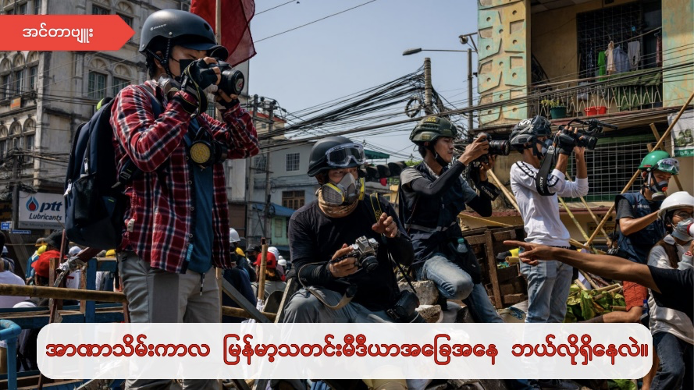
An interview with Nan Phaw Gay, Chair of IPCM, and Secretary U Toe Zaw Latt, about the current situation of Myanmar news media after the coup.
Due to deteriorating media freedom and increased challenges for media since the military coup in 2021, independent media professionals at home and abroad formed the Independent Press Council Myanmar (IPCM) on 22 December 2023.
The Than Lwin Times interviewed IPCM Chair Nan Phaw Gay and Secretary U Toe Zaw Latt, about the purpose of forming IPCM, its plans to support Myanmar news media and journalists, key initiatives following the committee’s establishment, and essential measures within the media industry, including combating misinformation.
Q: Let us know the purpose of establishing the IPCM.
Nan Phaw Gay: There is currently no media council representing Myanmar’s news media following the military coup. Media outlets under the military council are attempting to engage with the international community for representation. Recognizing the need for an organization that genuinely represents the media, independent Myanmar news media from various regions convened a conference and subsequently established the IPCM.
The establishment of IPCM aims to safeguard the independence of Myanmar’s media environment. Serving as the country’s media council, IPCM represents independent news media. As part of its structure, IPCM intends to elect a 15-member executive committee. This committee comprises nine members from independent news media, three freelance Myanmar journalists, two media specialists, and one lawyer specializing in media law.
U Toe Zaw Latt: It has four main objectives. One of the main objectives is the safety and protection of journalists. According to our record, 56 journalists have been arrested. Currently, they still remain behind bars. How can we support and safeguard them?
Safety is the first priority for both reporters on the ground and those abroad. The media council previously in Myanmar was also taken over by the military. Our council aims to represent our journalists and advocate both domestically and internationally. Another key objective is professionalism and adherence to media ethics. Additionally, legal support is crucial, particularly concerning the right to access information. The issue of VPNs directly impacts this right by attempting to restrict information flow. Our formation prioritizes journalists’ rights to access information sources. This is the major objective.
Q: Right now, we are in the process of selecting members for the executive committee. So, what is the first thing that will be done when the committee is formed? What additional activities will you continue to pursue?
Nan Phaw Gay: The council has been actively engaged in its work since its formation, focusing on various initiatives and responsibilities until the executive committee is established. Primarily, we have successfully updated media ethics to align with the current situation in Myanmar. It was published on World Press Freedom Day on 3 May. The second objective has three main tasks. The first one is we drafted media ethic and released it. The second one is to establish a better network with news media in neighbouring countries and regional countries. The last one is that we will work for the safety and protection of our independent Myanmar journalists who are working in challenging environments across various regions. We have been doing it step by step. We will make more efforts in this year’s first half. In the second half of the year, we plan to meet with EROs to discuss the rights to access information in accordance with media ethics. The conference’s objective is to determine the role the Press Council should play. During the second conference, we successfully elected 10 members instead of the originally planned 15 members.
U Toe Zaw Latt: We have not reached full capacity yet. The decisions made at the first conference were not merely speculative.
We need to fill the vacant positions of an individual, a lawyer, and a media specialist. Only then can we effectively expand our work. Now we have formed the committee with just 10 members over the past six or seven months. We are actively pursuing multiple initiatives and believe that with a diverse array of people, we can achieve even greater outcomes. For instance, we are actively advocating for the National Unity Consultative Council (NUCC) and Karen National Union (KNU) to establish media policies. Our primary focus remains on ensuring that journalists can access information freely and safely.
Q: What steps is IPCM taking to combat misinformation?
Nan Phaw Gay: Currently, we are not working to combat misinformation. IPCM has not yet been able to collect information, especially countering misinformation. Our efforts are concentrated on real-time data collection regarding charges, arrests, releases, and the imprisonment of journalists from independent media. Additionally, we plan to compile a comprehensive list of journalists working in various regions and border areas.
U Toe Zaw Latt: We are not currently working on it. Specifically, Mizzima, one of our members, hosts a daily program dedicated to debunking misinformation. Other media outlets within IPCM also run similar programs. Our press council plans to undertake this initiative once we have the necessary resources and capacity. At present, we are unable to do so but aim to implement it in the future when feasible.
Q: What actions will IPCM take for more than 50 imprisoned journalists?
U Toe Zaw Latt: We are currently providing support to imprisoned journalists, assisting those facing court trials and others in need. Currently we ourselves provide support. If we are unable to provide direct support, we facilitate connections with organizations or individuals who can offer assistance. Due to security concerns, we cannot disclose all the specific actions we are undertaking. However, the sure point is to ensure the survival of imprisoned journalists and arrange prison visits whenever possible.
Q: How would you assess the current situation of Myanmar’s news media?
Nan Phaw Gay: Currently, local, ethnic, and national media outlets in Myanmar are encountering more challenges than they did in previous times. The media is in critical need of resources for long-term survival. Nevertheless, we are committed to moving forward after carefully reviewing our challenges through consultation.
U Toe Zaw Latt: At the moment, the situation is not very good. It has become more difficult for the media to survive than before. In July, some media have stopped. Media receives less assistance. They are facing greater danger. Shin Daewe was sentenced to life prison. A DVB reporter also received a life sentence.
The sentencing of two journalists to life in prison indicates a worsening situation ahead. As a political exit, the military council plans to proceed with elections and a census. Media operations are increasingly challenging on multiple fronts. Despite these adversities, we are committed to exploring every avenue to ensure the survival and safety of journalists.
Q: How will IPCM react to the military council’s attempts to restrict the free flow of news?
U Toe Zaw Latt: Currently, we are actively addressing this issue. Media shutdowns have long been a concern, as seen in Russia. To counter this, we are exploring tools like Open Technology Resources, which assist communities in Russia by bypassing VPN restrictions. We have initiated discussions on these matters and are actively exploring potential avenues. In this era of advanced technology, it is impossible to block media. There must be a way to bypass it. We are actively working on responding to these challenges by studying how others have addressed similar issues. We are also collaborating with officials and international organizations, seeking their assistance in finding effective solutions.
Sent by Than Lwin Times