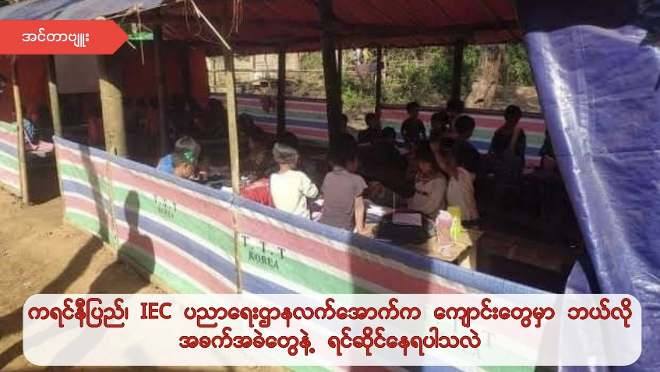
An interview with U Bal Nyar Mee No, Deputy Head of IEC’s Education Department, about the difficulties faced by the schools under the education department in Karenni (Kayah) State.
Following the military coup in Karenni (Kayah) State, the increasing number of internally displaced persons (IDPs) has led the Karenni State Interim Executive Council (IEC) to create an education department aimed at offering basic education to affected students.
Than Lwin Times interviewed U Bal Nyar Mee No, Deputy Head of the IEC’s Education Department, regarding the challenges that schools under the IEC are encountering during the current rainy season, the conditions of schools and students, and the essential assistance required by schools.
Q: Currently, how many basic education schools run by IEC have been opened in Karenni State? What is the status of student attendance?
A: Currently there are 456 schools run by IEC’s Education Department in Karenni State. The total number of students has reached 46,475. There are 3,543 teachers.
Q: What are the requirements for the number of teachers, capacity building for teaching and cash assistance?
A: Many of the teachers are volunteers. For capacity building in teaching, courses are conducted by subject heads from primary and middle level schools. We recently launched a proficiency subject mastery course for the Grade 12 curriculum. On-site, there is a critical need for teaching materials and aids. We need to do our best with the resources we have. Last year, we were able to provide financial assistance to 361 schools. We were able to support 2,842 teachers for five months. This year, the number of students and schools has increased. We coordinated with donors to develop plans for providing cash assistance in schools that have not yet received support, scheduled for 21 and 22 November.
Q: What kind of needs are there for teaching aids and facilities?
A: There is an urgent need for teaching aids. Especially, there are no saline solutions or chemicals essential for science education laboratories. Primary and middle schools have no sufficient teaching aids. It will be the same in other regions. I expect it happens only in Karenni State.
Nevertheless, we are making use of the available resources. The whole state is in need of building facilities. Students have to learn at makeshift tents of the IDP camps outside the village. When conditions stabilize to a certain degree, we conduct teaching sessions in separate rooms within civilian houses.
Some of those who can’t live in the village are studying at the IDPs camps in the forest. We can provide them with huts and rain-proof sheets. Currently, we cannot fully provide them. However, we keep trying. If necessary, we are connecting with donors.
Q: Is IEC opening higher education colleges and vocational schools? Or are independent organizations and INGOs opening any private institutions?
A: Regarding higher education, science and arts universities are currently open. We were also able to open an education degree college in Karenni State. As for vocational education, we conduct the course for vocational education only at our IEC’s school.
It is a self-reliant school run with its own donors. This school is benefical for Karenni people. However, we are unable to fully support it. Currently, the school is run with its own donor. Only self-reliant schools are doing vocational education.
Sent by Than Lwin Times