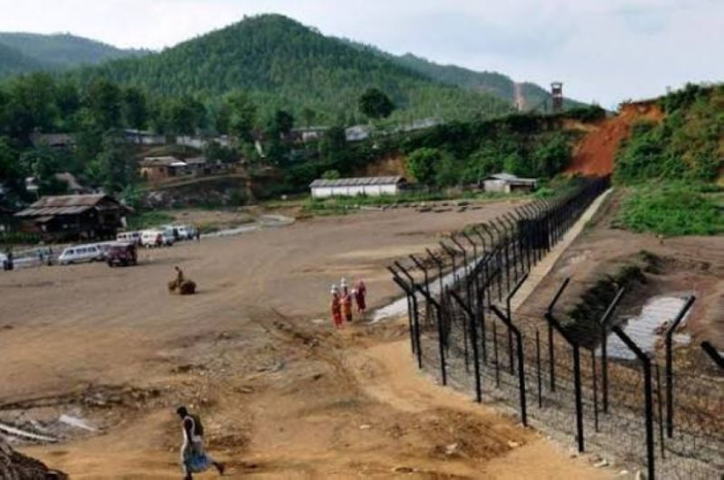
About 55 kilometers of the border fencing between India’s Manipur State and Myanmar has been completed, with a target for full completion by 2028, Manipur State Home Minister Govindas Konthoujam said on 2 September.
The minister made the remarks in the State Legislative Assembly in response to a calling attention motion from opposition MLA K Ranjit Singh regarding recent reports of a proposed India-Myanmar land exchange.
The minister said the state government has not yet received any official communication from the central government’s Ministry of External Affairs regarding the land swap proposal, and added that the government must inform affected citizens before making any decisions regarding territorial sovereignty.
Reports have surfaced that the Indian government has proposed a boundary adjustment involving approximately 1.4 square miles of land between border pillars 65 and 68, located between Manipur’s Chandel district and the Kabaw Valley in Sagaing Region, Myanmar.
The reports, first published by The Diplomat on 17 July, emerged following junta chief Min Aung Hlaing’s visit to India from 30 May to 3 June, during which border-related issues were discussed.
The minister explained that the border between Manipur State and Myanmar spans about 398 kilometers, from border pillars 32 to 130, and that fencing has been completed along approximately 55 kilometers of this stretch.
He also noted that the Moreh area, situated between border pillars 75 and 79, is of vital strategic importance.
The minister said the fencing project has faced delays due to difficulties transporting construction materials, and that efforts to demarcate some remaining unmarked sections of the border are still underway.
A member of the People’s Defense Force (PDF) based in Tamu Township told Mizzima that border fencing is not an issue that can be carried out unilaterally, arguing it should not be forced through given that some areas remain undemarcated and territorial encroachments have occurred.
“The fencing issue cannot be resolved unilaterally. There are undemarcated territories, and there have been territorial encroachments. No matter what, it should not be forced at this time,” he said, adding that fencing should only proceed after consultation with a democratically elected government and with the understanding and acceptance of local residents.
According to the PDF member, there have been about six instances of territorial encroachment from the Indian side, and local PDFs have staged protests at sites where fencing activities were being conducted.
These locations include two spots near Myothit town in upper Tamu Township, the area between Moreh and Tamu, and points between border pillars 59-60, 75-76, and 82-83, he said.
He also referenced an unresolved incident near border pillar 59, in which he alleged Indian military personnel crossed into Myanmar and raided a Tamu District People’s Defense Team (PDT/PaKaPha) camp, arresting and killing 10 of its members.
India is currently working to fence its entire 1,643-kilometer border with Myanmar in an effort to control drug trafficking, illegal trade, undocumented migration, refugee issues, armed conflict, and national security concerns.
The Mizo, Naga, Kuki, and Zo indigenous communities are opposing India’s fencing project, arguing that the physical barrier could divide indigenous populations living along the border, lead to the loss of ancestral and agricultural lands, and negatively affect their ethnic culture and livelihoods.
Mizzima