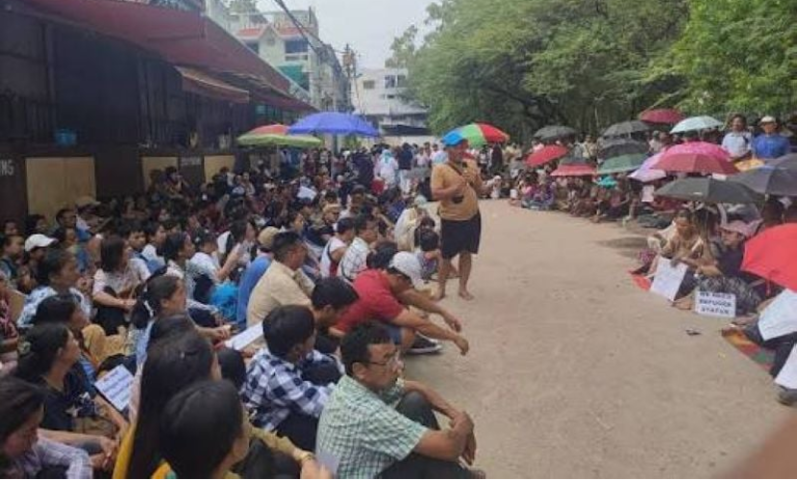
Nearly 200,000 Chin internally displaced persons (IDPs) inside and outside Chin State are facing major obstacles to returning to their places of origin due to the ongoing revolutionary situation, livelihood struggles, transportation issues, financial constraints, and the threat of junta airstrikes, according to Salai Za Thawng, Minister of Social Development for the Chinland Council’s government.
He made the remarks in response to an inquiry from Mizzima during an online press conference on 28 August, held to introduce a report titled “Report on Administrative Implementation during Two Years and Six Months of Exercising the Self-Determination of the Chin People,” compiled by the Chinland Council (CC) with support from the US-based Center for Peace and Reconciliation (CPR).
Asked by Mizzima about the population, difficulties, and ongoing assistance for IDPs within and outside Chin State, Salai Za Thawng said: “The primary need is essential food supplies for basic survival, such as rice, cooking oil, salt, and fish paste. Additionally, the displaced populations urgently require tarpaulins, mosquito nets, basic healthcare services, and emergency medicines.”
He said Chin IDPs are located not only within Chin State but also in Sagaing and Magway regions, as well as across the Indian border in Mizoram State.
Although officials from the Ministry of Social Development and the Chinland Council’s government have been visiting and assisting displaced people, with further support from the National Unity Government (NUG), it remains insufficient to meet the massive demand, Salai Za Thawng said.
IDPs remain unable to return home due to the ongoing political and revolutionary situation in Chin State, combined with livelihood struggles, disrupted travel routes, financial hardship, and the persistent threat of junta airstrikes.
Salai Za Thawng said the Chinland Council’s government is prepared to do its utmost to welcome and support anyone who wishes to return to areas under its control.
Mizzima also asked about the status of the Chinland Council’s administrative, judicial, and legislative control, given that junta forces have recently retaken several areas in Chin State.
Dr. Shwe Khar, the Chinland Council government’s Minister of Foreign Affairs, said: “They have only retaken Tonzang and Falam towns. The junta has absolutely no administrative influence in the surrounding villages, and even in those towns, they do not have complete, absolute control.” He added that merely occupying a town does not equate to controlling the entire township.
Dr. Shwe Khar said that although the routes between Kalay-Tedim and Kalay-Hakha were previously clear of junta outposts, the military has now stationed troops at over 30 outposts along these routes, leaving the regional security situation highly unstable.
He said that while the junta has declared full control over these routes, that control is not absolute, and Chin revolutionary forces retain the ability to operate and move through the areas at any time.
There are approximately 1,350 villages in Chin State, and the Chinland Council currently provides administrative and public services to 829 of them.
During the press conference, Dr. Sui Shwe Par, the Chinland Council government’s Minister of Health, delivered a slideshow presentation detailing the activities of government ministries, enacted legislation, and achievements in local and central administration.
Officials then addressed questions from the media and distributed the 33-page report.
The Chinland Council (CC) is composed of members of parliament who won seats in the 2020 election and opposed the military coup, representatives of the Chin National Front (CNF), and delegates from township and regional community groups. It has been implementing public administrative functions since adopting the Chinland Constitution on 6 December 2023.
Mizzima