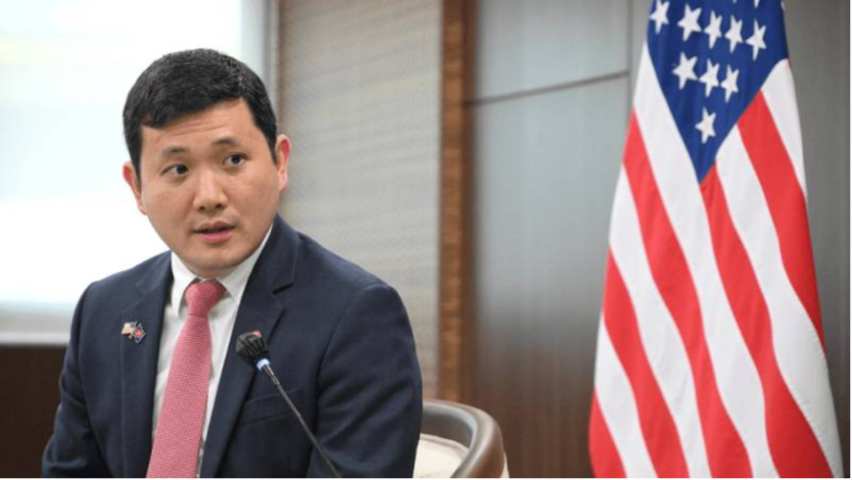
US Ambassador to ASEAN Mr Kevin Kim gave a press briefing on 24 July on the US participation in the 59th ASEAN Foreign Ministers meeting this week in which he mentioned the US stance on the Burma crisis and joint efforts to deal with illegal scam centers in Burma and the region.
For ASEAN, dealing with the Burma crisis hinges on adherence to the 5-Point Consensus signed in April 2021 following the February 2021 military coup, which five years on has failed to provide any concrete results.
In response to a question in the press briefing, Mr Kim said that while the US has its own position on the Burma crisis, it “respects ASEAN’s 5-Point Consensus” peace plan, which includes an end to fighting, the freeing of political prisoners, including elected leader Aung San Suu Kyi, and the provision of freedom of delivery of humanitarian aid.
Ambassador Kim was commenting after US Secretary of State Marco Rubio’s “successful visit” to Southeast Asia and his attendance at the 59th ASEAN Foreign Ministers meeting. Secretary Rubio has been meeting with a number of Southeast Asian leaders. He stressed the importance the US put on a free and open Indo-Pacific, open sea lanes, and reaffirmed the “centrality of ASEAN”, a key relationship for Washington.
Foreign ministers from fuel-stressed Southeast Asia called for freedom of navigation in international straits on Thursday as they wrapped a week of meetings largely overshadowed by the US-Iran war.
A joint communique issued at the ASEAN gathering in Manila also repeated calls for self-restraint in a Middle East conflict that has carried economic ripple effects throughout the region. All countries, including Burma, have been negatively affected by the lowering of fuel supplies and rise in prices.
Visiting US Secretary Rubio this week warned ASEAN envoys that Iranian control of the Strait of Hormuz would set a “dangerous precedent”.
“There is a fundamental principle about freedom of navigation that is threatened,” he told media. In the press briefing, Ambassador Kim mentioned the $2.5 billion Washington was investing in security in Southeast Asia.
“The US wants to work with ASEAN for stability and security in the region,” he said.
This includes joint efforts to deal with transnational crimes including money laundering and cracking down on illegal scam centers, the latter a problem in a number of countries including Burma.
The US Federal Bureau of Investigation has been working with a number of countries to tackle this issue, in part because of the negative effects posed to Americans through the scams, Ambassador Kim noted.
The ASEAN foreign ministers have faced the difficult question of how to deal with the Burma crisis. Burma has been formally excluded from such summits like this week’s since the country’s military junta seized power in 2021.
In May, the bloc’s leaders emerged from an emotional meeting in Cebu that ended with Philippine President Ferdinand Marcos calling for a “fine-tuning” of the long-stalled 5-Point Consensus to end Burma’s bloody civil war.
ASEAN members appear to have mixed views of how to tackle the challenge of bringing Burma back into the fold, given it has not only failed to adhere to the Five-Point Consensus but also formally rejected it in parliament in Naypyidaw.
Critics have claimed that the invitation to the Burmese foreign minister to a recent “informal” ASEAN meeting offered an element of legitimacy when the Burmese junta has failed to provide any action or progress on the 5-Point Consensus, an agreement currently dead in the water.
Mizzima