|
|
|
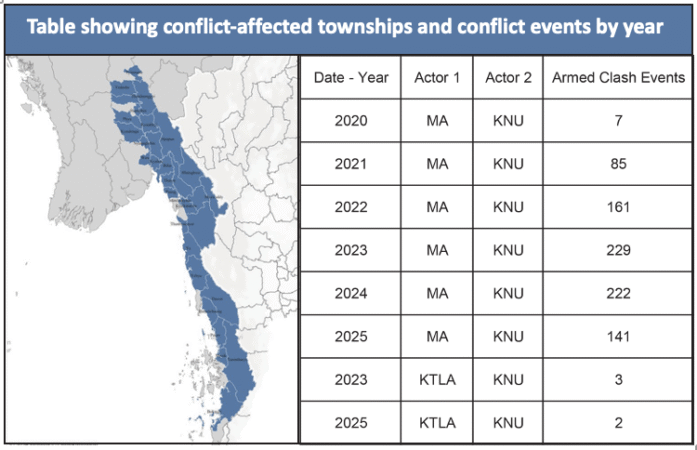
Founded – 5 February 1947 Headquarters – Klo Yaw Lay, Hpa-An District, Karen State Areas of Operation – 32 townships in Karen, Bago (East), Mon, Nay Pyi Taw and Tanintharyi Chairman – Padoh Saw Kwe Htoo Win Vice-chairman – Padoh Saw Hser Gay General Secretary – Padoh Saw Ta Doh Moo Facebook – https://www.facebook.com/KNUHQKTL Website – https://knuhq.org/mm Since the military coup, the KNU has supported civil servants participating in the Civil Disobedience Movement (CDM) and stood with the Spring Revolution in opposing the military takeover. As the junta troops launched intense offensives within KNU-controlled territories, the KNU has taken a leading role in the Spring Revolution’s defensive war, fighting in cooperation with People’s Defense Forces/Local Defense Forces (PDFs/LDFs) and other allied resistance groups. The KNU plays a leading role in the Central Command and Coordination Committee (C3C), which was formed by the NUG’s Ministry of Defense and four allied Ethnic Resistance Organizations (EROs). In the Southern Military Region, the KNU also leads and participates in the Joint Coordination Committee (J2C) and Joint Operation Command (JOC) in cooperation with the KNPP and NUG. The KNU is a part of the groups that have a common stance on ending the military dictatorship and building a federal democratic union. It is also participating in the “Bottom-Up Federalism” approach to building a future federal democratic union. The KNU is accelerating its efforts to prepare and build a Kawthoolei State and a Kawthoolei Government. According to Padoh Saw Taw Nee, the KNU spokesperson, the process for establishing the Kawthoolei State has been completed by over 80 percent, which includes the drafting of the Kawthoolei Charter, the formation of the Kawthoolei State, the establishment of the Kawthoolei Consultative Council (KCC), which is similar to a parliamentary system, the formation of the Kawthoolei Executive Committee (KEC) to oversee administrative functions within the KCC, and the establishment of a Kawthoolei Government (KG) through the KEC. He also stated that although the KNU will continue to be involved in the leadership, guidance, and oversight of the Kawthoolei Government since it is being formed during a revolution, it will be approached as a KNU Plus (+) model. 3 Padoh Saw Taw Nee also mentioned that the KNU’s core principles have consistently been to secure equality and full self-determination, ensuring justice and comprehensive opportunities for Kawthoolei (Karen State), establishing a federal union of states with democracy and self- determination, and securing full democratic rights for all Karen people and all citizens within the Union. He added that when a future federal democratic union is established, the Kawthoolei and the Kawthoolei Government will fully participate as a member state of the union. On the other hand, since early December 2023, the KNU and its local allied forces have captured and controlled the towns of Mone, Kyondoe, Hpapun, and Lay Kay Kaw, and have captured hundreds of junta positions. The KNU’s military momentum was so strong that it was able to capture and control Myawaddy, a town that is strategically important for military, political, border, and trade affairs, albeit for only a few days. Throughout the history of the Karen Revolution, the KNU has been able to use various methods, including military, political, and peace talks. It has also become familiar with the military junta’s tactics of infiltration, division, threats, deception, and military pressure. However, the role of armed resistance groups in the Kawthoolei region that are not under the KNU’s leadership or alliance is a process that must be approached with caution for the establishment of a Kawthoolei State and a Kawthoolei Government. Furthermore, the actions of other armed forces, including the Karen Border Guard Force (BGF), which is under the military junta’s command, is a cause for concern.
3. Formation of the Kawthoolei Government and the KNU’s Military-Political Shifts, Bi-WNR Issue 173, BNI-MPM Reference: Deciphering Myanmar’s Peace Process – A Reference Guide (2024 – 2025) |